


Quick Answer: What Is Waste Tide About?
Waste Tide (荒潮, Huāngcháo) is a 2013 science fiction novel by Chen Qiufan (陈楸帆, Chén Qiūfān). On Silicon Isle (硅屿, Guīyǔ), a near-future recycling center in coastal China, the migrant worker Mimi (小米, Xiǎomǐ) becomes central to a struggle over who controls the industry and who bears its costs.[1][3]
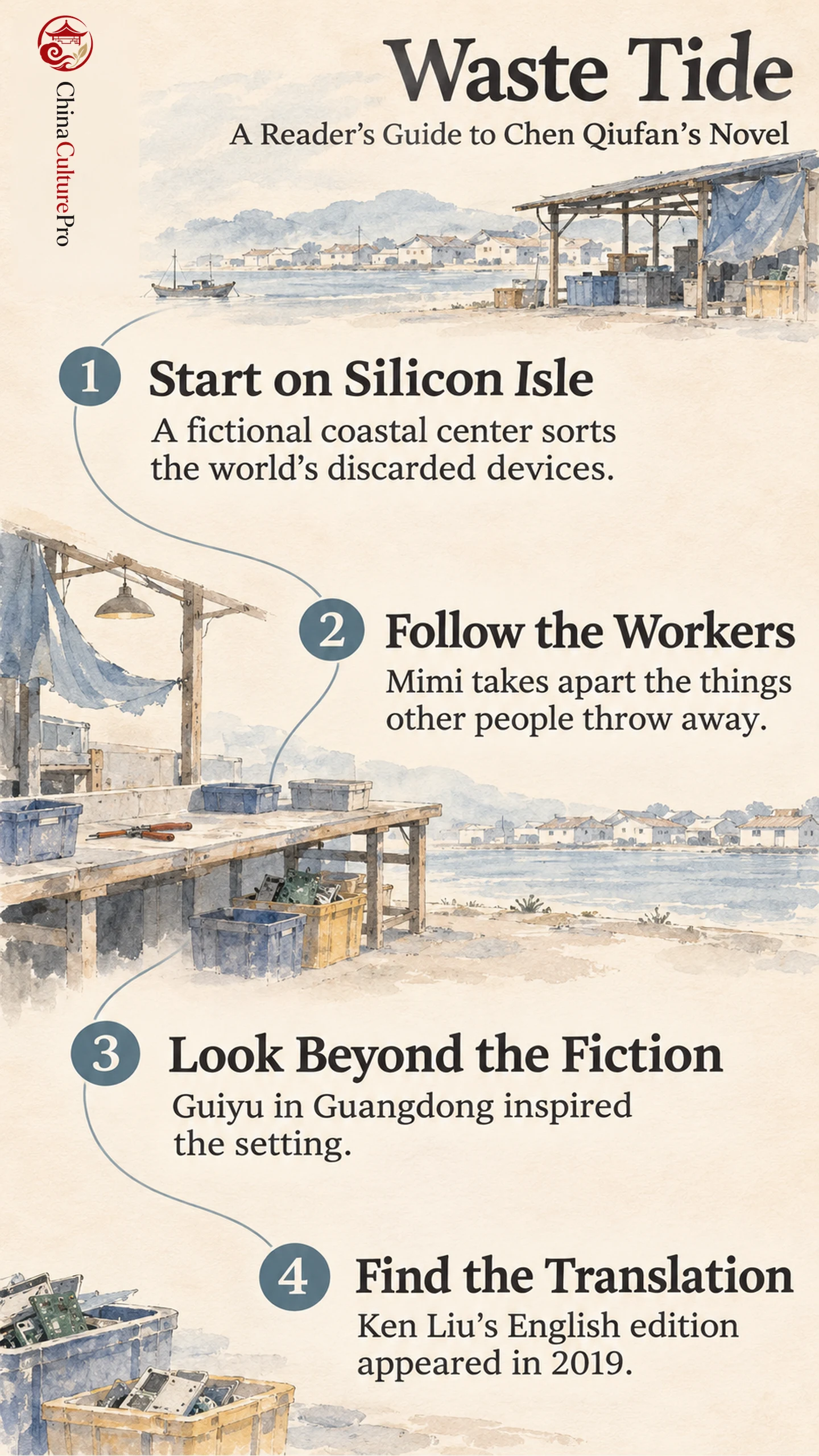
- Setting: The fictional recycling center takes its inspiration from Guiyu (贵屿, Guìyǔ), a town in Guangdong.[2]
- Central conflict: Local clan leaders control recycling work, and an American company seeks a deal to modernize the trade.[1]
- English edition: Ken Liu (刘宇昆, Liú Yǔkūn) translated the novel for Tor, which issued its first US edition in 2019.[5]
This guide discusses the setup and the kind of change Mimi undergoes. It leaves the outcome of that change and the ending for the novel.
Waste Tide starts with a display case, a model ship and a visitor who has trouble concentrating on the guide.[1]
The polished exhibit gives the island an official story about where its prosperity came from. Paying attention to who gets to tell that story makes the novel’s later disputes over labor and technology easier to follow.
What the Opening Museum Visit Tells You
Scott Brandle, a representative of an American recycling company, visits the island’s history museum with his interpreter, Chen Kaizong (陈开宗, Chén Kāizōng). The display traces the island’s passage from fishing and farming into industry. Looking at the model ship, Scott remembers a lobster served at a reception and its unsettling extra claw.[1]
That movement from the model ship to a memory of dinner gives you two ways to read the scene. Inside the case, the museum can arrange a clean narrative of progress. Scott’s memory introduces a detail that won’t fit inside it. Chen makes the reader think about where food comes from before anyone has even taken the visitors to a recycling workshop.
Watch Kaizong in the same scene. He listens with a personal interest that Scott lacks.[1]
The official tour can seem tedious to the investor and compelling to someone trying to recover a connection to his family’s home. The novel gives them access to the same room and lets them come away with different versions of it.
How Four Characters See the Recycling Trade
The opening visit can make Scott and Kaizong feel like guides to the novel. The workshop and the clan network reveal how limited that access is. Luo Jincheng (罗锦城, Luó Jǐnchéng) holds authority within one of the clans that run the island’s trade. Mimi is one of the migrant laborers who handle its discarded devices.[5]
Scott has a commercial reason to argue for new recycling technology. Luo has an inherited position to protect.[5]
Kaizong can carry messages between parties, yet the things he learns on his return can change what home means to him. Mimi’s place in the hierarchy determines what she can refuse, where she can go and who can act against her when she threatens their position.[3][5]
Keep those differences in mind when a character describes a proposal as progress. To a person who negotiates contracts, progress can mean a plant capable of processing more devices. To someone who dismantles the material, a change in ownership or equipment may matter only if it changes the conditions of the work.
Mimi’s transformation into a cyborg turns that question toward the body. She gains new ways to act, but the circumstances that alter her already involve people treating her body as expendable. Reading her transformation alongside her earlier work gives it a different weight from the arrival of a more powerful machine.[3][4]
What Guiyu Contributes to the Fiction
Guiyu, near the author’s home in the Shantou area, supplied the model for Silicon Isle. Chen described an industry built through local businesses and family workshops that generated private fortunes alongside severe pollution. Even the fictional place name sounds close to the name of the town in Mandarin.[2]
The resemblance gives a material starting point for the story. In a familiar account of a device, value begins with design and ends with the sale. On the island, the most consequential transaction may take place after the device has been thrown away. Someone has to decide which pieces are worth retrieving and who will work with everything that remains.
The novel opens with a reference to the Basel Convention, an international agreement concerning movements of hazardous wastes. That framing puts the island’s trade in a wider chain of decisions before the reader meets the people whose jobs depend on it.[6]
Chen extends the chain to speculative waste such as discarded body technology. The machinery that helps drive the plot is imagined. The separation between where devices are enjoyed and where they have to be dismantled anchors the novel’s speculative premise in a recognizable industry.[4]
How to Read the Novel in English
Search library catalogs for Waste Tide, Chen Qiufan and Ken Liu together. The 2019 first US edition is listed under Tor. Some English-language criticism uses The Waste Tide when discussing the same Chinese novel, so the author’s name is a better identifier than the initial article.[4][5]
For readers of Chinese science fiction who arrive through The Three-Body Problem, the translator will be familiar. For a contrast with The Wandering Earth, start with what each work asks a reader to notice. Here the key exchanges often happen at the scale of a device, a workplace or one conversation.
Give the first chapter a little time before deciding whose judgments to trust. When the book shifts to a different character, track one object or piece of information across that shift. For a wider reading path across Chinese literature, a guide to modern Chinese literature can then place the novel’s use of recognizable local detail alongside other ways writers have represented social change.
FAQs About Waste Tide
Is Waste Tide based on a real place?
Yes. Guiyu in Guangdong inspired the fictional Silicon Isle. The novel invents the island’s cast, corporate negotiations and speculative crisis.[1][2]
What kind of science fiction is Waste Tide?
It is near-future environmental science fiction with cyberpunk elements. The recycling workshops provide the material setting for a plot in which advanced machinery also changes what bodies can do.[3][4]
Who translated Waste Tide into English?
Ken Liu translated Chen Qiufan’s novel. Tor released the first US edition in 2019.[5]
Sources
[1] Macmillan. Waste Tide, Publisher Excerpt and Character Guide
[2] China Writers Association. Chen Qiufan on the Inspiration for Silicon Isle
[3] Amsterdam University Press. Becoming a Cyborg: Female Coming of Age in Waste Tide
[4] Modern Chinese Literature and Culture. Estranging Realism in The Waste Tide
[5] WorldCat. Waste Tide, First U.S. Edition
[6] ISLE. Dwelling on a Wasteland: Environmental Injustice in Waste Tide