

Quick Answer: What Is The Seventh Day About?
The Seventh Day (第七天, Dì Qī Tiān) is a novel by Yu Hua (余华, Yú Huá) about Yang Fei (杨飞, Yáng Fēi), a recently deceased man who spends seven days wandering and encountering people from his life. His search draws together stories of family attachment and the distinctions of wealth and rank that follow people into the novel’s afterlife.[1]
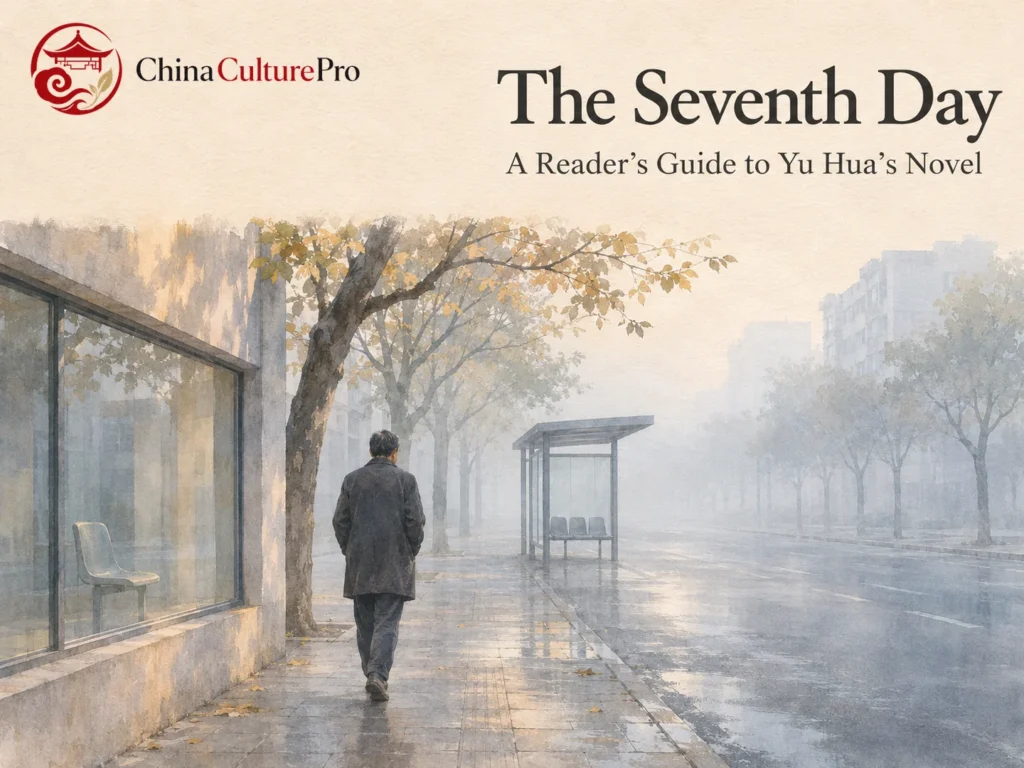
- The first scene: Yang crosses a foggy city to keep an appointment for his own cremation.[4]
- The family at its center: Yang Jinbiao (杨金彪, Yáng Jīnbiāo), a railway worker who adopts Yang Fei, is central to the book’s story of care.[1][8]
- The satirical device: Ordinary seats and VIP seating in a funeral home make social rank visible even among the dead.[6][8]
- The English edition: Allan Hepburn Barr translated the novel. Pantheon published the first English print edition in 2015.[2]
This guide discusses the premise, the beginning and a few recurring relationships. It leaves the circumstances of the later encounters for the novel to disclose.

Yang Fei has somewhere to be and a time to be there. Yu Hua makes his first walk sound almost like an errand until the notice says why the funeral home is expecting him.[4]
Keep that matter-of-fact tone in mind as the novel begins to move between the dead and the living. A notice setting the hour of a cremation is ordinary paperwork until the person named in it starts narrating the walk. A quiet scene about family can then bring you close to the ordinary life from which Yang has been separated.
What Happens During Yang Fei’s Seven Days?
Yang was born on a moving train and raised by the young railway switchman who took him in. In the afterlife, the people he encounters give him a way to piece together his own past. They include his adoptive father and his former wife Li Qing (李青, Lǐ Qīng).[1][8]
The day headings mark Yang’s time after death. The memories he hears within a day can belong to entirely different moments. If you catch yourself trying to arrange every remembered event on a single calendar, try tracking the present encounter first. Who is speaking? What brought Yang to that person? Only then decide where the remembered event belongs.
In a later interview, Yu Hua singled out Yang’s search for his father as the movement that allows him to meet others.[7]
That connection between one private need and a whole cast of people gives the novel a route through the city. It also allows someone Yang meets in passing to hold the floor long enough to tell a story of their own.
Why the Funeral Home Still Has VIP Seating
The waiting area makes distinctions among the dead by giving them different seats. The gap between a plastic chair and a VIP sofa lets the reader see the hierarchy before anyone explains it.[8]
Yu Hua said he drew this detail from waiting in a bank, where ordinary customers took numbers and VIP customers received different treatment. He put the two groups within view of each other in the novel’s waiting area.[6] The joke works because the rule survives in a place where the reasons for wanting special service should have fallen away.
There is a difference between classifying people as a group and knowing one of them well. The waiting area sorts strangers quickly. Yang’s memories of the man who raised him take time. A reader coming from To Live may recognize an interest in ordinary acts of care. In To Live (活着, Huózhe), the story follows one life across decades. Here a week of encounters gives Yang a way to hear several lives.
How Memory and the News Enter the Novel
When the book was published, some readers thought it drew too much from the news. In a 2013 interview, Yu Hua described news as one of several ways the events of other lives reach us. He also explained why the dead narrator gave him enough distance to write about the present.[5]
Years later, he described taking the idea of a ground collapse from news reporting and giving it a specific function in a fictional episode.[7] The detail changes what the characters can do next. It helps to read the episode first for that movement, then think about what it takes from public life.
This is one point of comparison with Brothers (兄弟, Xiōngdì). In the later interview, Yu Hua described a more concentrated use of social material in The Seventh Day.[7] The seven days make a short frame for a large number of encounters. See the guide to Yu Hua and the overview of modern Chinese literature for ways to place it alongside his other writing.
Which Edition Should You Read?
Look for 第七天 by 余华 if you want the Chinese original. The 2013 New Star Press edition is listed under ISBN 9787513312103. Its contents page marks the seven sections by day.[3]
In English, the first Pantheon print edition appeared in 2015 and credits Allan Hepburn Barr. The publisher also lists a 2015 e-book and a 2016 paperback.[1][2] Check the credit and format when you find different dates in a catalogue. They may refer to different editions of the same translation.
For a first reading, give the opening day your full attention. Then follow which encounter takes Yang into a memory. The shifts between ordinary speech, recollection and impossible circumstances make the book a distinctive way into contemporary Chinese literature.
FAQs About The Seventh Day
Why is the book called The Seventh Day?
The title names the span of Yang Fei’s journey after death. The Chinese edition’s editor also identified the seventh day in Genesis as the source of the title.[3][4]
Is The Seventh Day based on real events?
Yu Hua drew on experiences and news reports, then adapted selected details to fit a fictional story. The dead narrator and his encounters give that material a new setting.[5][6][7]
Who translated The Seventh Day into English?
Allan Hepburn Barr translated it. You may see his name as Allan Barr or Allan H. Barr. The first English print edition appeared from Pantheon in 2015.[2]
Sources
[1] Penguin Random House. The Seventh Day
[2] WorldCat. The Seventh Day, First English Print Edition
[3] Beijing Bookstore. Di Qi Tian, New Star Press Edition
[4] Yangtse Evening Post via China News Service. Yu Hua Releases the Opening of The Seventh Day
[5] Xinmin Evening News via China Writers Association. Yu Hua on His New Book The Seventh Day
[6] China Writers Association. Yu Hua on Truth, Reality and Uncertainty
[7] China Writers Association. Yu Hua on Literature, His Times and His Writing
[8] China Writers Association. Yu Hua’s Contemporary Writing in The Seventh Day