


Quick Answer: What Is The Plum in the Golden Vase?
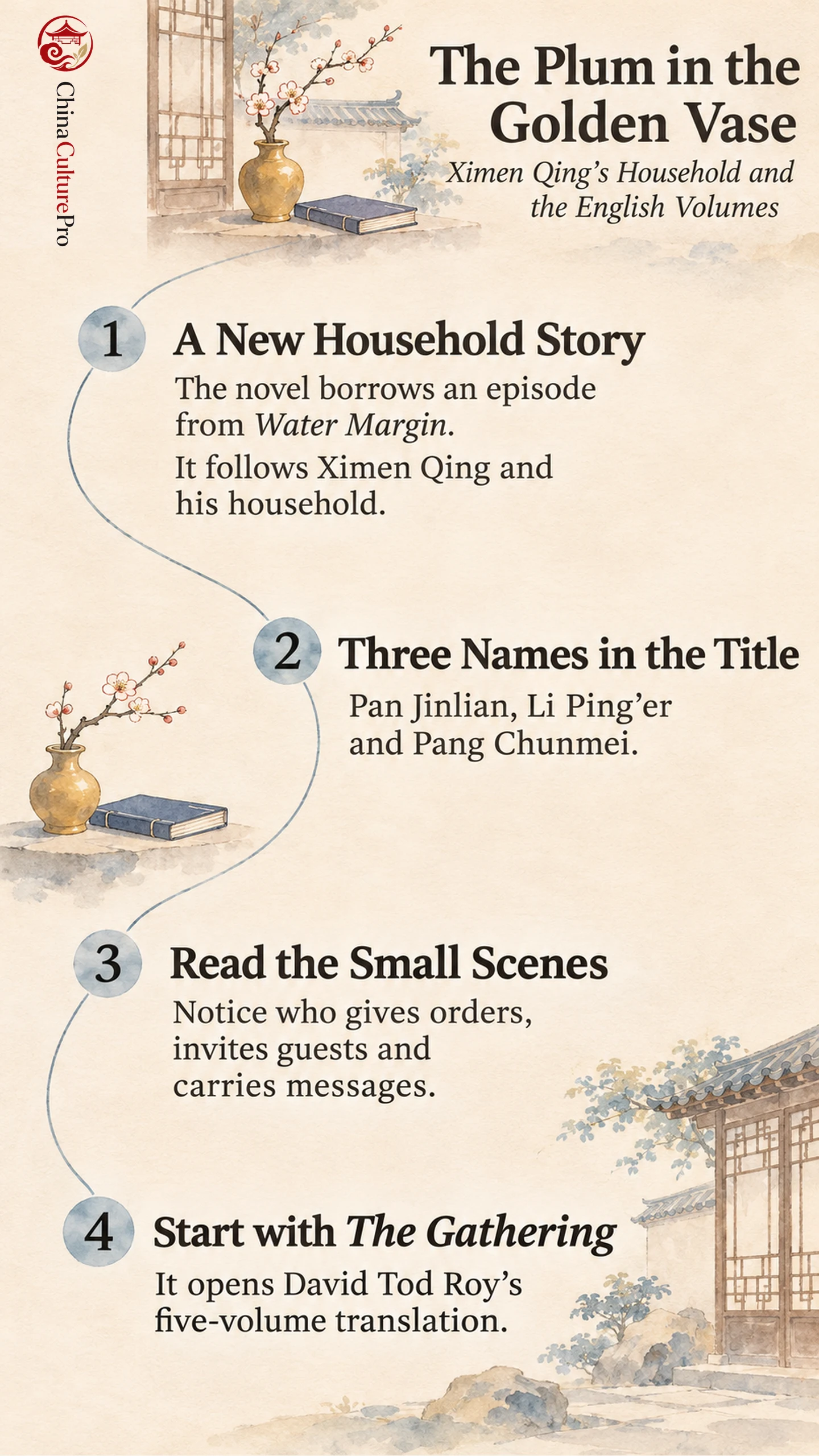
The Plum in the Golden Vase (金瓶梅, Jīn Píng Méi) is an anonymous late Ming novel about the merchant Ximen Qing (西门庆, Xīmén Qìng) and the people in his household. It takes part of the story from Water Margin (水浒传, Shuǐhǔ Zhuàn) and uses it to begin a much longer account of money, desire and rank. Start David Tod Roy’s English translation with The Gathering.[1]
- The main setting: Follow a wealthy household and the relationships that sustain it.
- The title’s clue: Its three Chinese characters also come from the names of three women.
- The earlier book: The novel borrows an episode from Water Margin and then develops its own story.
- The English reading order: Roy’s translation runs for five volumes. The Golden Lotus is an alternate English title used for another translation.
The guide describes the novel’s opening and themes in broad terms. You can begin with The Gathering without first reading Water Margin.
A reader coming from Water Margin might expect the story of Ximen Qing to end quickly.[2]
The Plum in the Golden Vase keeps him in view long enough for other questions to become more pressing. Who brings someone into the house? Who can ask for a favor? What happens when a friendship and a financial obligation become difficult to separate? Those questions can help you keep your bearings when the cast grows.
From Water Margin to Ximen Qing’s Household
The novel develops material from an episode involving Wu Song (武松, Wǔ Sōng), Pan Jinlian (潘金莲, Pān Jīnlián) and Ximen Qing in Water Margin. It changes the course of that story so that Ximen lives long enough to become the center of an extended account of his house and its connections.[2] If you know the older episode, use it to recognize the names. Then follow the people who keep appearing around Ximen.
The novel takes place in the Northern Song dynasty, but it was written under the Ming dynasty. Scholar David L. Rolston explains why the novel is often read as a portrayal of Ming social life using an earlier setting.[3]
Details of consumption, speech and relationships are literary evidence for how the author imagined the household. The dynastic setting and the time of composition answer different questions about those details.
The Three Women in the Title
The early preface identifies three women in the title. Jin comes from Pan Jinlian, ping from Li Ping’er (李瓶儿, Lǐ Píng’ér), and mei from Pang Chunmei (庞春梅, Páng Chūnméi). Read together as a title, the three characters also suggest a golden vessel and a plum blossom.[4] The English title gives you the image. The Chinese names let you recover the other layer.
Their positions in the household differ. Pan and Li become members of Ximen’s household through their relationships with him. Chunmei enters Pan’s rooms as an attendant.[8] Keep both the names and the relationships in view. A decision made in one room can change what someone is able to do in another.
The early preface offers one way to read the book as a warning about the household. The novel’s extended attention to the women and their servants also gives you room to see how people make decisions when they have different kinds of power.[4]
Reading the Household Scenes
When a scene seems crowded, locate the person who can give instructions. Notice who moves from one room to another, who can get a private audience and who is carrying a message. A household position can determine what a character hears and whether another person takes their account seriously. That is one reason the title’s women can share a setting without sharing the same range of choices.
The novel also pays attention to the work that makes a social occasion possible. In chapter 69, Ximen goes to Xie Xida’s birthday feast, where two singers have been hired, and leaves after a short visit.[3]
Notice who makes the arrangements and who can leave after a couple of cups. That difference lets the scene tell you about the host and the guest with little explanation.
For a separate book in which money and personal attention are hard to separate, see The Nine-Tailed Turtle. Compare what its characters promise in conversation with what they are prepared to pay for.
The Five David Tod Roy Volumes in Order
Princeton University Press divides David Tod Roy’s complete English translation into the following volumes. The fifth finishes the hundred-chapter work.[3][5][6]
| Ordre | Volume subtitle |
|---|---|
| 1 | The Gathering |
| 2 | The Rivals |
| 3 | The Aphrodisiac |
| 4 | The Climax |
| 5 | The Dissolution |
Chin P’ing Mei is the romanization that appears on Roy’s title. If the spine gives only a number or part of the title, check that the catalogue identifies The Gathering as volume one and credits Roy. The Golden Lotus is the title used for Clement Egerton’s translation, made with help from Shu Qingchun, better known as Lao She.[7] For broader reading choices, see the guide to Chinese classic books.
FAQs About The Plum in the Golden Vase
Who wrote The Plum in the Golden Vase?
The author’s identity is uncertain. The work is attributed to the pen name Lanling Xiaoxiao Sheng (兰陵笑笑生, Lánlíng Xiàoxiào Shēng).[1][7]
Is Jin Ping Mei a sequel to Water Margin?
It is a separate novel that borrows and changes an episode from Water Margin. It follows Ximen Qing and his household beyond the scope of the borrowed episode.
Is The Golden Lotus the same book?
It is another English title for Jin Ping Mei. Check the translator to distinguish Clement Egerton’s The Golden Lotus from David Tod Roy’s five-volume The Plum in the Golden Vase.
Sources
[1] Princeton University Press / JSTOR. The Plum in the Golden Vase: The Gathering
[2] Peter H. Rushton, Ming Studies. Aspects of the Plot of Jin Ping Mei
[3] David L. Rolston, CHINOPERL. Music and Oral Performing Literature in the Jin Ping Mei Cihua
[4] Wikisource. Jin Ping Mei Cihua: Early Preface
[5] Princeton University Press. Literature Catalogue: David Tod Roy’s Five Volumes
[6] Princeton University Press. The Plum in the Golden Vase: The Dissolution
[7] CiNii Books. The Golden Lotus: Clement Egerton Translation
[8] Wikisource. Jin Ping Mei Cihua: First Group of Chapters