


Quick Answer: What Is The Peach Blossom Fan?
The Peach Blossom Fan (桃花扇, Táohuā Shàn) is a historical play completed around 1699 by Kong Shangren (孔尚任, Kǒng Shàngrèn). It follows the courtesan Li Xiangjun (李香君, Lǐ Xiāngjūn) and the scholar Hou Fangyu (侯方域, Hóu Fāngyù) through the crisis that brings down the Southern Ming (南明, Nán Míng) court in Nanjing. The fan begins as a pledge between them and later carries a record of what has happened in their separation.[1][2][6][9]
- Start with the fan: Scenes 7, 22 and 23 show how it changes from a pledge to a message.
- Follow the money and the pressure: Ruan funds gifts that can gain him access to Hou. Officials later pressure Li to marry.
- Keep the dates separate: The Qing playwright looks back on the events of the 1640s.
- Find the annotated translation: Wai-yee Li’s edition introduces each scene and explains historical and literary references.
The guide follows the fan through the middle of the play. It stops short of the final choices the lovers make.
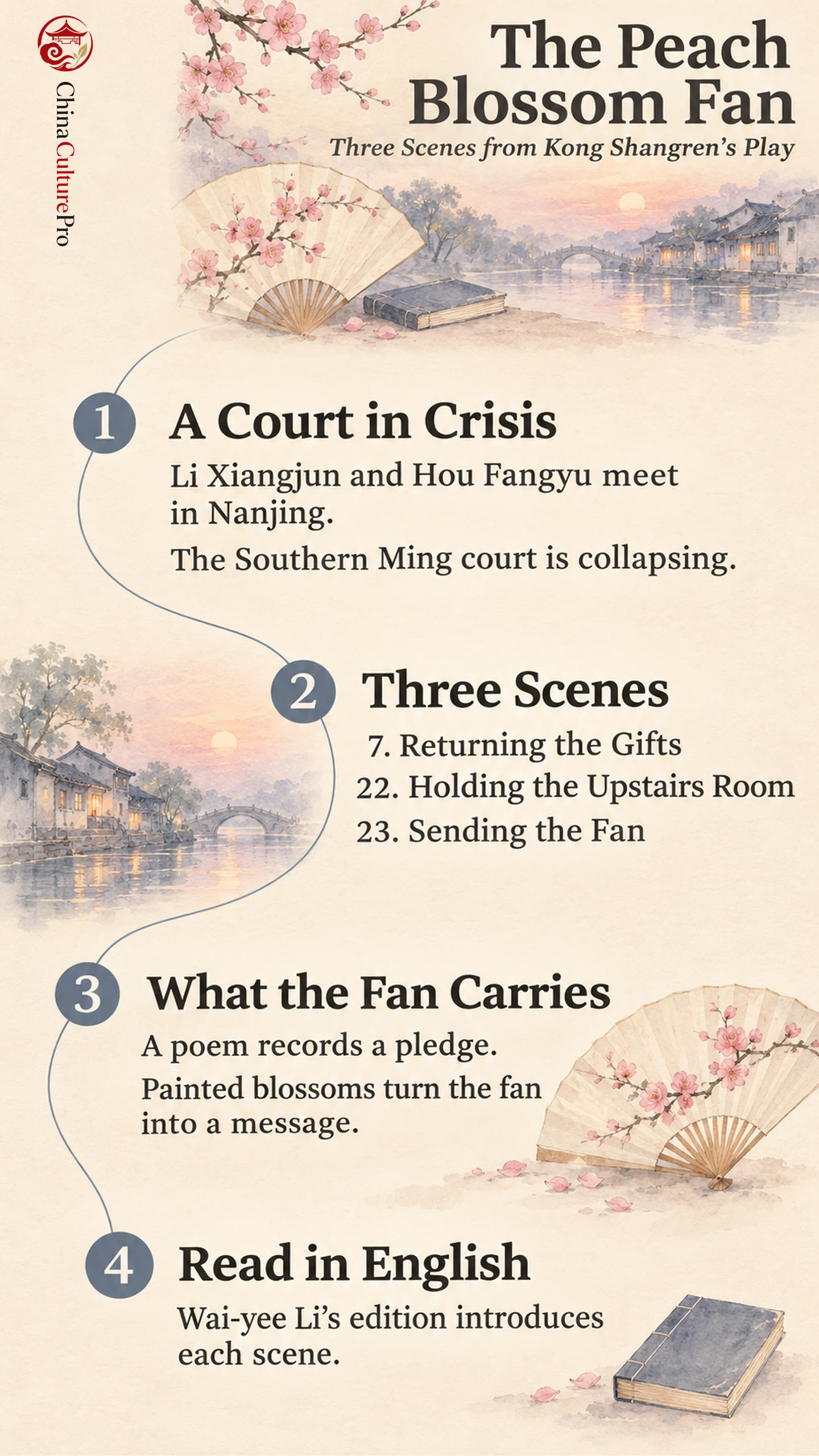
A fan with a poem on it could serve as a private pledge. In The Peach Blossom Fan, it also becomes something its owner can bring out in a room full of people who want her to marry someone else. If you keep track of who holds the fan and what they can do with it, the shifts from a room in Nanjing to the wider politics of the court are easier to follow.[3][4]
Li Xiangjun, Hou Fangyu and the Southern Ming
Li Xiangjun is a courtesan in a milieu where performance brings patrons, writers and officials together. Hou is a young scholar whose acquaintances and reputation have political value. The play draws them together in Nanjing, then puts pressure on their relationship through people who can offer expensive gifts or call on officials to get their way.[1][3][4]
The fall of the Ming dynasty involved more than the loss of Beijing in 1644. The Hongguang (弘光, Hóngguāng) court in Nanjing was a Southern Ming attempt to continue dynastic rule. That court becomes the immediate political setting of the lovers’ separation and the collapse that surrounds them.[9] Kong completed the play decades later, during the Qing dynasty.[2]
The court scenes give scale to choices made in private rooms. When Li asks where money came from, she wants to know what its acceptance would mean for Hou. When officials try to arrange her marriage, she experiences political power as pressure at her own door.
Three Scenes That Follow the Fan
Start with Returning the Gifts (却奁, Quèlián), continue to Holding the Upstairs Room (守楼, Shǒulóu), then read Sending the Fan (寄扇, Jìshàn). The English labels here are descriptive. Use the scene numbers and Chinese titles to find them in different editions.[3][4][5]
7. Returning the Gifts
Hou has inscribed a poem on the fan as a pledge. In the same scene, the couple learn that the gifts came from Ruan Dacheng (阮大铖, Ruǎn Dàchéng), who wants a connection with Hou. Li refuses the gifts when she learns who paid for them.[3] As you read, keep the fan separate from the other objects in the room. It came from Hou, while the finery puts a different obligation before them.
22. Holding the Upstairs Room
Men come to take Li away for an unwanted marriage. She brings out the fan with Hou’s poem and appeals to the promise it records. In resisting, she is injured, and her blood marks the fan.[4] Li uses the promise it records to explain her refusal to the people trying to take her away.
23. Sending the Fan
Yang Longyou (杨龙友, Yáng Lóngyǒu) turns the spots into part of a painted spray of peach blossoms. Li sends the fan with her singing teacher so it can reach Hou.[5] If you want to follow it into his hands, continue to scene 27, where he hears how the marks came to be there.[6]
How the Fan Carries the Story
The poem records what Hou and Li have promised. The stain records something Hou was absent for, and the painted blossoms make the fan a message he can receive. The change of form also leaves him needing another person’s account. In scene 27, Hou sees the picture and asks who painted it.[6]
Kong’s account of how he came to write the play treats the blood-stained fan as a story passed to him indirectly. He distinguishes it from events he found in several accounts of the Southern Ming.[7] That distinction matters when you follow the fan through the drama. In the play it connects people who cannot speak to each other. In the playwright’s account it connects a personal anecdote to a story about the fate of the Nanjing court.
If you see an excerpt, watch when the fan is displayed and when a character explains it. An audience can see the object without knowing all that has happened to it. For another long Qing play where a private relationship is caught in a political crisis, see The Palace of Eternal Life.
Which English Translation to Read
Wai-yee Li’s 2024 Oxford University Press edition offers notes and a short introduction to each scene.[1] Use the notes and scene introductions to keep track of the court figures as well as the lovers. The 1976 translation is by Chen Shih-Hsiang and Harold Acton, with Cyril Birch’s collaboration. New York Review Books reissued it.[8][9]
If you watch an excerpt, use its scene title to find the passages that precede and follow it in the full script. The guide to Chinese opera and The Peony Pavilion give other examples of how to move between a play on the page and a work in performance.
FAQs About The Peach Blossom Fan
Why is it called The Peach Blossom Fan?
A fan that Hou gives Li comes to bear a spray of peach blossoms. The painter works the stains from Li’s injury into the design, and she uses the fan to send Hou news of what happened.
When did Kong Shangren write the play?
He completed it around 1699 during the Qing. The fall of the Southern Ming court that it dramatizes took place decades earlier.
How many scenes are in The Peach Blossom Fan?
The full play is commonly described as having 44 scenes. Its contents have forty regularly numbered scenes plus four additional units with separate labels.[2][10]
Sources
[1] Harvard Fairbank Center. The Peach Blossom Fan: Wai-yee Li Translation
[2] National Endowment for the Humanities. Annotated Translation of Peach Blossom Fan
[3] Wikisource. Taohua Shan: Scene 7
[4] Wikisource. Taohua Shan: Scene 22
[5] Wikisource. Taohua Shan: Scene 23
[6] Wikisource. Taohua Shan: Scene 27
[7] Wikisource. Kong Shangren: On the Origins of The Peach Blossom Fan
[8] University of California Press. The Peach Blossom Fan: 1976 Translation
[9] New York Review Books. The Peach Blossom Fan
[10] Dedao. Taohua Shan: Annotated Chinese Edition Contents