

Quick Answer: What Is The Injustice to Dou E About?
The Injustice to Dou E (窦娥冤, Dòu É Yuān) is a Yuan-era zaju (杂剧, zájù) play by Guan Hanqing (关汉卿, Guān Hànqīng). Dou E (窦娥, Dòu É), a young widow, is convicted of a killing she did not commit. Her three vows ask heaven and earth to show what the court failed to establish.
- The confession: Dou E admits to the killing under pressure to protect her mother-in-law.
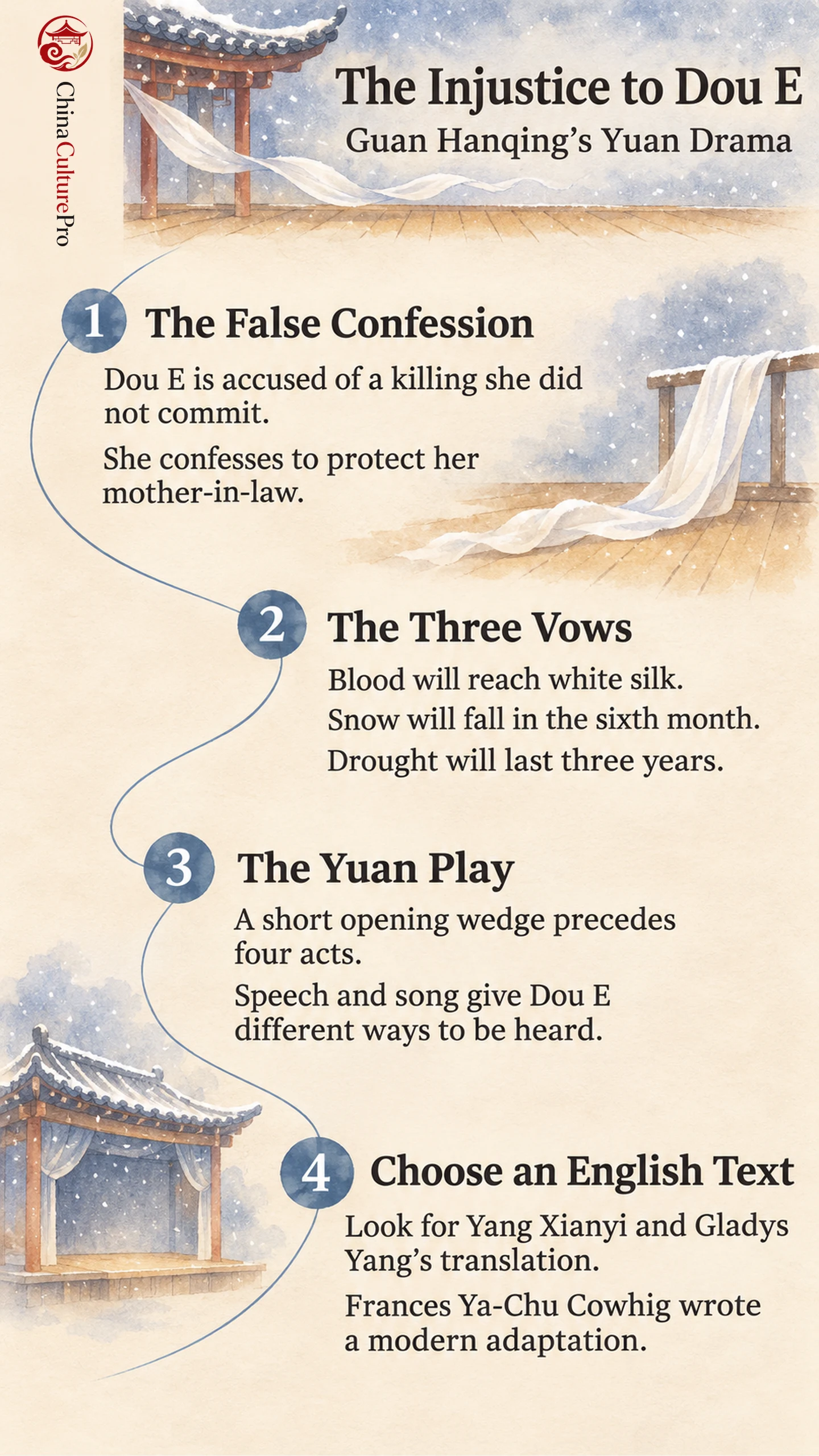
- The three signs: She calls for her blood to reach white silk, snow to fall in midsummer and a drought to last three years.
- The title: Snow in Midsummer can refer to the classical story or a modern stage adaptation. Check the author and adapter credits.
The audience knows more about the accusation than the magistrate does. Much of the play’s tension comes from watching an official mistake a coerced statement for the truth.
The central question of this play is how someone can make an injustice visible after the official record has closed around a false account. Guan gives the audience several ways to hear the case. What one person says in court, what Dou E can sing and what the weather does onstage have different kinds of authority.
How an Accusation Becomes a False Confession
Dou E enters the Cai household as a child through an arrangement that settles her father’s debt. She becomes the wife of Cai’s son and is widowed while still young. Her connection to her mother-in-law matters because it later shapes a choice the magistrate misreads. [1][2]
A man named Zhang Lü’er (张驴儿, Zhāng Lǘ’ér) tries to poison Dou E’s mother-in-law. His own father takes the poison instead. Zhang then accuses Dou E. The audience has seen how the death occurred, so the court scene tests whether the official can distinguish what actually happened from what an accuser says happened. [1]
Dou E has denied the accusation. She yields when the magistrate turns his threat of punishment toward her mother-in-law. Her statement is therefore evidence of what she is willing to endure to spare someone else. The magistrate treats it as confirmation that she caused the death. Pay attention to the pressure immediately before she speaks, because it tells you more about the statement than its literal words do. [2]
The Three Vows and the Snow in Midsummer
At the execution ground, Dou E asks for signs that will make her wrongful conviction visible. The vows expand from the space around her to the wider community:
- Her blood will rise to white silk without falling on the ground.
- Snow will fall in the sixth month and cover her body.
- The locality will suffer a drought for three years.
The play sets the scene in the sixth month of the traditional lunisolar calendar. Snow in June is a familiar rendering of the image, while Snow in Midsummer emphasizes the impossible season. A snowfall makes the claim visible to the witnesses. In court, the same claim depended on a magistrate willing to listen. [1][2]
Notice how the signs change scale. A piece of silk is close enough for the witnesses to inspect. Snow changes the scene around them. Drought makes the consequences last beyond the day of judgment. The later appearance of Dou E’s ghost brings the matter back to official investigation. That turn keeps the play concerned with what a human court must do after the extraordinary signs have appeared. [1]
How Zaju Gives Dou E a Voice
The script contains a short opening wedge (楔子, xiēzi) followed by four acts. The wedge establishes the arrangement that puts the child in the Cai household. Later scenes alternate among spoken dialogue, arias and stage directions. The format lets the audience hear Dou E at greater length than the court does. [1][4]
In the Chinese text, labels mark when a character speaks or sings, and the arias carry the names of their tune patterns. Those labels help a reader tell apart what characters address to one another, what the audience hears as song and what the actors are directed to do. The Yuan dramatic form helps explain why a character can have little power in court and a great deal of expressive power onstage. [1][4]
Try reading the court exchange alongside the songs near the execution ground. In court, a question can be put in terms the official controls. The singing gives Dou E time to say what the verdict has failed to hear. The two forms make it possible to hear obedience in one statement and resistance in another.
The play gives readers one route into theater within Chinese literature. For comparison, The Orphan of Zhao also builds tension around wrongdoing and the long delay before accountability. The Western Wing gives a different view of the dramatic tradition, with a longer structure and a story centered on courtship. [4]
Which English Version to Read
For the classical script in English, look for Yang Xianyi and Gladys Yang’s 1958 translation in Selected Plays of Guan Hanqing. Catalogues can use the spelling Kuan Han-Ching for the playwright. For a translation with a dedicated study, look for Chung-wen Shih’s Injustice to Tou O. Tou O is a different romanization of Dou E. [3][6]
Frances Ya-Chu Cowhig’s Snow in Midsummer is a modern reworking. In the 2017 Royal Shakespeare Company production, the widow is Dou Yi, and a businesswoman arrives to take over a factory. Choose the modern script for that retelling and a translation for Guan’s court scenes, vows and stage structure. The Chinese dynasties timeline gives historical context for the Yuan period in which Guan wrote. [3][5]
FAQs About The Injustice to Dou E
Is Snow in Midsummer another title for the play?
It can refer to Guan Hanqing’s classical story. Frances Ya-Chu Cowhig also used it for her modern adaptation, so check the credits.
Does Snow in June refer to the Gregorian month?
The original refers to the sixth month of the traditional Chinese calendar. The image is a snowfall at a time when the season makes it extraordinary.
What makes the confession unreliable?
Dou E is trying to protect her mother-in-law from coercion. The audience already knows who put poison into the food and why the accusation is false.
Sources
[1] Guan Hanqing, Wikisource. The Injustice to Dou E That Moved Heaven and Earth: Chinese Script
[2] Wai-Yee Li, Royal Shakespeare Company. The Birth of Chinese Drama
[3] Research Centre for Translation, Chinese University of Hong Kong. Guan Hanqing: Works Available in English
[4] ChinaCulture.org. Yuan Opera: The Main Body of Literature in the Yuan Dynasty
[5] Royal Shakespeare Company. Snow in Midsummer: 2017 Production
[6] DePaul University, Theatrical Histories. Snow in Midsummer or The Injustice Done to Dou E by Guan Hanqing