


Quick Answer: Who Was Tang Yin?
Tang Yin (唐寅, Táng Yín), also known as Tang Bohu (唐伯虎, Táng Bóhǔ), was a Suzhou painter of the Ming dynasty whose subjects included landscapes, figures, birds and flowers.[2]
- Career: An examination scandal in 1499 interrupted his route toward government service.[1]
- Range: His art includes mountain landscapes, refined figure pictures and expressive ink painting.[3]
- Writing: The dated fan Song of One Year preserves his calligraphy.[6]
His later romantic persona should be distinguished from the artist’s documented career.
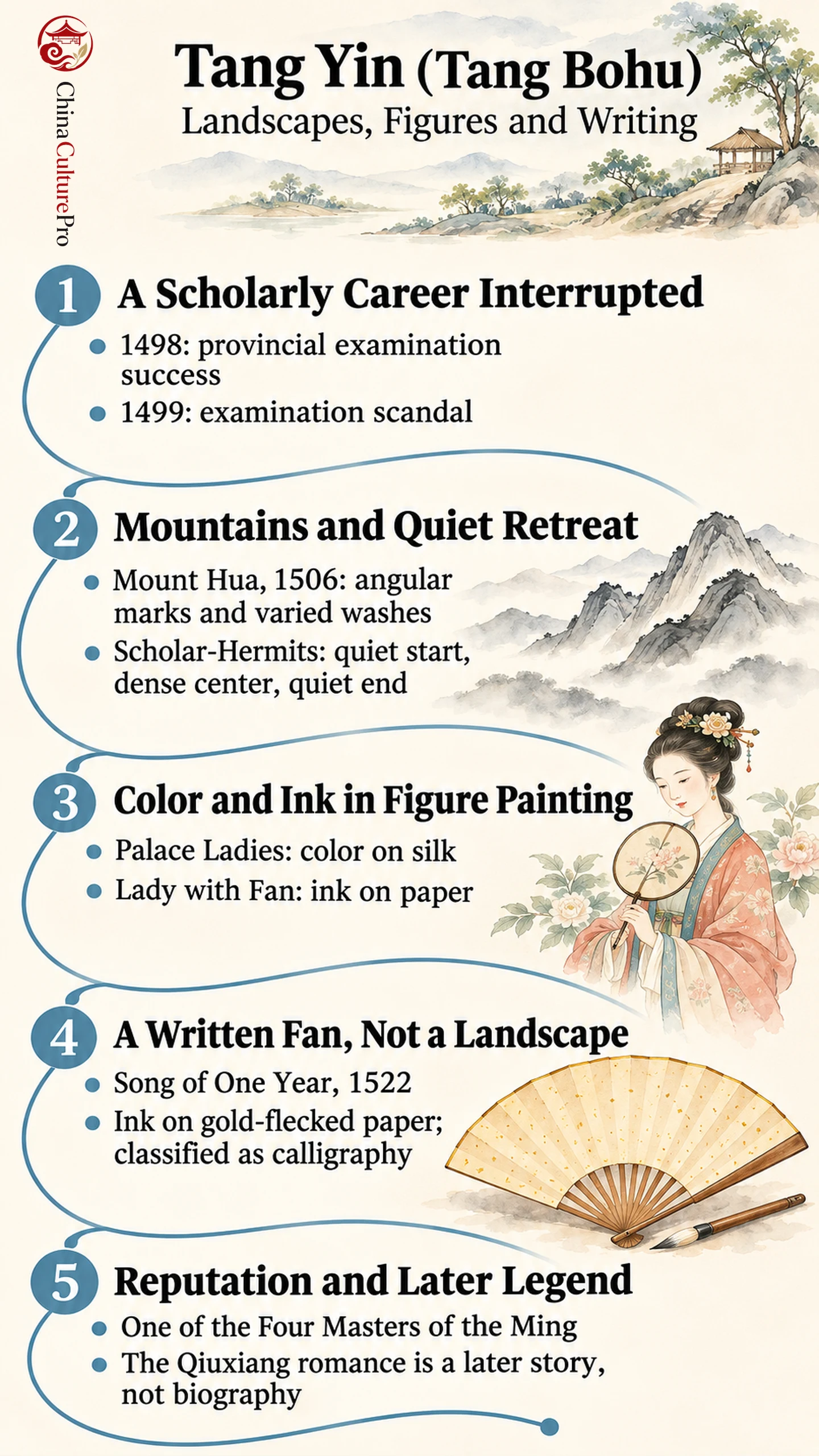
A lone woman with a fan and a densely rising mountain can seem to belong to different artistic worlds. Tang Yin’s range invites comparison across subjects, materials and ways of handling the brush, with poetry and writing forming part of the picture.
A Suzhou Scholar Whose Official Career Was Interrupted
Born in 1470, Tang belonged to the art world of Ming-dynasty Suzhou.[2] He placed first in the 1498 provincial examination in Nanjing. The following year, he became embroiled in an examination scandal in the capital, was jailed and expelled from the examinations, and lost his expected route into official life.[1]
His later work depended on literary and wealthy patrons in Suzhou, who supported a sometimes precarious living through art and writing.[1]
Landscape Painting: Mountain Structure and Quiet Retreat
Tang learned from Shen Zhou and Zhou Chen.[2] In Mount Hua, dated 1506, he built up summits in a manner associated with Li Tang. Angular marks and washes of differing strength establish the rocky surface and its changing light.[4] Compare his brushwork along a rock’s edge with the wash beside it.
Scholar-Hermits in the Autumn Mountains offers a different rhythm. This 1500–1510 handscroll begins quietly, becomes denser and more massive at its center, and returns to quietness at the end.[5] Reading its landscape in sequence reveals an unfolding experience rather than a single fixed view.
Figure Painting: Fine Color and Expressive Ink
The Palace Ladies of Former Shu shows four female court performers awaiting their ruler. Their lotus-shaped crowns and Daoist-style robes identify an episode associated with Wang Yan, the tenth-century ruler of Former Shu. The painting’s older title linked it to Meng Shu; the current identification follows the historical content of its inscription.[3]
Its fine, richly colored handling contrasts with the monochrome ink handling of Lady with Fan in the Autumn Breeze.[2][3] Compare how his figure painting uses costume color or ink alone to describe a subject.
Four Museum Works Across Painting and Calligraphy
Dimensions describe the painting or fan image, not a complete scroll mounting.
| Work | Date and medium | Collection and size |
|---|---|---|
| Mount Hua | 1506; hanging scroll, ink and light color on paper | Cleveland Museum of Art; painting 116.4 × 41.4 cm.[4] |
| Lady with Fan in the Autumn Breeze | Ming dynasty; hanging scroll, ink on paper | Shanghai Museum; 77.1 × 39.3 cm.[2] |
| The Palace Ladies of Former Shu | Ming dynasty; hanging scroll, color on silk | Palace Museum, Beijing; 124.7 × 63.6 cm.[3] |
| Song of One Year | 1522; folding fan mounted as an album leaf, ink on gold-flecked paper | Metropolitan Museum of Art; image 17.3 × 49.8 cm; calligraphy.[6] |
Artistic Reputation and the Tang Bohu Legend
Tang belongs to the Four Masters of the Ming (明四家, Míng sì jiā), with Shen Zhou, Wen Zhengming and Qiu Ying.[3]
His popular legend includes the romance of Tang Bohu and Qiuxiang, repeatedly adapted in fiction, stage performance and film. That familiar story is not a factual account of his life.[7]
FAQs About Tang Yin
Are Tang Yin and Tang Bohu the same person?
Yes. Bohu was one of Tang Yin’s courtesy names.[2]
Did Tang Yin become an imperial official?
His promising examination career was derailed in 1499. He subsequently made his living through painting and writing with support from patrons.[1]
Is the story of Tang Bohu and Qiuxiang historical fact?
No. It belongs to the artist’s literary and dramatic afterlife, rather than a reliable biographical record.[7]
Sources
[1] National Museum of Asian Art. Jinshi, Juren, and Jieyuan
[2] Shanghai Museum. Lady with Fan in the Autumn Breeze
[3] Palace Museum. Court Ladies of the Former Shu Ruler Wang Yan
[4] Cleveland Museum of Art. Mount Hua
[5] Cleveland Museum of Art. Scholar-Hermits in the Autumn Mountains
[6] Metropolitan Museum of Art. Song of One Year
[7] National Palace Museum. Chen Longgui: The Real Life of Tang Bohu Seen through His Poetry