
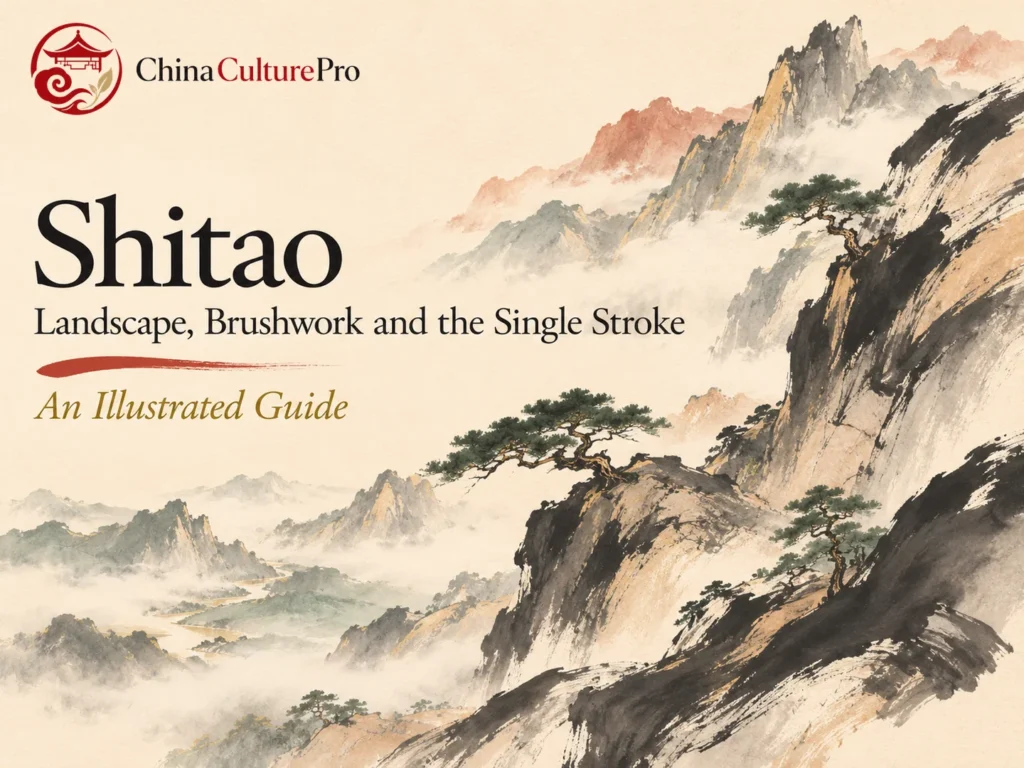

Quick Answer: Who Was Shitao?
Shitao (石涛, Shí Tāo) was an early-Qing painter, poet and theorist known for inventive landscapes and varied brushwork.[4]
- Background: He descended from the Ming royal family and became a Buddhist monk.[1]
- Style: His pictures range across fluid washes, bold marks and unusual spatial arrangements.[4]
- Idea: His theory links brush marks with a unified design.[2]
His mountain paintings can be remembered or imagined places as well as responses to travel.

A landscape by Shitao may pull the eye from a rush of water to an abrupt cliff, then dissolve into mist. Looking closely means following those changes in space and ink, rather than searching for one fixed formula that explains every picture.
From Ming Royal Descent to a Painter in Yangzhou
Born in 1642, Shitao was also known as Zhu Ruoji (朱若极, Zhū Ruòjí). His family belonged to the Ming imperial lineage.[7] After the dynasty’s fall in 1644, he lived as a traveling monk; after 1696, he settled in Yangzhou and supported himself through painting.[1]
His career connects Buddhist monastic life with the professional art world of the Qing dynasty. He is grouped among the Four Monks (四僧, sì sēng), alongside Bada Shanren, Kuncan and Hongren.[6] That label is a useful historical grouping, not a reason to expect identical styles.
The Single Stroke: A Principle of Unity
The single stroke (一画, yī huà) can also be understood as painting’s oneness. His 1699 Landscape fan’s inscription connects the beginning of a design with unity among its many marks, mediated by mind, hand and nature.[2]
To study his painting techniques, ask where a dark accent leads the eye and how a pale wash connects forms.
Four Museum Works and Their Different Visual Effects
These works offer contrasting scales and supports. Dimensions below describe the painted image or fan, not the entire mounting.
| Work | Date and format | Collection and size |
|---|---|---|
| Landscapes | 1694; eight-leaf album, ink and color on paper | Los Angeles County Museum of Art; image 27.94 × 22.22 cm.[4] |
| Landscape | 1699; folding fan mounted as an album leaf, ink and color on gold-flecked paper | Metropolitan Museum of Art; 17.5 × 44.5 cm.[2] |
| Thirty-six Peaks of Mount Huang Recollected | About 1705; hanging scroll, ink on paper | Metropolitan Museum of Art; image 205.9 × 78.7 cm.[3] |
| Reminiscences of Nanjing: Washing the Inkstone | 1707; ink and color on paper | National Museum of Asian Art; image 24.1 × 19.7 cm.[5] |
In the 1694 album’s mountain scene, rapids at the lower left lead toward a leap across mist to higher peaks and a path where three figures meet. The viewpoint shifts instead of holding the viewer at one stable distance.[4]
Washing the Inkstone recalls Shitao’s years as a monk in Nanjing. The figures’ action refers to painting and calligraphy; saturated color and toothlike clumps of pine needles give the scene a forceful, distinctive character.[5]
Mountains Seen, Remembered and Imagined
Thirty-six Peaks recalls Mount Huang through splashed ink and bold marks associated with Yan Zhenqing’s calligraphy.[3] Notice the relationship between a brush mark’s movement and the mountain form it describes.
The Luo-Fu Mountains album offers a different relationship to place: Shitao never visited those Guangdong mountains. He used travel descriptions and drew on his knowledge of woodblock illustrations. Of the original twelve leaves, four genuine paintings remain in Princeton’s collection.[1] An imaginative landscape can therefore be carefully informed without recording an actual visit.
Artistic Independence and a Lasting Legacy
His Remarks on Painting by the Bitter Gourd Monk (苦瓜和尚画语录, Kǔguā Héshang Huàyǔlù) belongs beside the pictures when considering his legacy.[6] His emphasis on a personal response to nature challenged the mechanical repetition of inherited models, and his work influenced later Yangzhou and modern Chinese painting.[6][7]
Alongside these visual choices, consult the inscriptions: they may state an idea that the image alone leaves open.
FAQs About Shitao
Did Shitao make a whole painting with one brushstroke?
No. It describes unity across many marks, not a literal one-stroke rule.[2]
Did he visit every mountain that he painted?
No. His Luo-Fu album depicts mountains he had not visited, informed partly by written descriptions.[1]
Why do sources give different dates for his death?
They preserve different chronologies: 1707 at the Metropolitan Museum, about 1718 in one Palace Museum entry.[3][6]
Sources
[1] Princeton University Art Museum. Luo-Fu Mountains
[2] Metropolitan Museum of Art. Landscape
[3] Metropolitan Museum of Art. Thirty-six Peaks of Mount Huang Recollected
[4] Los Angeles County Museum of Art. Landscapes, 1694
[5] National Museum of Asian Art. Reminiscences of Nanjing: Washing the Inkstone
[6] Palace Museum. Shitao: Biographical Entry
[7] Palace Museum. Shitao: Artist Profile