


Quick Answer: What Is White Clouds and Red Trees?
White Clouds and Red Trees(白云红树图,Báiyún hóngshù tú) is a 1658 colour-on-silk hanging scroll by Lan Ying(蓝瑛,Lán Yīng) in Beijing’s Palace Museum. Blue-green peaks rise above richly coloured trees and clouds.[1]
- Format: A very narrow vertical image encourages the eye to move between successive levels.
- First detail: The clouds interrupt the mountains instead of forming one distant backdrop.
- Human scale: A small figure on a bridge provides a quieter point of entry near the lower part.
The 1658 Beijing scroll should be distinguished from another same-title work dated 1659.
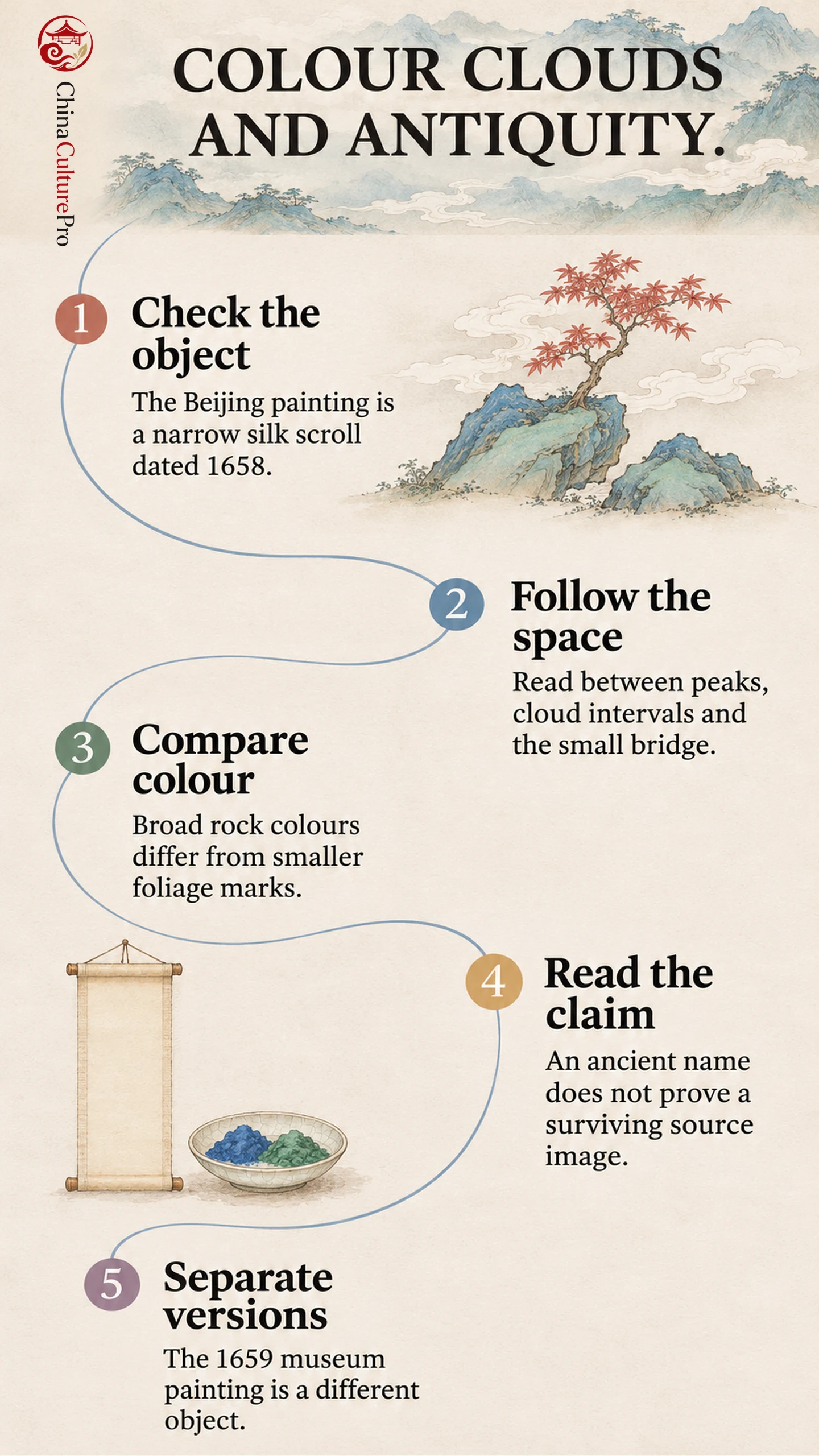
Blue and green peaks appear to emerge through pale cloud bands. Below them, patches of red foliage lead downward toward a bridge, water and a small figure. The view feels extensive despite its narrowness. Looking closely means following the intervals between coloured forms, as well as admiring the strength of the colours themselves.
The Narrow Silk Scroll Dated 1658
The image measures 189.4 × 48 cm and bears the collection number 新00138452.[1] Its height is nearly four times its width. This makes the relationship between upper and lower zones especially important: a small detail can sit far below a major peak while remaining within a tightly connected field.
The 1658 date places the painting in the early Qing period. Lan Ying’s association with late-Ming painting traditions does not move this particular work back before the dynasty changed. Keep the dated object separate from a broad label describing an artist’s career.
Compare the painted field with its surrounding mounting in a full photograph. The silk image and fabric border have different roles, and an enlarged crop may exclude the latter altogether. The guide to Chinese scroll formats explains this distinction.
Following Clouds, Peaks and the Small Bridge
Begin at the top, where tall green forms rise beside a darker blue mass. Their edges do not make one continuous mountain wall. Pale intervals cut between them, allowing some shapes to appear isolated before the eye reconnects them with the terrain below.
Move down toward the trees. Their red, green, yellow and pale foliage produces a more broken pattern than the broad upper peaks. Bare or partly exposed branches interrupt the leaf clusters. Changes in scale and density distinguish the upper peaks from the lower foliage.
Near the lower right, a small blue-clad figure stands on a bridge. Its scale makes the surrounding rocks and trees more imposing without requiring a large crowd or settlement. Follow the bridge toward the banks, then look upward again: the lower passage offers a route into a scene that initially seems dominated by distant peaks.
Clouds help hold these different levels together. They obscure parts of forms while leaving other edges clear. A mountain can therefore feel substantial and partially hidden at the same time. That interaction is central to reading the space within the Chinese landscape-painting tradition.
Colour, Mineral Pigments and the Boneless Approach
The technique is described as mogu(没骨,mògǔ), commonly translated as “boneless.” Forms are built through colour rather than depending throughout on preliminary ink outlines. The work belongs to the richly coloured tradition of blue-and-green landscape(青绿山水,qīnglǜ shānshuǐ).[1]
The palette includes mineral blues and greens for rock forms, vermilion accents and white pigment for clouds.[1] The clouds are therefore more than a convenient name for every untouched area. Their light colour has an active role beside the stronger colours of mountains and foliage.
Compare a red tree with a broad green rock face. The tree is assembled from many small marks around branching forms; the rock carries more extensive areas of colour. Contrast works both between hues and between kinds of mark. A bright passage need not be a flat, evenly filled shape.
“Boneless” also should not make the viewer stop looking for drawn edges or darker marks. The term identifies an approach to constructing forms; the individual parts of the painting still reward close comparison. The guide to Chinese painting techniques puts colour-built forms alongside other uses of line and wash.
What the Inscription’s Ancient Reference Means
The upper-left inscription names the subject, refers to the Shunzhi(顺治,Shùnzhì) era and supplies a year corresponding to 1658. It also invokes the boneless method of Zhang Sengyou(张僧繇,Zhāng Sēngyóu).[1]
That ancient reference is part of Lan Ying’s presentation of his own painting. It does not establish that the scroll reproduces a securely preserved work by the earlier artist. The vivid landscape is better understood as a creative engagement with an imagined or reconstructed antiquity than as straightforward evidence of an unchanged technique transmitted across centuries.[2]
When reading inscriptions and seals, distinguish a stated artistic lineage from proof of an identifiable source image. The inscription records Lan’s chosen artistic reference; identifying an actual earlier model requires separate evidence.
A Different Same-Title Painting from 1659
The Central Academy of Fine Arts Museum has another White Clouds and Red Trees, dated 1659 and measuring 162 × 86 cm. It is also a colour-on-silk hanging scroll, but it is a separate object with different proportions and an inscription of its own.[2]
Those differences are enough to prevent a common identification mistake. The later painting is substantially wider in relation to its height. Its date and dimensions should not be attached to a reproduction of the narrow Beijing scroll. Keep artist, title, collection, date and measurements together when comparing records.
FAQs About White Clouds and Red Trees
What does boneless mean here?
It describes building forms through colour instead of relying throughout on an ink-outline framework.[1]
Is this a Ming or Qing painting?
This particular work dates to 1658, in the early Qing period. Lan Ying’s career spans the Ming–Qing transition.
Are all White Clouds and Red Trees images the same work?
No. At least the 1658 Palace Museum scroll and the 1659 Central Academy of Fine Arts Museum scroll must be distinguished.[2]
Sources
[1] Palace Museum. Lan Ying’s White Clouds and Red Trees: object record and inscription
[2] Central Academy of Fine Arts Museum. White Clouds and Red Trees: the 1659 painting and its archaizing context