

Quick Answer: What Is Sailboats and Pavilion?
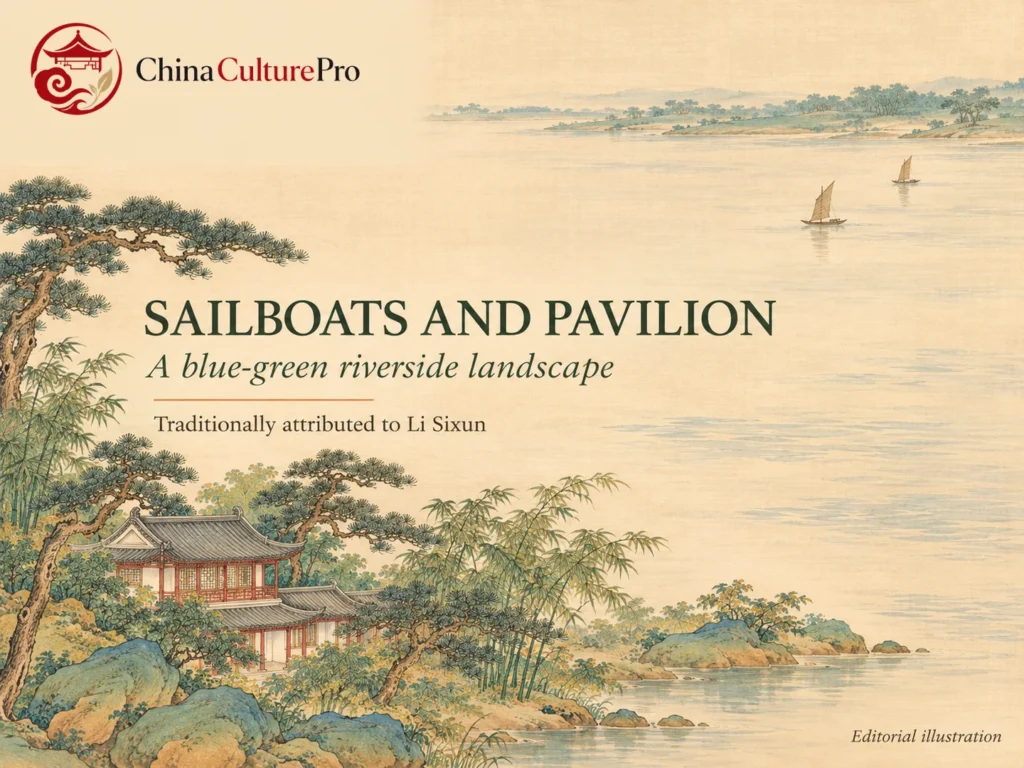
Sailboats and Pavilion (江帆樓閣, Jiāngfān Lóugé), catalogued as River Sails and Lofty Buildings, is a silk landscape in the National Palace Museum, Taipei, traditionally attributed to Li Sixun (李思訓, Lǐ Sīxùn). It combines blue-green hills, trees, elaborate buildings and river craft. The scroll has no artist’s signature or seal. Its traditional Tang attribution should be qualified: museum research proposes a Northern Song imitation preserving an earlier landscape tradition.[1][2]

The title points toward boats and architecture, but trees and painted rocks occupy much of the view. Looking through that wooded shore toward the open river reveals how the picture brings together travel, a substantial residence and an expansive landscape.
The Taipei Scroll and Its Traditional Attribution
The English titles describe the same museum object. Its collection number is the most reliable identifier when captions use different translations.[1]
| Champ | Identification |
|---|---|
| Familiar title | Sailboats and Pavilion |
| Current catalogue title | River Sails and Lofty Buildings |
| Traditional artist attribution | Li Sixun |
| Medium and format | Ink and colors on silk; hanging scroll |
| Painting dimensions | 101.9 × 54.7 cm |
| Collection | National Palace Museum, Taipei |
| Collection number | 故畫000003 |
The name attached to an old title label and the proposed date of the surviving painting answer different questions. Keep both visible when describing the work.
A Wooded Shore Faces a Wide River
Begin with the large contrast between the two sides. The wooded land rises on the left and spreads across the lower picture. Above and to the right, water and sky create a much more open area. Small boats interrupt that openness without filling it.
The trees are layered, with darker crowns overlapping lighter foliage and blue-green rock forms. Their trunks provide routes for the eye through the dense vegetation. At a reduced viewing size, the whole bank can appear almost continuous; closer inspection separates the trees, roofs and small paths within it.
Near the lower-right shore, tiny figures supply a different scale from the trees. They remind the viewer that this is an inhabited and traversable landscape. The river craft extend that sense of movement beyond the paths on land.
The contrast is useful when exploring Chinese landscape painting: density and openness can organize a view before any particular hill or building is identified.
Red Columns and Rooflines Give the Buildings Their Weight
The architecture is partly concealed among the trees, rather than displayed on an isolated open platform. Roofs, passages and structural lines emerge in fragments. Looking for those fragments is a better starting point than expecting one simple pavilion to explain the whole title.
The main building has a complex roof with double eaves. Red structural members contrast with pale walls, joining the architectural color to the surrounding green and blue landscape. The museum considers the building substantial enough to suggest an official’s residence or a temple, without identifying a specific surviving site.[1]
Doors, windows and corridors also mark an organized human space. Their repetition contrasts with the branching trees that partly conceal it. Compare the intervals between the posts with the irregular gaps within a nearby tree crown.
The guide to Chinese architecture provides context for roof forms and structural elements. In this painting, their visual role is also important: relatively straight edges interrupt the more irregular growth of trees and the turns of the shore.
Blue-Green Color Works with Delicate Outlines
The work belongs to the tradition of blue-green landscape painting (青綠山水, qīnglǜ shānshuǐ). Dark outlines define rock forms, while blue and green washes give them color. The heritage description emphasizes this combination and the decorative effect of patterned leaves.[2]
Compare a colored rock with a nearby tree crown. Their surfaces are organized differently: broader colored areas meet repeated smaller leaf forms. Then look at where a dark contour stops one shape from dissolving into its neighbor.
The presence of color does not remove the work of line. Nor does a photograph establish the chemical identity of every pigment. The guide to Chinese painting techniques offers the broader vocabulary for comparing outline, wash and texture.
Why the Tang Name Does Not Secure a Tang Date
The old label attributes the work to Li Sixun, a Tang painter associated with richly colored landscapes. The absence of his signature leaves that attribution dependent on later transmission and interpretation.[2]
Museum research points instead to features of architecture and clothing consistent with a later work, proposing a Northern Song imitation, possibly connected with that period’s court academy. The cultural heritage record likewise assigns it to the Northern Song. These assessments make it inappropriate to present the surviving scroll as a securely identified Tang autograph.[1][2]
It can still preserve and transform an earlier artistic tradition. Distinguishing inherited style from the date of a particular object is essential when reading painting inscriptions and seals, old labels and modern captions together.
How to Read the River, Buildings and Painted Surface
- Check the object identity: Match the title with collection number 故畫000003 and retain the qualified attribution.
- Compare land and river: Look from the dense wooded shore toward the open water and small boats.
- Locate the architecture: Follow rooflines, red structural members and the passages concealed among trees.
- Examine line and color: Compare outlined rocks, blue-green washes and patterned foliage.
FAQs About Sailboats and Pavilion Attributed to Li Sixun
Are Sailboats and Pavilion and River Sails and Lofty Buildings the same work?
Yes. These English titles refer here to the Taipei scroll with collection number 故畫000003 and dimensions of 101.9 × 54.7 cm.[2]
Does the scroll have Li Sixun’s signature?
No. His name comes from an old title label, while the painting itself has no artist’s signature or seal.[2]
Can the building be identified as a particular palace?
The museum discusses an important residence or temple. Its architectural details do not establish the identity of a named palace or a specific real property.[1]
Sources
[1] National Palace Museum. River Sails and Lofty Buildings: Collection Record and Research
[2] Bureau of Cultural Heritage. River Sails and Lofty Buildings: Heritage Record