


Quick Answer: Who Is Manjushri Wenshu?
Manjushri (文殊, Wénshū) is the bodhisattva associated with wisdom in Mahāyāna Buddhism. Chinese works can show him on a lion, holding a scripture or carrying a sword. Mount Wutai (五台山, Wǔtái Shān) is a major center of devotion to him.[1][2][3]
- Mount: A lion helps identify him in some paintings and sculptures.[1][6]
- Objects: A sword and a book can express wisdom in another form.[2]
- Story: A scene of a visit to a layman can depict his dialogue with Vimalakirti.[4][5]
Look for attributes and companions together. A mountain landscape and a dialogue scene each offer a different kind of clue.
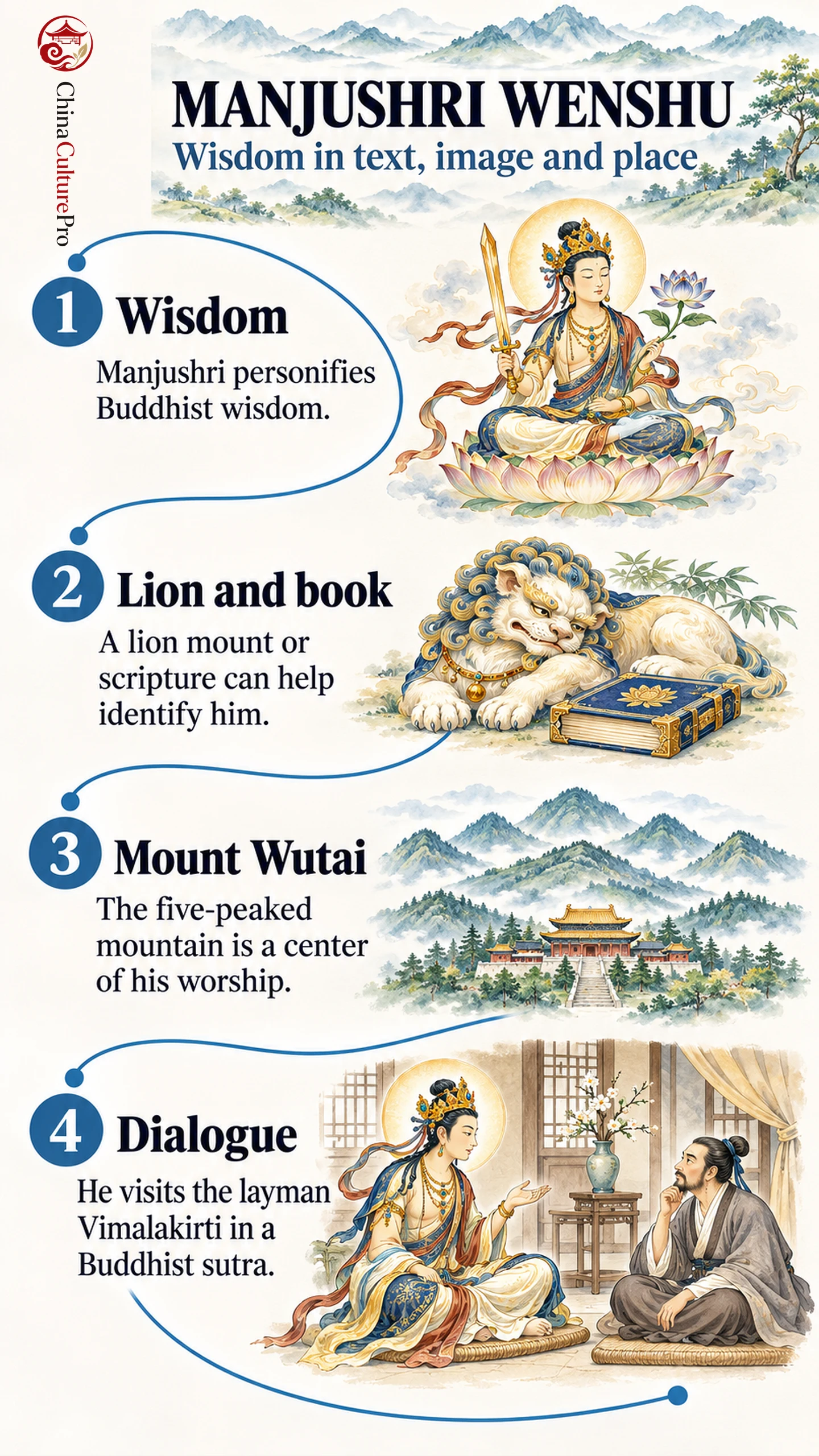
Manjushri (文殊, Wénshū) appears in Chinese Buddhist art both as an individual sacred figure and as a participant in stories. A lion can make his figure easy to distinguish in a group. In a narrative scene, his encounter with another figure may provide the strongest clue.
Recognizing the Lion, Sword and Book
A Ming painting in the Smithsonian collection shows Manjushri seated on a lion. In a Tang scroll in Cleveland, the lion distinguishes him from Samantabhadra, who rides an elephant. Comparing the two mounts helps read an assembly with several sacred figures.[1][6]
A sculpture discussed in the Met’s study of Yongle art represents a different form with four arms. Among its attributes are a sword and a volume of the Perfection of Wisdom scripture. The sword represents wisdom cutting through ignorance, while the book points to the scriptural tradition of the Perfection of Wisdom.[2]
Why Mount Wutai Matters
Mount Wutai (五台山, Wǔtái Shān) in Shanxi has five flat peaks and a long association with Manjushri worship. The landscape and its monasteries give a geographical setting to devotion. In the wider tradition of Chinese Buddhist pilgrimage, the connection explains why a sacred figure may be approached through a journey as well as through a temple image.[3]
Why Manjushri Visits Vimalakirti
In the Vimalakirti Sutra, Manjushri goes to see the layman Vimalakirti, who is ill. Their exchange presents wisdom as something tested in dialogue. The Dunhuang collection preserves versions of the story in art, alongside the wider tradition represented by the Dunhuang murals. Recognizing the person opposite Manjushri can help identify which episode is being shown.[4][5]
FAQs About Manjushri Wenshu
Are Wenshu and Manjushri the same figure?
Yes. Wenshu is the familiar Chinese name for Manjushri, the bodhisattva associated with wisdom.
Does Manjushri always ride a lion?
The lion is common in Chinese art, but other forms show him with attributes such as a sword and a book.
Where is Manjushri especially venerated in China?
Mount Wutai in Shanxi is a major center of devotion to him.
Sources
[1] Smithsonian National Museum of Asian Art. Manjushri seated on a lion
[2] The Metropolitan Museum of Art. Defining Yongle: Imperial Art in Early Fifteenth-Century China
[3] UNESCO World Heritage Centre. Mount Wutai
[4] Getty Research Institute. Vimalakirti and Manjushri Iconography Record
[5] International Dunhuang Programme. References: Whitfield 1983, page 3
[6] Cleveland Museum of Art. Shakyamuni Triad: Buddha Attended by Manjushri and Samantabhadra