

Quick Answer: What Are Daoist Precepts?
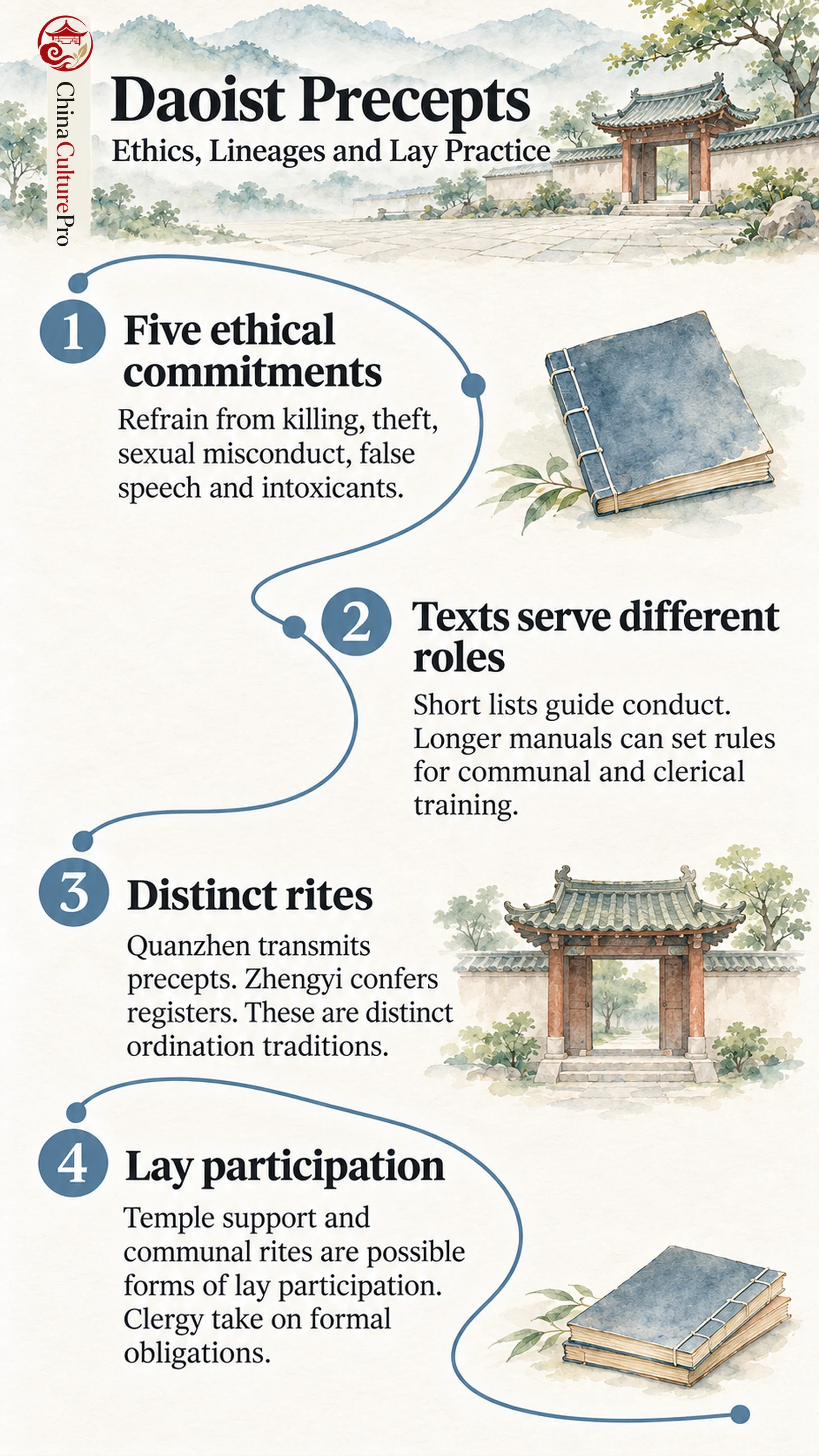
Daoist precepts (戒, jiè) are commitments that guide conduct and religious training. A familiar set is the Five Precepts (五戒, wǔjiè). It calls for restraint in harming life, taking what belongs to others, sexual conduct, speech and the use of intoxicants.[1]
- Everyday ethics: The basic commitments guide how a person acts toward others and exercises restraint.[1]
- Clerical training: Quanzhen (全真, Quánzhēn) and Zhengyi (正一, Zhèngyī) have distinct paths for receiving formal commitments and religious authority.[3][4][5]
- Lay participation: Lay people may support temples and participate in religious life. Ordained clergy take on obligations specific to their roles.[2][6][7]
A named set of precepts makes the most sense when read alongside its text, lineage and intended practitioners.[1][2]
You may encounter a short list of moral commitments in an introduction to Daoism and a much longer rulebook in a text for priests. Who receives the rules, and in what setting, explains much of the difference.
What the Five Precepts Ask of Practitioners
The following themes appear together in a precept scripture associated with the Celestial Masters. Wording differs across texts and translations.[1]
- Protect life: Refrain from taking life.
- Respect property: Refrain from theft.
- Act responsibly in sexual relationships: Refrain from sexual misconduct.
- Speak truthfully: Refrain from false speech.
- Refrain from intoxicants: Refrain from substances that intoxicate.[1]
One historical text maps the precepts to the Five Phases. It links the restraint against killing to Wood and associates truthful speech with Earth. Those correspondences show how a text can place an ethical commitment within a larger cosmology.[1]
Why Daoist Texts Preserve Different Sets of Precepts
Daoist institutions used precepts for different stages of training and different kinds of community life. The early seventh-century Rules and Precepts for Worshiping the Dao, for example, sets out expectations for monastic practitioners and priests in training. Its rules belong to institutions where people lived, practiced and learned together.[2]
The Tao Te Ching explores restraint through short verses and images. A precept manual can ask a trainee to make a specific commitment and receive it through a formal rite.[1][2][6]
How Quanzhen and Zhengyi Ordination Differ
The China Daoist Association distinguishes these rites in its regulations revised in December 2025. These are institutional rules for a specific setting. Historically, local practices and the ways communities understood clerical roles have also varied.[3][4][5][7]
| Tradition | Formal rite in this framework | What it emphasizes |
|---|---|---|
| Quanzhen | Transmission of precepts (传戒, chuánjiè) | Ordination in a tradition associated with celibate monastic discipline.[3][4][6] |
| Zhengyi | Conferral of registers (授箓, shòulù) | A rite in a tradition associated with the Celestial Masters and communal ritual. Receiving a register is part of a cleric’s formal progression.[3][5][6] |
Conferral of a register does not imply the absence of moral obligations. The association’s current clergy code expects its clergy to observe the Five Precepts and sets out some distinct expectations for the two traditions.[3]
What Precepts Mean for Lay Practice
Lay participation can include supporting a temple and joining communal rituals in religious Daoism. Some Song-period associations, for instance, supported local temples and performed religiously meritorious acts.[6]
Someone approaching a community can distinguish three questions: what it asks of visitors, what commitments it teaches to lay participants and what requirements apply to clergy. A temple’s rules for participation depend on its own practice. For an ordinary visit to a place of worship, start with local instructions and Chinese temple etiquette.[3][6][7]
FAQs About Daoist Precepts
Are the Daoist and Buddhist Five Precepts the Same?
The two traditions share familiar restraints against killing, stealing, sexual misconduct, false speech and intoxicants. Daoist texts place these commitments within their own forms of religious training and sometimes connect them to the Five Phases. See Buddhism and Taoism for the wider relationship.[1][8]
Do All Daoists Have to Be Vegetarian?
Quanzhen monastic clergy traditionally follow a vegetarian diet. The association’s clergy code describes that discipline specifically for Quanzhen priests. A lay person’s commitments or a Zhengyi priest’s obligations depend on the setting.[3][6]
Does Following the Five Precepts Make Someone a Daoist Priest?
Observing the precepts can be part of ethical or religious practice. Clerical standing involves formal training and transmission within a community. The form of ordination depends on the tradition.[2][4][5]
Sources
[1] Louis Komjathy. Scriptural Statutes
[2] Livia Kohn. The Daoist Monastic Manual: A Translation of the Fengdao Kejie
[3] China Daoist Association. 道教教职人员行为准则
[4] China Daoist Association. 关于全真派传戒的规定
[5] China Daoist Association. 关于正一派授箓的规定
[6] Fabrizio Pregadio. Religious Daoism
[7] Vincent Goossaert. Quanzhen, What Quanzhen?
[8] Livia Kohn. Buddho-Daoism