


Quick Answer: What Is Thousand-Armed Guanyin?
Thousand-Armed Guanyin (千手观音, Qiānshǒu Guānyīn) is a form of the Buddhist bodhisattva of compassion. Many hands and eyes express the capacity to perceive suffering and respond. Artists can show the form with different numbers of arms.[1][2]
- Eyes: In many images, an eye in a palm suggests awareness of suffering.[1]
- Hands: Radiating arms may carry objects or form gestures.[1][2]
- Medium: A painted fan of hands and a gilded relief solve the same visual problem in different ways.[2][5]
The title refers to a religious form. An image can evoke it with far fewer than a thousand visible hands.
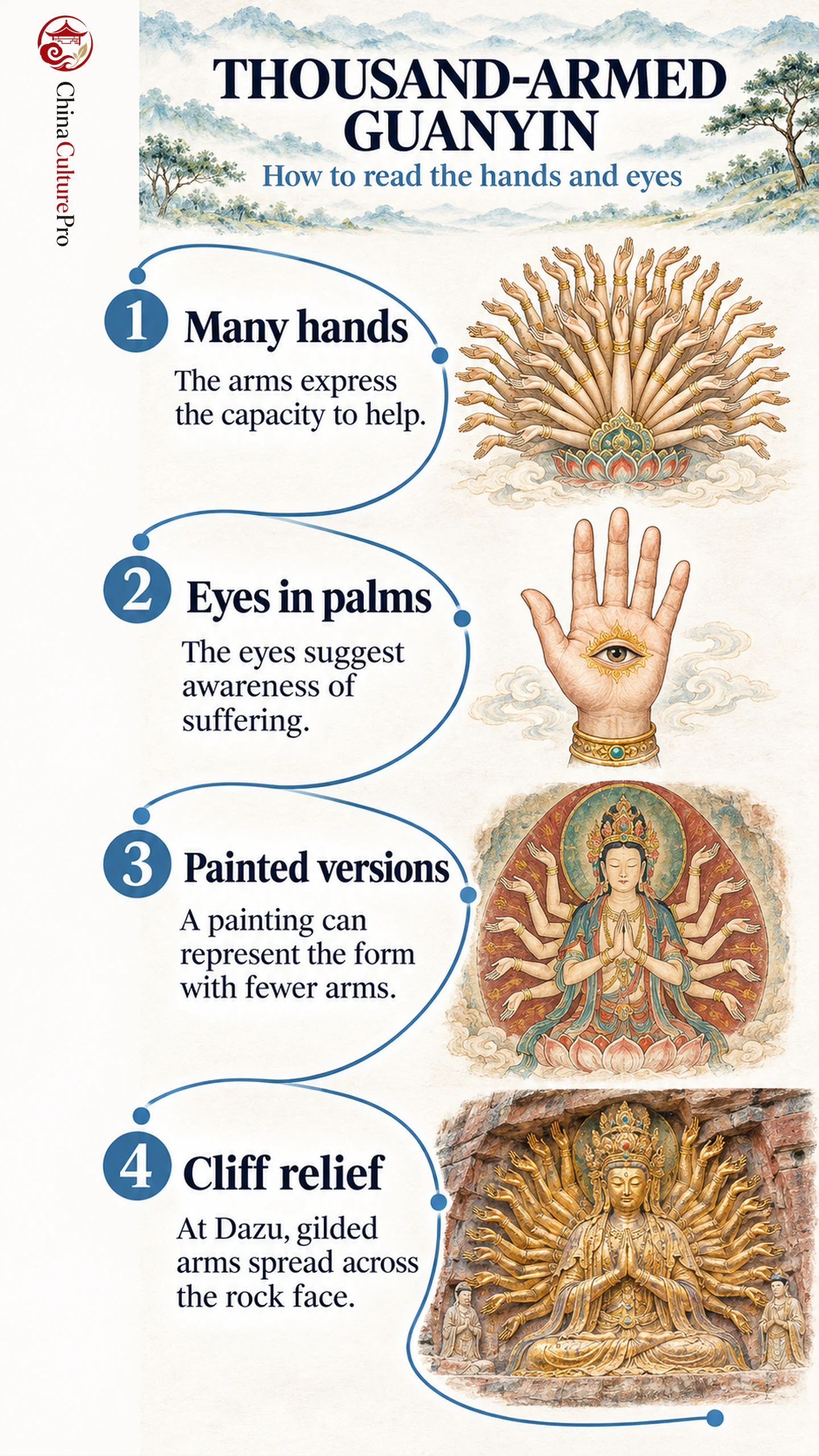
Thousand-Armed Guanyin (千手观音, Qiānshǒu Guānyīn) can fill a painting or spread across a stone wall. The central figure gives the viewer a place to begin. Looking outward reveals the arms, gestures and held objects that help distinguish the form.
What the Hands and Eyes Express
The palm eyes show a capacity to see suffering, and the hands express ways to help. Together the eyes and hands give two aspects of compassion a visible form. Devotion to this form in places such as Dunhuang was associated with the Great Compassion Dhāraṇī (大悲咒, Dàbēi Zhòu), a formula that circulated in traditions also discussed in Chinese esoteric Buddhism.[1][4]
How Painters Organized the Arms
A Tang silk painting from Dunhuang uses prominent hands holding objects such as discs representing the sun and moon. Another large silk painting combines the multiple arms with eleven heads. In the Smithsonian’s Ming hanging scroll, the figure has twenty-two pairs of arms. A painter can use repetition and symmetry to make the form recognizable without making every hand equally prominent.[1][2][3]
The surrounding hands supply a strong clue in this form. Water-Moon Guanyin instead often uses landscape and a relaxed posture. These clues can belong to distinct figures even when several forms appear within one work.
How the Dazu Relief Uses the Cliff
At Baodingshan, part of the Dazu Rock Carvings, gilded hands radiate from a seated figure across the cliff. The deep relief gives the arms shadows and depth that change across the stone surface. The surface also bears evidence of conservation, so its present appearance reflects more than one period of work.[5]
FAQs About Thousand-Armed Guanyin
Do the works literally have a thousand hands?
The number varies. The Smithsonian’s Ming scroll is identified as the thousand-armed form and has twenty-two pairs.
Why are eyes painted in the hands?
They signify awareness of suffering. The many hands express the bodhisattva’s ability to respond.
Is this the same as the form with eleven heads?
The two features can appear together. A surviving Dunhuang painting shows both multiple arms and eleven heads.
Sources
[1] Smithsonian National Museum of Asian Art. Thousand-Armed Thousand-Eyed Bodhisattva Avalokiteshvara
[2] British Library, International Dunhuang Programme. References: Whitfield 1983
[3] British Library, International Dunhuang Programme. Thousand-Armed and Eleven-Headed Avalokiteśvara
[4] Brill. The Avalokiteśvara Cult in Turfan and Dunhuang
[5] World Archaeology. Re-carving Meanings: Negotiating Social Value and Conservation in Southwest China’s Rock Carvings