


Quick Answer: What Is the Platform Sutra?
The Platform Sutra (坛经, Tánjīng) is a Chinese Chan Buddhist text that presents teachings attributed to Huineng (慧能, Huìnéng). It combines stories of religious succession with instruction. Early Dunhuang manuscripts and later editions preserve different forms of the work.[1][3][4]
- Story: Verses about a mirror and dust frame different ways of talking about practice.[2]
- Teaching: No-thought (无念, wúniàn) concerns how a practitioner relates to thoughts.[5]
- Transmission: A familiar later edition is the version associated with Zongbao, dated 1291.[4]
The date of a surviving copy, the date of an edition and the time when a story is set answer different questions.
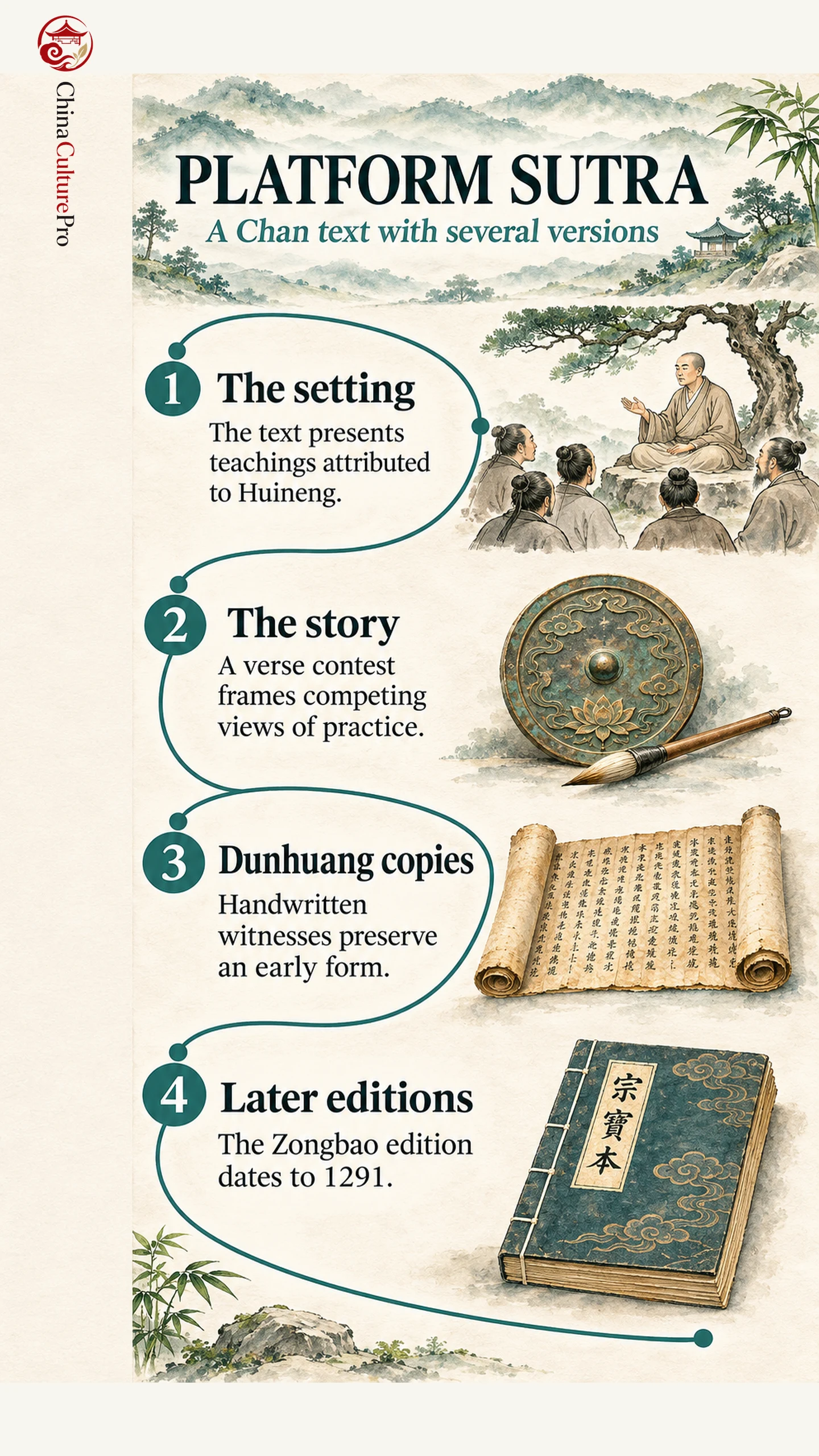
The Platform Sutra (坛经, Tánjīng) presents Huineng (慧能, Huìnéng) as a teacher and heir to a religious lineage. Its place in Chan Buddhism developed through the reading and circulation of a text whose surviving versions differ.
The Verse Contest and the Teaching
The story places Huineng at the community of Hongren. A verse attributed to Shenxiu compares cultivation to keeping dust off a mirror. Huineng’s response asks how dust could alter original purity. The exchange dramatizes how practice relates to an originally pure Buddha-nature. It belongs to the text’s narrative of succession.[2]
The teaching of no-thought (无念, wúniàn) addresses attachment when thoughts occur. An ordinary perception can arise without becoming something the practitioner grasps or follows. The text uses the term to explain how attention can change in the course of ordinary experience.[5]
What the Dunhuang Copies Show
Handwritten Dunhuang witnesses include the Stein manuscript, Or.8210/S.5475, and a copy kept at the Dunhuang Museum. These are evidence for early forms of the work and how people copied it. A modern reader can see the difference between manuscript and edition in a note to the Columbia University excerpt, where a gap in the Dunhuang text is filled using a later version.[2][3]
How Later Editions Shaped the Text
Later editors transmitted the work in forms associated with Huixin, Qisong and Zongbao. The Zongbao edition dates to 1291 and is widely read. Its date identifies one edition, while the Dunhuang witnesses preserve earlier textual material. When two translations differ in the wording or placement of a scene, the edition each translator used is worth checking.[4]
FAQs About the Platform Sutra
Was the Platform Sutra written by Huineng?
It presents teachings attributed to him and traditionally associates their recording with his disciple Fahai. The surviving versions reflect later textual transmission.
Why do the verses differ among editions?
The text circulated in more than one form. Copyists and editors transmitted different wording, and modern translations can draw on different versions.
Does no-thought mean having an empty mind?
In this context it concerns the relation to thoughts as they arise, including freedom from clinging to them.
Sources
[1] BDK America. The Platform Sutra of the Sixth Patriarch
[2] Columbia University, Asia for Educators. Excerpts from the Platform Sutra of the Sixth Patriarch
[3] Chung-Hwa Buddhist Journal. Christoph Anderl, Was the Platform Sūtra Always a Sūtra?
[4] Academia Sinica, Institute of History and Philology. Tangut Translation of the Platform Sutra of the Sixth Patriarch
[5] Bukkyō Dendō Kyōkai. Zen Texts, translated by John R. McRae