
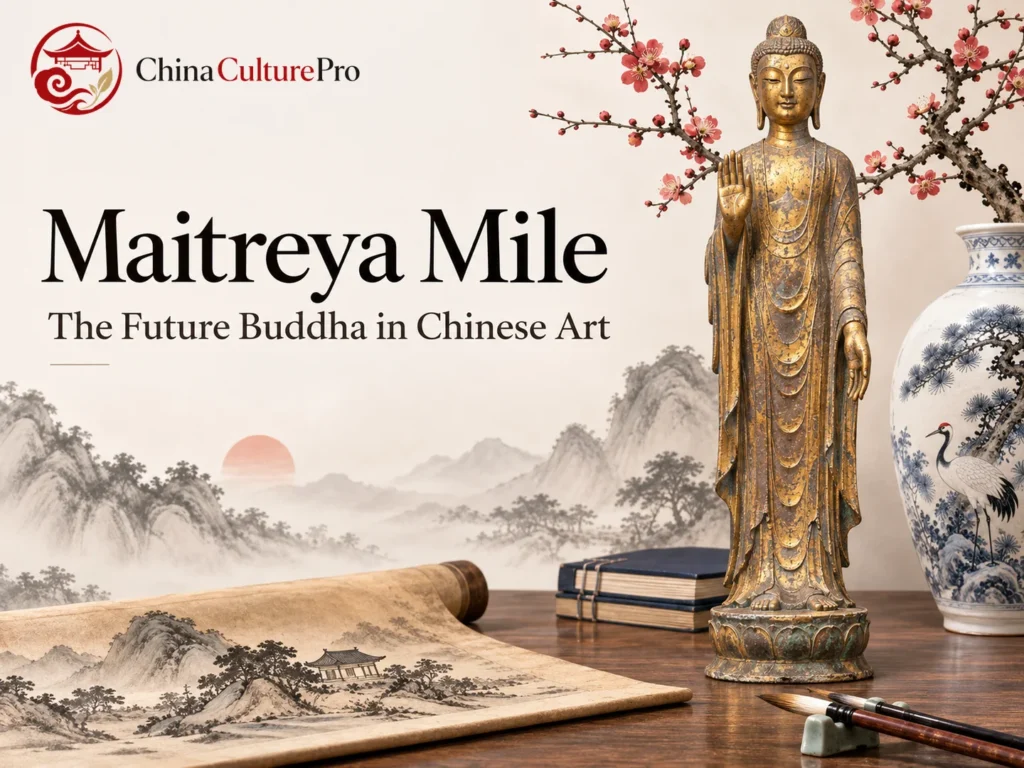

Quick Answer: Who Is Maitreya Mile?
Maitreya (弥勒, Mílè) is the Buddha of a future age in Buddhist tradition. He is described as a bodhisattva awaiting his final birth in Tuṣita Heaven (兜率天, Dōushuài Tiān). Chinese images show him in more than one form.[1][2]
- Future Buddha: He is expected to teach the Dharma in a later age.[1]
- Early images: Some sculptures identify Maitreya in a dedication. Others are identified through visual comparisons.[3][4]
- Chinese tradition: Budai (布袋, Bùdài), the laughing monk with a cloth sack, came to be understood as an incarnation of Maitreya.[5]
The image can emphasize a different part of Maitreya’s role in Buddhist and Chinese tradition.

Maitreya (弥勒, Mílè) can appear as a dignified standing Buddha, a jeweled bodhisattva or a laughing monk. These different forms are easier to understand when you start with his role as the future Buddha and then look at the evidence for each image.
Tuṣita and the Buddha of a Future Age
In Buddhist accounts, Maitreya resides in Tuṣita Heaven (兜率天, Dōushuài Tiān). He will be born into the world and teach after the present Buddha’s teaching has largely been forgotten. Devotional hopes can center on meeting him in Tuṣita or when he comes to teach. His future arrival also explains why the luohan are said to preserve the teaching until another Buddha comes.[1][2]
How Early Images Are Identified
A standing gilt-bronze Buddha at the Met has a dedication on its base. It dates the work to 486, names Maitreya and records that it was made in honor of the Northern Wei dowager empress Wenming. The inscription identifies the subject more securely than the figure’s costume or raised hand alone.[3]
The same museum identifies a fifth-century bodhisattva with crossed ankles as likely Maitreya based on its resemblance to related works. The pose supplies a clue, while the inscribed bronze supplies an explicit name. Maitreya can also appear at much greater scale, as in a colossal figure at Mogao, where sculpture and the Dunhuang murals share the cave setting.[4][6]
Where Budai Fits
Chinese tradition identifies the monk Budai (布袋, Bùdài) as an incarnation of Maitreya. A Qing figure in the Met collection depicts him smiling with his cloth sack. The sack and smile identify the monk in the sculpture. The earlier bronze and the later Budai figure express the connection in very different visual forms.[3][5]
FAQs About Maitreya Mile
Are Mile and Maitreya the same name?
Mile is the Chinese name for Maitreya, the Buddha of a future age.
Is Maitreya already a Buddha?
Buddhist tradition describes him as a bodhisattva awaiting his final birth. Images can depict him in the form of the Buddha he is expected to become.
Is the Laughing Buddha always how Maitreya looks?
The laughing monk is the Budai form associated with Maitreya in China. Early Chinese images can show Maitreya as a standing Buddha or seated bodhisattva.
Sources
[1] Getty Research Institute. Maitreya Iconography Record
[2] Oxford Bibliographies in Buddhism. Alan Sponberg, Maitreya
[3] The Metropolitan Museum of Art. Buddha Maitreya (Mile)
[4] The Metropolitan Museum of Art. Bodhisattva (Maitreya) with crossed ankles
[5] The Metropolitan Museum of Art. Buddhist monk Budai
[6] Dunhuang Foundation, Khan Academy. Mei Mei Chan, Maitreya