

Quick Answer: What Is Making Tea by Tang Yin?
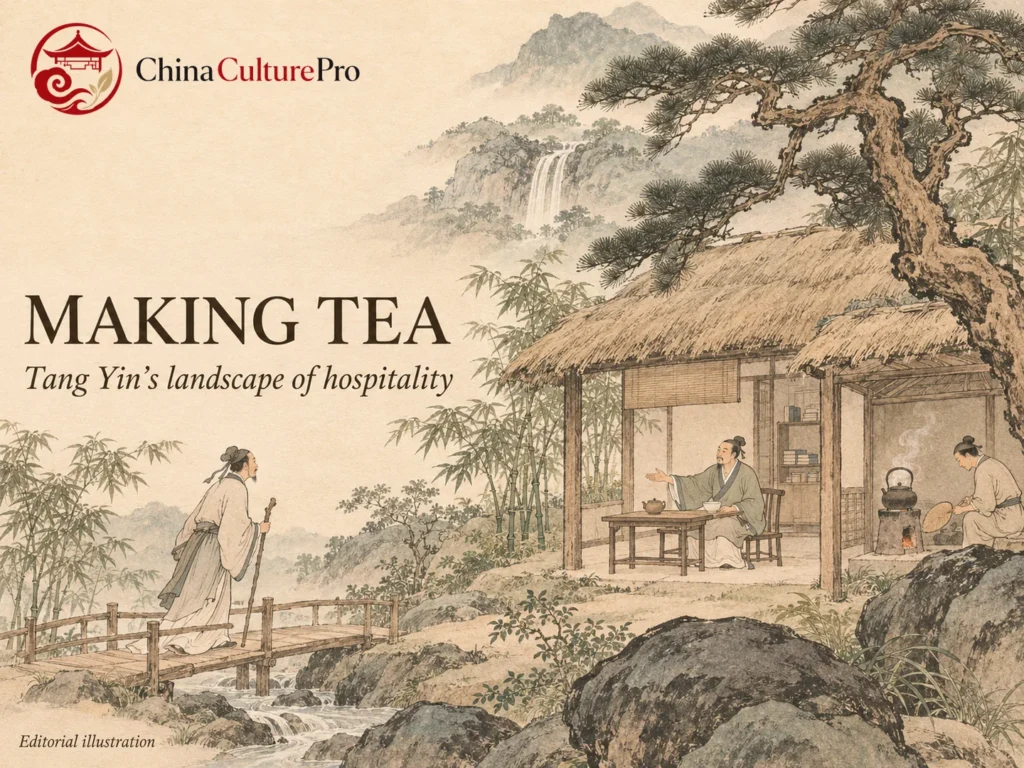
Making Tea (事茗图, Shì Míng Tú) is a Ming-dynasty handscroll by Tang Yin (唐寅, Táng Yín), held by the Palace Museum in Beijing. Painted in ink and color on paper, its picture measures 31.1 × 105.8 cm. A seated host, tea preparation and an approaching visitor occupy a quiet dwelling surrounded by rocks, trees and water. The work connects cultivated hospitality with an ideal landscape, while its attached writing adds several different voices.[1][2]

The title directs attention to tea, but the setting gives that activity its character. Look for the work involved in receiving someone, then compare the small domestic spaces with the larger scenery around them.
The Handscroll at a Glance
| Champ | Identification |
|---|---|
| Artiste | Tang Yin |
| Période | Ming dynasty |
| Exact creation year | Not established in the records used here |
| Format | Handscroll |
| Support | Ink and color on paper |
| Picture size | 31.1 cm high × 105.8 cm wide |
| Collection | Palace Museum, Beijing |
These dimensions describe the picture; the attached calligraphic sections and mounting extend the full object.[1]
The guide to Tang Yin’s works and style places this landscape within a practice that also included figure painting and poetry. Here, the connection between image and written response is especially useful for close looking.
Tea Preparation Makes Hospitality Visible
The main dwelling opens toward the viewer, revealing a host seated at a table. In a side area, an attendant tends the tea preparation. A visitor approaches by the bridge with a staff, accompanied by another attendant carrying a zither.[2][3]
Those activities distribute attention across the scene. The host’s seated position establishes a place of reception; the preparation area shows the labor that makes refreshment possible; the path and bridge give the guest a route toward them.
Start with the arriving person and follow that route. Then look back at the interior. The dwelling changes from an isolated architectural detail into a place ready for an encounter. The figures are small, but their positions make the surrounding landscape socially legible.
Tea belongs to a larger environment of books, pictures and conversation. Shelved volumes and scrolls within the dwelling reinforce that setting, while the guest’s musical accompaniment suggests another possible shared activity.[3]
For the wider background, see Chinese tea culture. In this picture, the most revealing question is how preparing and receiving tea becomes part of an imagined cultivated life.
Dark Rocks Frame a Quiet Place of Study
Large, dark rocks occupy the near edges of the scene. Their worked surfaces contrast with the paler buildings and banks behind them. Farther away, mountains and a waterfall extend the setting beyond the inhabited center.[1][3]
Compare the dark foreground mass with the open space around the house. The rocks can feel close and substantial, while the lighter middle ground seems available to enter. This difference helps the eye move inward instead of treating every feature as equally near.
Trees also interrupt and connect the view. A trunk can divide a stretch of architecture, while foliage partly shelters a roof. Follow one branch or roofline until another form crosses it; then notice how the interruption changes your sense of depth.
Follow the rocks’ rounded contours, then pause at a textured surface. Compare that density with the lighter handling around the waterfall. Notice how the farther scene seems less firmly enclosed by a boundary.
This is a useful example of Chinese landscape painting organizing a human setting through differences in density, tone and scale. The house remains intimate even while the view expands beyond it.
The Title, Poem and Later Writing Have Different Authors
The title can be understood as attending to tea. Tang’s poem develops the subject through a long day, a tea bowl, a southern window and a cooling breeze. Its language gives the painted retreat a sense of duration and bodily ease.[1]
Wen Zhengming (文徵明, Wén Zhēngmíng) wrote the two-character title at the front of the scroll. A later essay by Lu Can (陆粲, Lù Càn), dated 1535, belongs to the attached textual history.[1][3]
Keep these contributions distinct:
| Apport | Role in the scroll |
|---|---|
| Tang Yin’s painting and poem | Establish the scene and its poetic tea subject |
| Wen Zhengming’s frontispiece | Presents the two-character title before the picture |
| Lu Can’s essay, 1535 | Adds a later discussion connected with the tea theme |
The date of a later text does not automatically date the image it accompanies. Reading the scroll means asking who produced each part and how that contribution changes the experience of the others.
The page on Wen Zhengming provides context for the frontispiece’s writer. Chinese painting inscriptions and seals explains how such additions can help reconstruct an object’s history. Together, these relationships also illuminate the social exchange surrounding Chinese literati painting.
How to Follow the Guest into the Tea Setting
- Locate arrival and reception. Find the approaching visitor, the bridge and the seated host. Trace the relationship between their positions.
- Find the preparation. Look for the side area where tea is being heated. Consider how work and leisure coexist within the dwelling.
- Compare near and far. Move from a dark foreground rock to the pale architecture, then toward the distant waterfall. Notice changes in tone and detail.
- Identify each written voice. Separate the frontispiece, Tang’s poem and the 1535 essay. Read them as contributions to the scroll’s unfolding history.
FAQs About Making Tea by Tang Yin
Was Making Tea painted in 1535?
The 1535 date belongs to an attached essay written after Tang Yin’s lifetime. It should not be used as the painting’s creation year.[3]
Is the seated host definitely Chen Shiming?
The title has traditionally been connected with Chen Shiming (陈事茗, Chén Shìmíng). The later text’s evidence does not securely establish that person’s biography, relationship with Tang or identification as the painted host.[1][3]
Who wrote the 1535 essay attached to the scroll?
Lu Can wrote the appended essay in 1535, after Tang Yin’s lifetime.[3]
Sources
[1] Palace Museum. Tang Yin’s Making Tea handscroll: collection record, poem and composition
[2] Palace Museum, Wang Zhongxu. Making Tea: exhibition introduction and the scene’s figures
[3] Palace Museum, Xi Yu. Two Making Tea Scrolls and Literati Tea Culture, Forbidden City, August 2023