

Quick Answer: Which Dim Sum Dishes Should You Know?
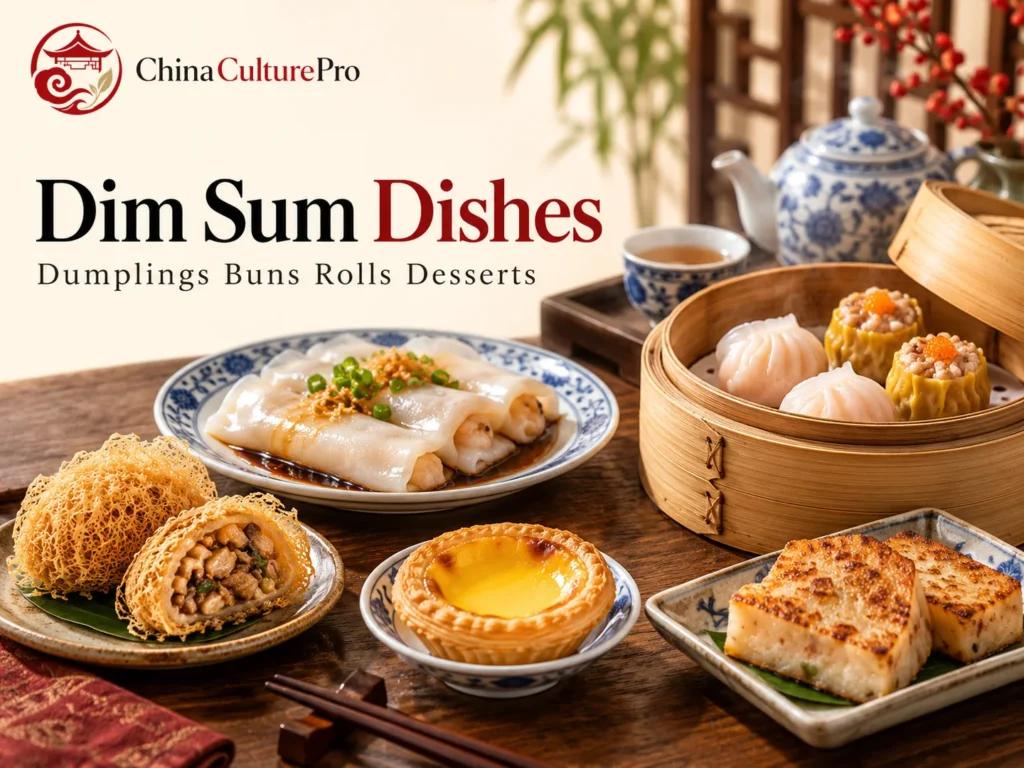
Dim sum(点心,diǎnxīn)covers small savory and sweet dishes, including dumplings, buns, rice rolls, cakes, meat dishes and desserts. A useful first menu is a mixture of food forms rather than a list of dishes that all look alike.[1]
- Wrappers: Translucent starch skins, wheat dough, rice sheets and pastry create different structures.
- Preparation: Steamed, pan-fried, deep-fried, baked and chilled dishes offer contrasting textures.
- Fillings: Pork, shrimp, chicken, vegetables, custard and sweet pastes are separate ingredient choices.
The dishes below are recognizable examples, not a ranking or a fixed set that every restaurant must serve.
On a dim sum menu, “cake” can mean a savory radish slice, a bun can contain either meat or custard, and a roll may use rice sheets rather than wheat dough. Learning those differences makes ordering easier. The dim sum overview explains the tea meal around this food-focused guide.
Read the Menu by Food Form
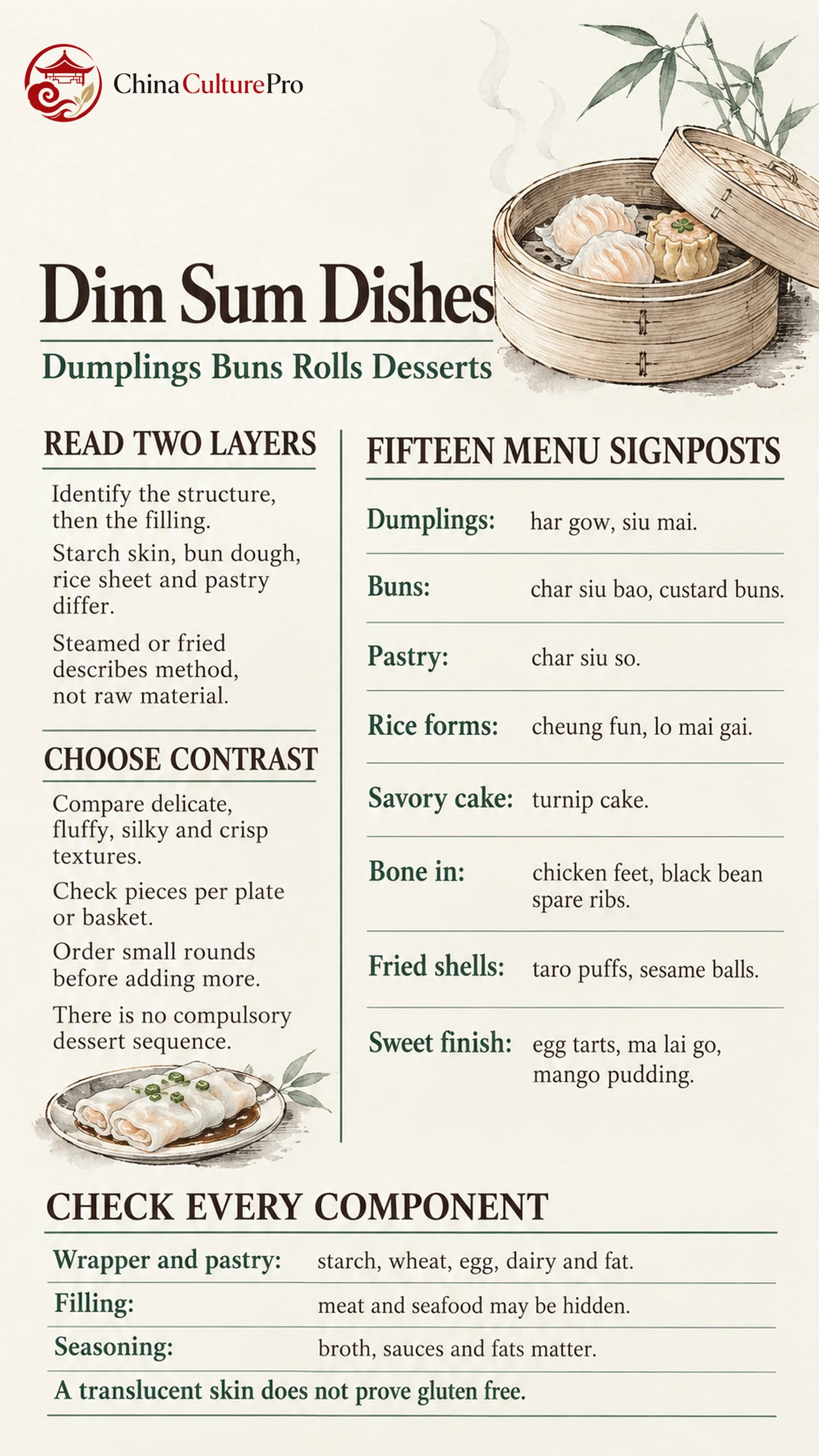
Read each name in two stages: first identify its structure, then its filling or seasoning. A steamed dumpling has a wrapper surrounding a compact filling; a bun uses a thicker dough; a rice roll is built from a sheet. Pastry puffs and custard tarts have another kind of exterior altogether.
Cooking method is a second axis. “Steamed” does not identify the wrapper’s raw material, and “fried” does not tell you whether the center is savory or sweet. A restaurant may also pan-fry something that was previously steamed, producing a crisp surface around a soft interior.
These distinctions sit within Cantonese cuisine, while the broader Chinese steamed-bun family extends beyond dim sum. A bun shape alone does not establish that an item belongs specifically to dim sum.
Fifteen Dim Sum Dishes at a Glance
Cantonese spellings are common on English menus. The characters and tone-marked pinyin below identify the corresponding Mandarin terms; they do not transcribe Cantonese pronunciation. Descriptions show common forms, with fillings and sauces varying by kitchen.
| Plat | Form and common ingredients | Texture or menu clue |
|---|---|---|
| Har gow(虾饺,xiājiǎo) | Steamed shrimp dumplings with a translucent starch wrapper | Supple skin and springy shrimp; wheat starch is used in many wrapper formulas.[2] |
| Siu mai(烧卖,shāomài) | Open-topped dumplings commonly combining pork, shrimp and mushroom | A compact filling visible above the thin wrapper. |
| Char siu bao(叉烧包,chāshāo bāo) | Buns with sweet-savory barbecue-pork filling | Steamed buns are fluffy; baked buns have a different surface and crumb.[3] |
| Custard buns(奶黄包,nǎihuáng bāo) | Soft buns enclosing a sweet custard filling | An ordinary custard bun need not have a flowing salted-egg center. |
| Char siu so(叉烧酥,chāshāo sū) | Flaky pastry around barbecue-pork filling | Layered, crisp pastry rather than bread-like bun dough. |
| Cheung fun(肠粉,chángfěn) | Rice-noodle sheets rolled or folded, often with shrimp, beef or pork | Slippery, soft sheets, commonly served with seasoned soy sauce. |
| Lo mai gai(糯米鸡,nuòmǐ jī) | Lotus-leaf sticky rice with chicken and mushrooms | Cohesive rice and savory filling; the wrapper is unwrapped rather than eaten. |
| Turnip cake(萝卜糕,luóbo gāo) | A savory Chinese-radish and rice-flour cake, sometimes with dried shrimp and sausage | Steamed slices may be pan-fried for browned edges around a soft center.[4] |
| Chicken feet(凤爪,fèngzhuǎ) | Seasoned, braised or steamed feet, often served with a savory sauce | Soft skin and connective tissue around small bones; “phoenix claws” is a menu name for the same ingredient. |
| Black-bean spare ribs(豉汁蒸排骨,chǐzhī zhēng páigǔ) | Small bone-in pork ribs steamed with fermented-black-bean seasoning | A savory meat dish rather than a filled dumpling.[5] |
| Taro puffs(芋角,yùjiǎo) | Fried taro-based shells around a savory filling | A fragile, lacy exterior; distinct from a sliced taro cake.[6] |
| Sesame balls(煎堆,jiānduī) | Fried glutinous-rice dough coated with sesame, often enclosing sweet paste | Crisp outside and chewy within; the filling is not always sesame paste.[7] |
| Egg tarts(蛋挞,dàntà) | Egg custard baked in a pastry shell | A soft filling with a crumbly or flaky exterior. |
| Ma lai go(马拉糕,mǎlā gāo) | Steamed sweet sponge cake | Airy cake crumb, not a yeast bun or a rice parcel. |
| Mango pudding(芒果布甸,mángguǒ bùdiàn) | A chilled, mango-flavored set dessert | Smooth and spoonable; check the actual dairy and setting ingredients.[8] |
Some dishes cross category boundaries: a sweet bun still uses bun dough, and a savory cake can have a crisp pan-fried surface. Fillings and seasonings still need to be checked for the version being served.
Build a First Order Around Contrasting Textures
Choose a few forms you want to compare rather than trying to tick off the whole table. A delicate dumpling, a soft bun and a rice roll provide three different exteriors. Add something crisp if the table wants another contrast, then choose a sweet item according to appetite.
Check how many pieces come in a basket or plate before ordering another portion. Buns and sticky rice can be substantial; bone-in dishes also differ from filled dumplings in how they are eaten. Ask whether quantities on an order sheet refer to dishes or individual pieces.
There is no compulsory savory-to-sweet tasting sequence. Order in manageable rounds and leave space for other diners’ choices. The dim sum etiquette guide covers shared plates and tea-table behavior without turning these food categories into strict rules.
Check Wrappers, Fillings and Seasonings
Check three components before ordering:
- Exterior: Ask about wheat flour, wheat starch, rice flour, egg, dairy and pastry fat as relevant. Translucency does not prove a wrapper is rice-only or suitable for a gluten-free diet.
- Interior: A shrimp dumpling may include pork ingredients; a radish cake can contain dried shrimp and sausage. A vegetable name does not describe everything in the mixture.
- Seasoning: Check broth powders, sauces and cooking fats, including those absorbed into the food before serving. Removing a visible meat piece does not remove the remaining seasoning.
These questions apply to sweet dishes too. Custards, pastry and set puddings may use egg, dairy or animal-derived ingredients, depending on the recipe. The Chinese vegetarian food guide explains how to discuss the whole dish. For an allergy, confirm the actual ingredients and preparation arrangements with staff rather than judging from a photograph.
FAQs About Dim Sum Dishes
Are har gow wrappers made from rice?
Not necessarily. Many use wheat starch blended with another starch. The translucent appearance is not evidence of a rice-only or gluten-free formula.
Is turnip cake a sweet cake?
The dim sum version is usually savory, based on Chinese radish and rice flour. Dried shrimp, sausage or other seasonings may be included.
Are chicken feet called phoenix claws?
Yes, “phoenix claws” is a familiar menu translation. The dish still contains chicken feet and small bones; the poetic name does not identify another meat.
Do all dim sum restaurants serve the same dishes?
No. Menus vary by kitchen, region and service style. This list helps identify common forms without promising that every item will be available.
Sources
[1] Hong Kong Tourism Board. 6 Must-Order Dim Sum for Beginners
[2] Sur La Table. Crystal Shrimp Dumplings
[3] Hong Kong Tourism Board / GreaterGo. The Four Heavenly Kings of Dim Sum
[4] Chung Sun Lau. Chinese Turnip Cake
[5] Ying Dim. Our Menu
[6] Ricky Chu / StarChefs. Taro Puff
[7] King Arthur Baking. Jian Dui: Fried Sesame Balls
[8] Centre for Food Safety. Nutrient Values of Chinese Dim Sum