


Quick Answer: How Does Wen Zhengming Fit So Much into a Narrow Scroll?
Contending Greenery among Thousands of Cliffs (千岩竞秀图, Qiān Yán Jìng Xiù Tú), by Wen Zhengming (文徵明, Wén Zhēng Míng), stacks rock faces, ledges, trees and falling water within an unusually slender landscape.
- Collection: National Palace Museum, Taipei; identifier 故畫000507.
- Medium and size: Ink and color on paper, 132.6 × 34 cm.
- Completion: 1550, after intermittent work begun in 1548.
- Look first: Compare the small figures low in the scene with the interlocking cliffs above.
The artist’s inscription makes the picture a record of repeated returns to work as well as a landscape.
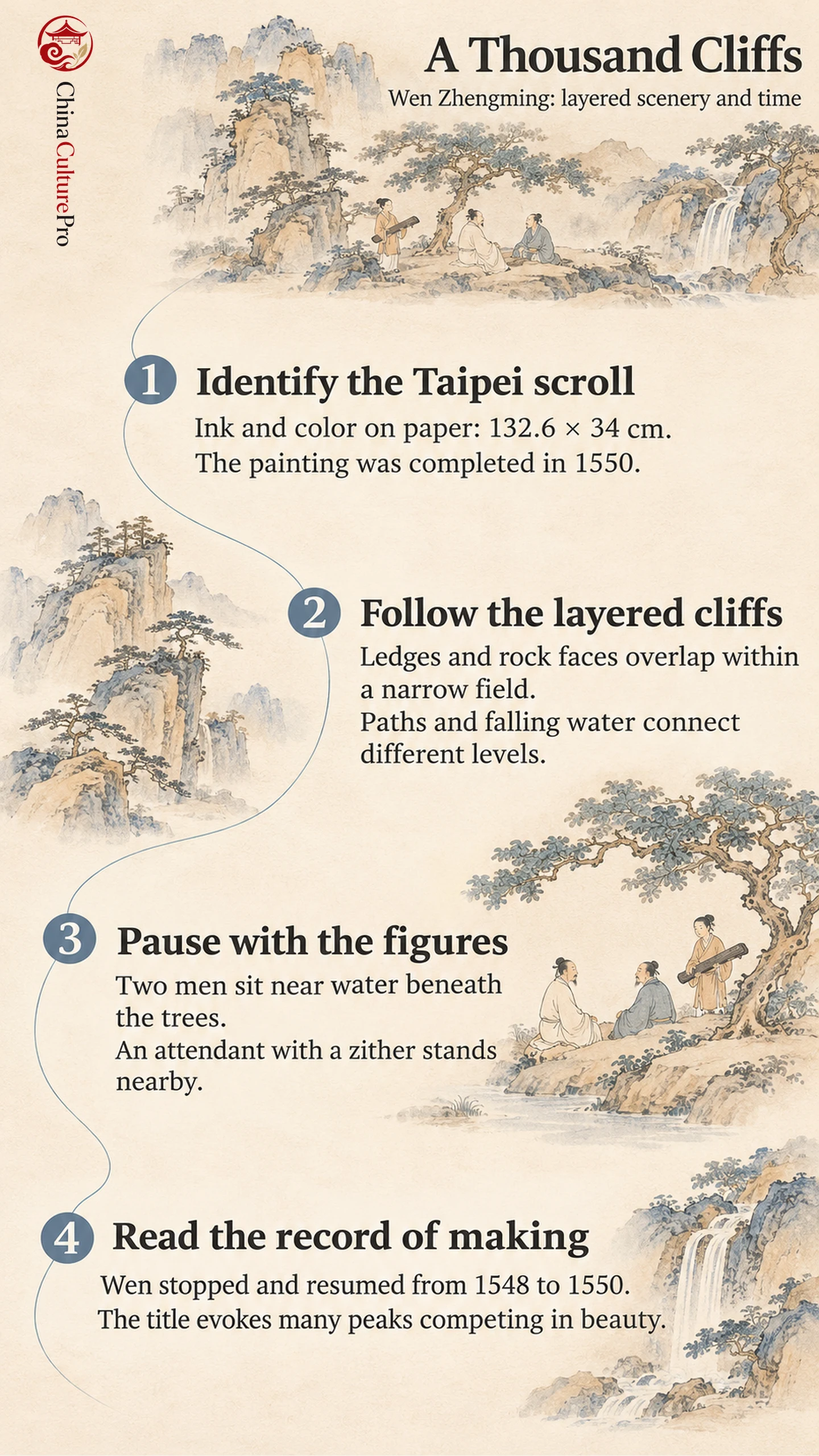
A tall tree rises near the lower right. Behind its canopy, a cascade descends between rock faces. Higher up, ledges and slopes overlap until the eye reaches the more open outline of the highest peak.
The lower water provides a pause within this crowded vertical field. Tiny seated figures occupy one edge of that opening, while trees and foreground rock keep the space enclosed.
Identify the Narrow Taipei Scroll
The collection record identifies a paper hanging scroll measuring 132.6 cm high by 34 cm wide, completed in 1550. Its cataloged English title is A Thousand Peaks Vying for Splendor. The identifier 故畫000507 helps distinguish this object from other works with similar titles. [1]
Its height is almost four times its width. That proportion matters: there is little room for a broad lateral panorama, yet the landscape contains many different levels and changes of direction.
The scroll-format guide explains the vertical format. Here, look at how the major tree trunks and the high peak occupy the same slender strip of paper while belonging to different depths.
Begin with the whole image before enlarging a figure or brush mark. A close detail may explain how something is drawn, but the full height is needed to see how one zone leads toward another.
Follow the Interlocking Cliffs
The Southern Branch’s account emphasizes stacked peaks, steep middle-ground walls, a descending stream and a winding path that contributes to an upward rhythm. It describes the colors as restrained and the brushwork as graceful. [4]
Start above the foreground trees, where an opening of falling water cuts into the more densely marked terrain. Follow its sides upward and compare the rock contours on either bank.
The direction changes repeatedly. A diagonal ledge can carry the eye sideways, while a cliff face rises above it and a small cluster of rounded rocks interrupts the next passage. The landscape does not depend on a single unbroken outline from bottom to top.
Compare a broad, lightly marked surface with a nearby edge containing many short, darker accents. Compare how clearly a contour can be followed in each area.
The landscape-painting guide develops these relationships between masses and openings. In this work, locate one open ledge within the upper half and compare it with the much denser terrain immediately beside it.
The techniques guide supplies vocabulary for texture and washes. Use it to compare particular surfaces here, rather than assuming that all the cliffs are made with one repeated mark.
Pause with the Figures and Water
The museum identifies two men seated by the water beneath the trees, with a young attendant carrying a qin zither (琴, Qín) nearby. These figures introduce quiet human activity within the much larger landscape. [4]
In the lower detail, find the figures before moving back to the whole scene. Their pale robes and small outlines differ from the dense foliage around them, but they remain far less prominent than the large tree trunks.
Compare the open area beside them with the tightly interlocked rock above. Look across the water toward an isolated stone, then back to a seated figure. Compare the space around each with the packed rock forms above.
The cascade adds movement nearby without requiring the people themselves to be traveling. Follow the narrow falling passage toward the water below, then compare its direction with the curves of an overhanging branch.
The foreground rocks partially interrupt the lower opening. Look at what remains visible around their edges. Even this relatively quiet space is framed and divided, rather than left as a large, featureless blank.
Compare each small figure with the trunk beside it and the cliff farther above. Their placement invites looking into the setting, without establishing the names of the men or the exact words they might be exchanging.
Read the Title and the Making Process
The title’s phrase has a literary history. The Ministry of Education’s idiom dictionary explains it as peaks and unusual rocks competing in beauty, citing A New Account of Tales of the World (世说新语, Shì Shuō Xīn Yǔ). It is paired there with a phrase about many valleys competing in flowing water. [3]
The chengyu guide introduces this kind of compact literary expression. Here, “thousands” suggests abundance; it is more useful to compare varied cliff forms than to count an exact inventory of peaks.
The heritage record draws attention to Wen’s inscription: he began on a sleepless winter night in 1548, initially completing only one tree, then repeatedly stopped and resumed before finishing in the third lunar month of 1550. The process spans three named calendar years, with interruptions explicitly part of the account. [2]
That record changes what completion means. The landscape’s many carefully joined passages were not presented by the artist as the result of one uninterrupted performance. His own words preserve the pauses as well as the eventual finish.
The collection also records an imperial inscription added in 1767. It belongs to the work’s later reception, distinct from Wen’s account of making it. [1]
The inscriptions-and-seals guide helps distinguish those contributions. Return afterward to the layered cliffs and the lower seated figures: the written evidence adds a history of making and viewing to their contrasting visual rhythms.
FAQs About Wen Zhengming’s Thousand Cliffs
Does the title mean there are exactly a thousand cliffs?
The phrase describes numerous peaks competing in beauty. It functions as a literary expression of abundance rather than a requirement to count exactly one thousand forms.
Did Wen work on it continuously for three years?
His inscription explicitly describes stopping and resuming between 1548 and 1550. It should not be paraphrased as three full years of continuous painting.
Who are the two seated men?
The cited museum descriptions identify them as seated figures or scholars but do not supply personal names. Their identities should not be invented from the scene alone.
Sources
[1] National Palace Museum. A Thousand Peaks Vying for Splendor: digital collection record
[2] Bureau of Cultural Heritage, via National Cultural Memory Bank. Wen Zhengming: A Thousand Peaks Vying for Splendor
[3] Ministry of Education. Dictionary of Chinese Idioms: Qian yan jing xiu
[4] National Palace Museum, Southern Branch. Wen Zhengming: A Thousand Peaks Vying for Splendor, selected work