
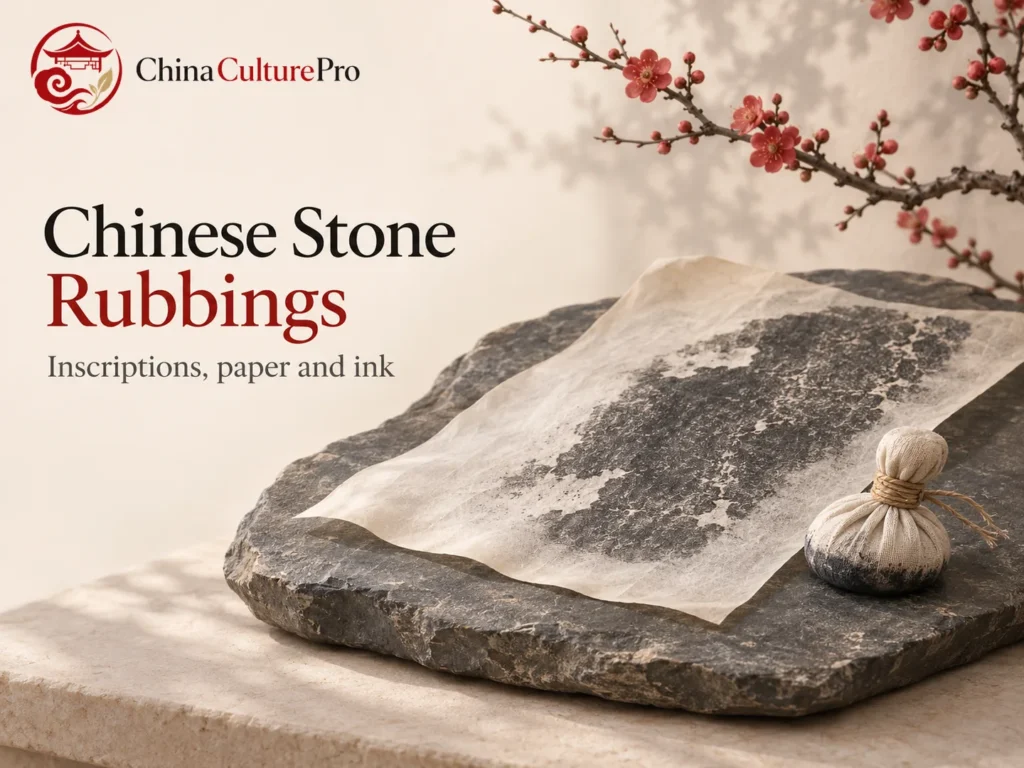

Quick Answer: What Is a Chinese Stone Rubbing?
A Chinese stone rubbing (拓片, tàpiàn) is an ink-on-paper impression made from a carved surface. On a typical rubbing of incised writing, the letters appear pale because the ink reaches the paper over the higher areas of the stone. The paper over the cuts stays lighter. [1][2]
- Surface: A rubbing can record carved writing, figures or other designs. [4][5]
- Copying: An existing monument can be the source, or older brush writing can be transferred to a new engraving for reproduction. [1][3]
- Dating: The inscription, the stone and the sheet can have different dates. [2][3]
Ask which surface the paper touched. A rubbing can preserve details later lost from a stone. Its value depends on which carving it records and when it was made. [1][2][3]
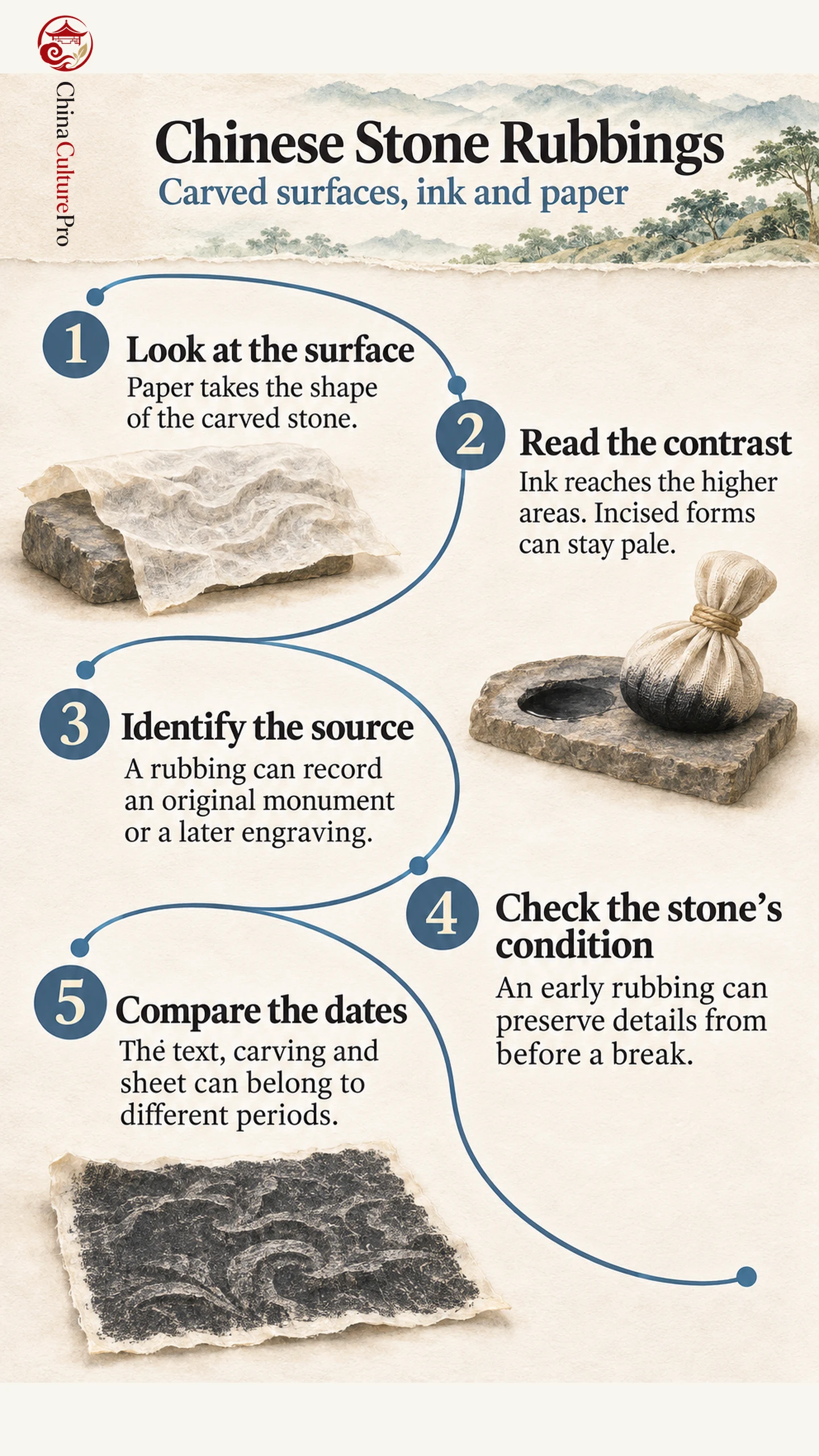
Pale writing on black paper can look like the inverse of a brush manuscript. It is also a record of how the paper met a surface. That material relationship explains both what a rubbing can preserve and why it can differ from the oldest version of the text.
Why the Letters Can Appear Pale on Dark Paper
In one documented technique, damp paper is pressed against the carved surface so it takes the shape of the recesses. Ink is then dabbed onto the paper over the raised areas. Where paper lies deeper in an incised line, it remains pale. The contrast is a result of where the ink touches the paper. It can make pale letters seem like white pigment even when they are simply the less inked parts of the sheet. [1]
This differs from a relief woodcut, where the raised block is inked and then transfers the image to paper. In an ink rubbing, the paper first conforms to the surface. The two methods use raised and recessed areas in different ways. [1][6]
How Rubbings Carry Texts and Images
A rubbing can record a monument directly. It can also reproduce a separate engraving prepared from older brush writing. In the Qing Hall of Three Rarities anthology, older calligraphic works were traced, transferred and carved for reproduction. One page transmits Dong Qichang’s copy of Eulogy for Ni Kuan. Dong’s added note says he followed an earlier version by the Tang calligrapher Chu Suiliang. A reader can encounter several stages of copying on one album page. [1]
The process also records images. Collections include paper impressions of carved figures and ornament from tombs and shrines. The cataloged rubbing of Wu-liang Temple is one example of the wider range of stone material that survives on paper. Some collections also include rubbings from bronze or ceramic objects. A flat impression can carry the outline of a relief from Chinese sculpture, while the carved object gives you its depth, scale and place in the original setting. [4][5]
Three Surviving Examples and Their Dates
| Exemple | Date of text or inscription | What the paper records |
|---|---|---|
| Cao Quan Stele (曹全碑, Cáo Quán Bēi) | 185 CE | An early Ming impression records the stone before it broke later in the dynasty. It is now mounted as an album. [2] |
| Sweet Wine Spring at Jiucheng Palace | 632 | One surviving rubbing comes from a 1656 re-engraving of the Tang model. [3] |
| Hall of Three Rarities anthology | Multiple texts and calligraphic models | The Qing compilation preserves impressions from newly carved versions of earlier writing. [1] |
In the Cao Quan example, an earlier impression can show details that a later crack might disrupt. Compare the Cao Quan forms with Chinese clerical script and the Jiucheng model with regular script. For the way impressions were collected and studied, see Chinese calligraphy copybooks. [1][2]
FAQs About Chinese Stone Rubbings
Is a Rubbing as Old as Its Inscription?
Often the surviving paper is later. Check the date of the original writing, whether the source stone was recarved, and when the paper impression was made. [2][3]
Are Rubbings Only for Calligraphy?
Rubbings can also preserve relief images, ornaments and inscriptions on objects such as bronzes or tiles. The paper records the shape of a surface. [4][5]
Is a Rubbing the Same as a Woodblock Print?
In a relief woodcut, ink is applied to the raised block before it reaches paper. In a typical ink rubbing, paper is formed against the carved surface and ink is dabbed onto the paper. [1][6]
Sources
[1] The Metropolitan Museum of Art. Model Calligraphies from the Hall of Three Rarities
[2] The Palace Museum. Early Ming Rubbing of the Eastern Han Cao Quan Stele
[3] National Palace Museum. Inscription on the Sweet Wine Spring at Jiucheng Palace
[4] University of Toronto, Cheng Yu Tung East Asian Library. Chinese Rubbings Collection
[5] Smithsonian National Museum of Asian Art. Rubbing of Wu-liang Temple
[6] The Metropolitan Museum of Art. Woodcut