


Quick Answer: Who Was Wang Xizhi?
Wang Xizhi (王羲之, Wáng Xīzhī) was an Eastern Jin writer, conventionally dated to about 303–361, whose brushwork became a model for later Chinese calligraphers. His best-known composition is the Orchid Pavilion Preface (兰亭序, Lántíng Xù), written for a gathering in 353. The surviving objects include copies and rubbings that preserve his texts and aspects of his manner of writing. [1][2][3][5]
- Preface: Its text introduces poems composed at a gathering near present-day Shaoxing. [2]
- Letters: On the Seventeenth Day (十七帖, Shíqī Tiè) preserves a selection of his correspondence in later impressions. [5]
- Transmission: Later copyists and engravers passed on models of his hand. [1][3][5][6]
A date in the fourth century can refer to the composition. The paper or impression you see may be from a later period. [1][3][5]
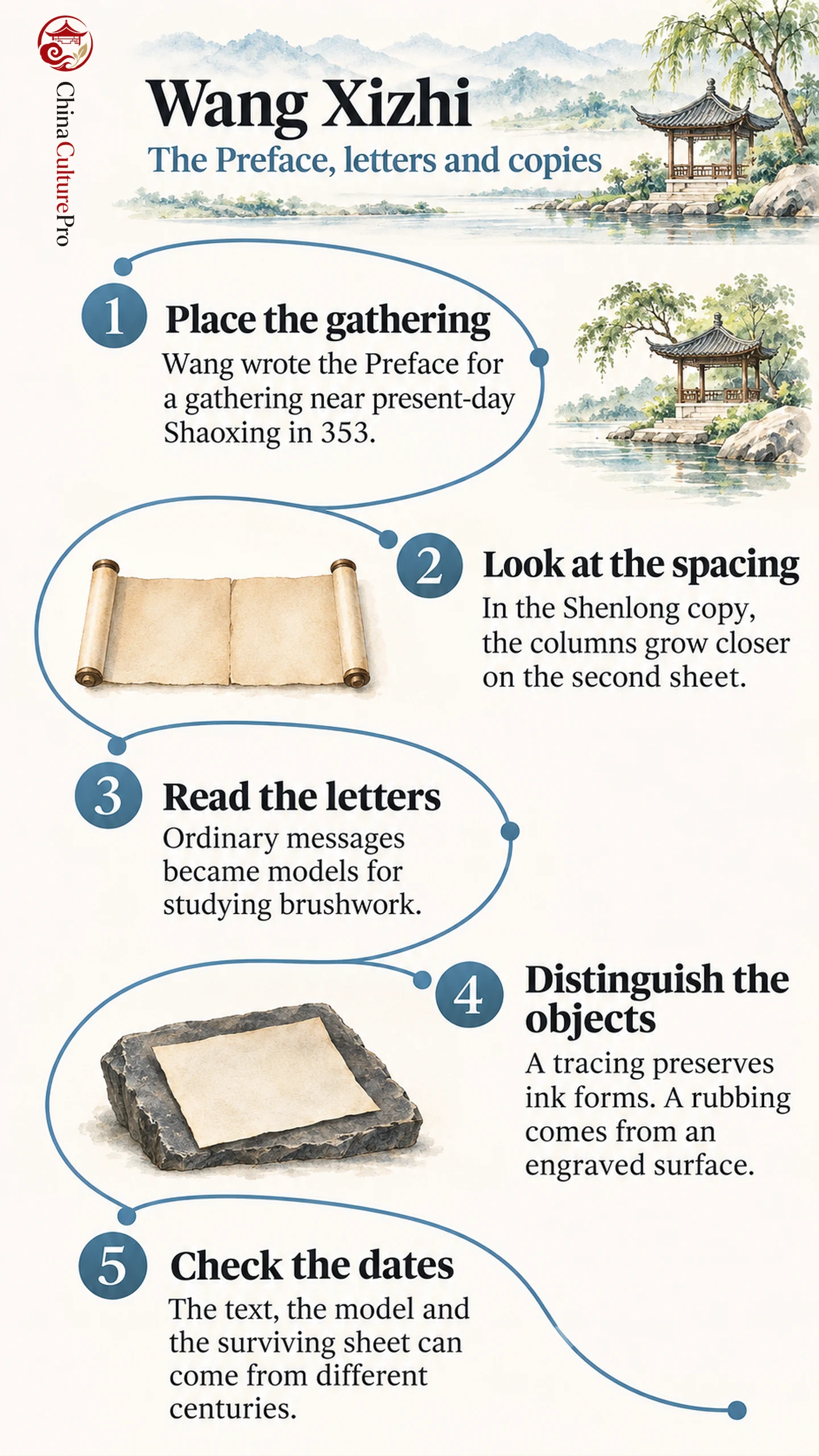
One of the most influential hands in Chinese calligraphy is known largely through other hands. A Tang copy and a later rubbing can each preserve something useful. Their physical features also tell you how Wang’s work came to be studied long after he wrote.
The Orchid Pavilion Gathering and Preface
On the third day of the third lunar month in 353, Wang and companions gathered at the Orchid Pavilion near Kuaiji, now Shaoxing in Zhejiang. The gathering took place on a customary spring purification day. The group composed poems, and Wang wrote the text that introduced them. [2][7] The text connects the gathering with thoughts about time and the lives of those taking part. Later artists also made paintings of the gathering, giving the event a visual history separate from the written text. [2]
The Tang paper copy commonly associated with Feng Chengsu (冯承素, Féng Chéngsù) is known as the Shenlong version after a small seal near its beginning. A Ming collector’s colophon links the copy to Feng. The attribution of the hand and the Shenlong name therefore come from different marks on the scroll. The 69.9-centimeter written field joins two pieces of paper, with thirteen columns on the first and fifteen on the second. The spaces are looser early on and become tighter on the second sheet. Look at how the running script (行书, xíngshū) keeps a readable structure while changing the pace and placement of individual marks. [3]
The Letters Behind the Famous Name
Some of the texts attributed to Wang began as everyday messages. One of the Three Passages asks after the recipient’s health. Another mentions sending three hundred oranges. It adds that frost has yet to arrive, a specific detail far removed from the ceremonial setting of the Preface. The words make it easier to see why a letter can be both an ordinary communication and a model for brush writing. [4]
The Tang compilation On the Seventeenth Day brings together twenty-nine letters. Its title comes from the opening words of the first. The writing includes draft cursive (章草, zhāngcǎo), with shortened marks and connections suited to informal writing. Compare these forms with the cursive script guide when a reproduction makes several marks appear to run together. [5]
How Wang Xizhi’s Writing Survived
The Tang court collected and copied works associated with Wang. Tracing could transmit shapes and details from an older ink model. A probable seventh-century tracing of the letter known as Ritual to Pray for Good Harvest is one surviving example. Such a copy is itself a historical ink object, even though its writing was transmitted from an earlier model. [1]
Another route led through carving and rubbing. Engraved versions could produce many paper impressions for circulation and study. A Qing rubbing of the Shenlong Preface version records a later stage in the history of a Tang copy of a fourth-century text. The process behind Chinese stone rubbings and the practice of studying calligraphy copybooks help explain how a model reached new readers. In 1964, Wang Yunwu made his own transcription, another example of the text’s continued life through writing. [5][6][7]
Three Works to Compare
| Work | Surviving form in this example | Éléments à observer |
|---|---|---|
| Orchid Pavilion Preface | Tang ink-on-paper copy traditionally associated with Feng Chengsu | Compare the spacing of the two groups of columns across the join. [3] |
| Three Passages: Ping’an, Heru, and Fengju | Handscroll of three short letter texts | Compare the recognizable forms of the greetings with the compact everyday message about oranges. [4] |
| On the Seventeenth Day | Thirteenth-century rubbing of fourth-century letter texts | Look for draft-cursive abbreviations and check the rubbing date separately from the date of the letters. [5] |
FAQs About Wang Xizhi
Does the Original Orchid Pavilion Preface Survive?
No surviving autograph is securely identified. Copies, including the Shenlong version, are important evidence for the transmitted layout and brush forms. [1][3][6]
Why Is Wang Xizhi Called the Sage of Calligraphy?
The title reflects his status in Chinese calligraphic tradition. Later collectors, copyists and the Tang court helped establish his writing as a model for study. [1][5]
Did Wang Xizhi Only Write in Running Script?
The Preface is associated with running script. The letters in On the Seventeenth Day show abbreviated draft-cursive forms. Both are ways his writing reached later readers. [3][5]
Sources
[1] The Metropolitan Museum of Art. The Embodied Image
[2] Smithsonian National Museum of Asian Art. Gathering at the Orchid Pavilion
[3] The Palace Museum. Feng Chengsu’s Copy of the Orchid Pavilion Preface
[4] National Palace Museum. Three Passages: Ping’an, Heru, and Fengju
[5] The Metropolitan Museum of Art. On the Seventeenth Day
[6] The Palace Museum. Qing Rubbing of Feng Chengsu’s Orchid Pavilion Copy
[7] The Metropolitan Museum of Art. Wang Yunwu: Preface to the Orchid Pavilion Gathering