


Quick Answer: How Does Chinese Rhetorical Parallelism Work?
Chinese rhetorical parallelism relates phrases or clauses through corresponding structure. The reader compares not only their appearance but also their grammatical roles and connected meanings.
- Structure: Corresponding positions can contain matching kinds of words.
- Meaning: Clauses may reinforce, contrast or develop an idea.
- Form: A strict poetic pair can add character-count and tonal requirements.
- Reading: Symmetry is a clue to interpretation, not permission to ignore the actual words.
This guide introduces structural reading rather than a complete set of composition rules.
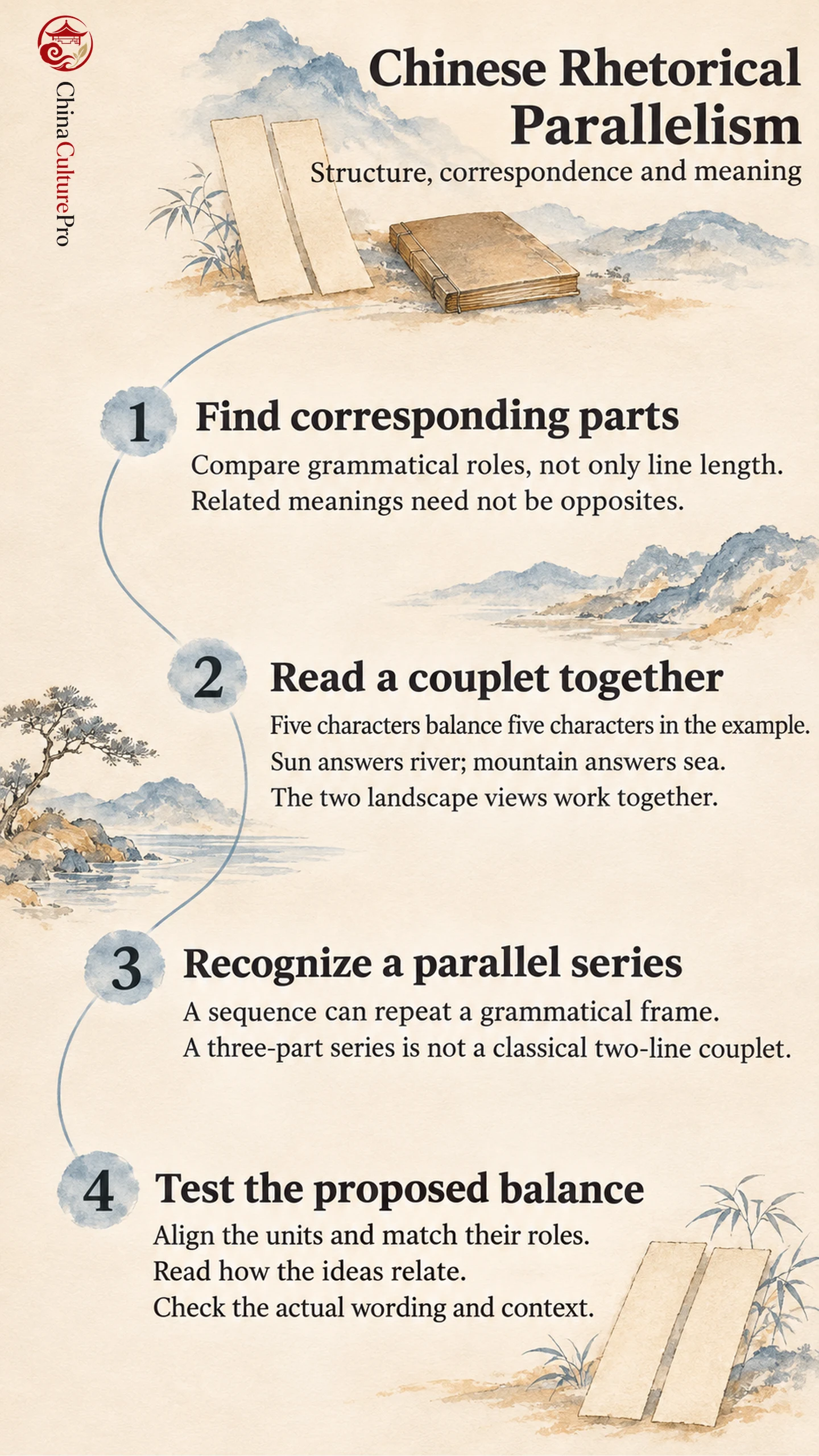
Two Chinese lines can look balanced before their meaning is fully clear. That visual impression gives you a useful question: which parts answer one another? Compare the grammar, then check how the ideas relate.
Identify the Corresponding Parts
Paired parallelism (对偶, duì ǒu) brings two related units into balance. A noun phrase may answer a noun phrase, or an action may answer an action. In stricter descriptions, equal character counts, similar syntax and contrasting tonal patterns are important formal features. [1][5]
Begin with correspondences instead of looking only for opposite meanings. Two lines can describe related views or develop connected thoughts. Their structural relationship does not automatically require a good–bad, day–night or other semantic opposition.
In literary reading, balanced phrasing can suggest how a difficult expression is organized. It remains necessary to test that suggestion against the actual sentence: apparently corresponding positions do not always have identical functions. [2]
Read One Classical Couplet Closely
The opening lines of Wang Zhihuan’s On the Stork Tower provide a compact example from Tang poetry. The Chinese text is ancient; the plain English renderings below explain the scene rather than imitate the original metre. [1]
| Chinese line and reference reading | Plain English sense |
|---|---|
| 白日依山尽, bái rì yī shān jìn | The sun disappears behind the mountains. |
| 黄河入海流, huáng hé rù hǎi liú | The Yellow River flows into the sea. |
Each line has five characters. The sun and Yellow River occupy corresponding noun positions; mountain and sea also correspond. The actions complete two linked views of a broad landscape. The balance joins equal length with corresponding grammatical roles. [1]
Reading the lines together adds something that a list of individual dictionary meanings cannot supply: you see a coordinated scene rather than two disconnected observations.
Distinguish Paired Balance from a Parallel Series
Serial parallelism (排比, pái bǐ in mainland Mandarin) uses a succession of related, similarly structured units. The cited Taiwan dictionary describes three or more and records the regional reading páibì. The spelling difference in pronunciation does not change the structural distinction being discussed. [3][4]
A simple English practice series is “Read the words; follow the structure; test the meaning.” Its three verb-led phrases show repetition of a grammatical frame. They do not form a two-line classical couplet or satisfy a Chinese tonal pattern merely because their syntax resembles one another.
The separate parallel-couplet guide addresses paired composition; regulated verse adds its own formal setting. Neither should be treated as a synonym for every instance of parallel wording.
Use Structure as a Reading Aid Rather Than Proof
Apparent balance can create false parallelism: a reader may force the same grammatical analysis onto both halves even when the wording does not support it. [2]
- Align the units: Put the corresponding phrases or clauses beside one another.
- Match the roles: Compare subjects, actions, objects and modifiers in their positions.
- Read the relationship: Decide whether the clauses reinforce, contrast or develop an idea.
- Check the actual wording: Test the proposed match against grammar and context instead of forcing symmetry.
If the analysis leaves one word unexplained, return to the sentence. The Classical Chinese grammar guide helps with that check. Word-level reduplication is a different phenomenon: repeating a form does not by itself establish parallel clauses.
FAQs About Chinese Rhetorical Parallelism
Must parallel clauses express opposite meanings?
No. Structural correspondence can connect related or developing ideas as well as contrasts. Examine how the two meanings actually relate.
Does equal character count prove a pair is parallel?
No. Compare the grammatical roles and meanings too. A balanced appearance can suggest a reading that the actual sentence does not support. [2]
Can an English translation preserve every feature?
A translation may convey the scene while changing character count, rhythm and tonal relationships. Compare it with the original when studying the formal structure.
Sources
[1] Ministry of Education, Taiwan. Concise Mandarin Dictionary: 對偶
[2] Robert Eno, Indiana University. Introduction to Literary Chinese, Lesson5
[3] Ministry of Education, Taiwan. Revised Mandarin Dictionary: 排比
[4] Chinese Text Project. Dictionary: 排比
[5] Taipei Chinese Language Subject Centre. Rhetoric: 對偶