

Quick Answer: What Is Wenzhounese?
Wenzhounese(溫州話,Wēnzhōuhuà)is a Chinese language variety traditionally classified within Wu(吳語,Wúyǔ). It is associated with Wenzhou in southeastern Zhejiang, rather than being a local pronunciation of Standard Mandarin.[1][2]
- Sounds: Descriptions commonly distinguish eight lexical tones, with changes when syllables combine.[3]
- Writing: Characters, phonetic transcription and Mandarin translations supply different kinds of information.
- Learning: Local recordings and complete expressions are more useful than an unlabelled list of approximations.
Keep the speaker’s locality and the resource’s notation together. “Wenzhou” does not make every recording an identical model.
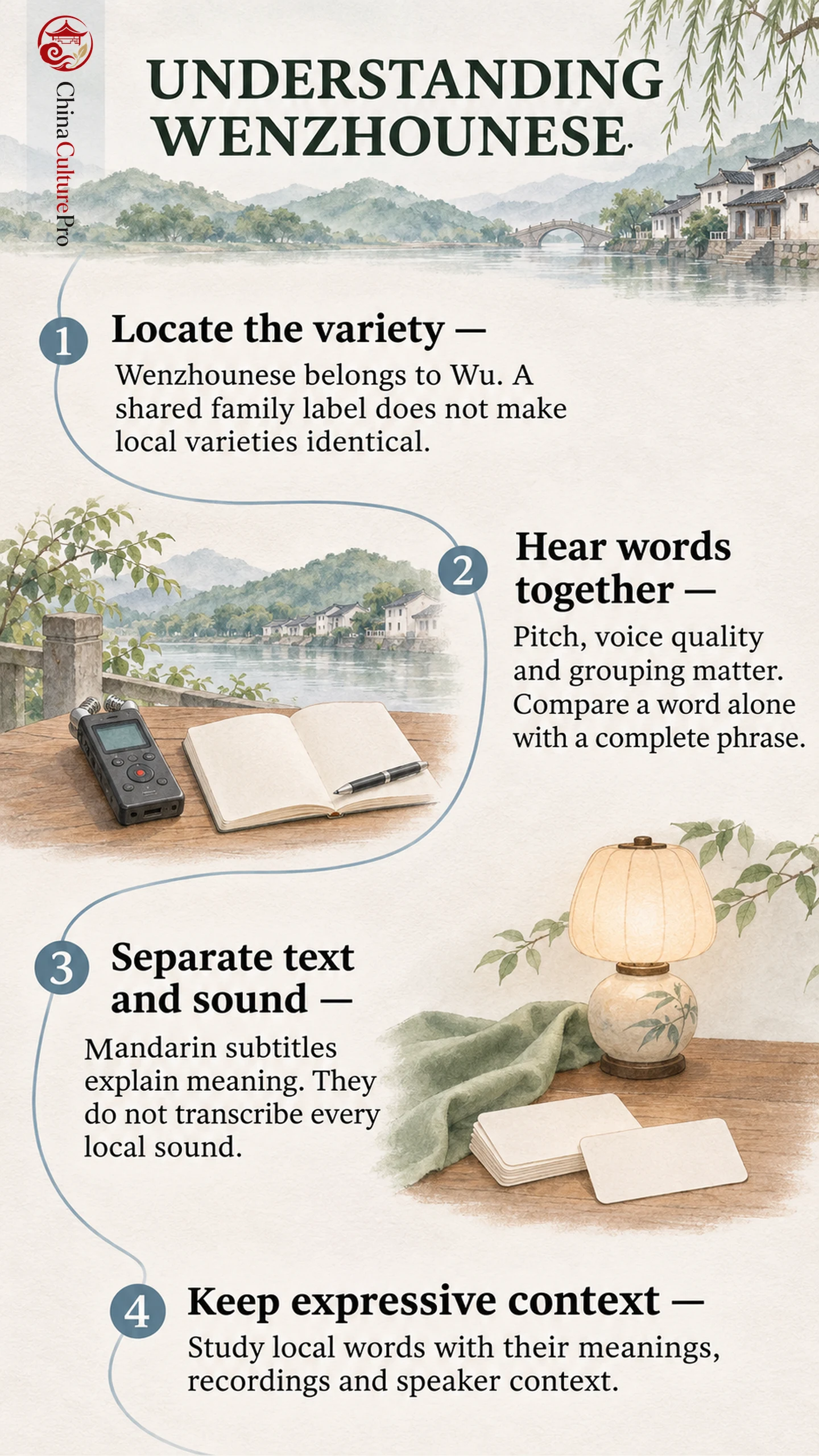
A video can show familiar Chinese subtitles while its Wenzhounese speech remains hard to follow. The gap involves more than an unfamiliar accent: the words, sound system and phrasing deserve separate attention. A useful introduction starts with those differences and connects them to real examples, rather than treating the language as a puzzle nobody can learn.
Language, Place and the Meaning of Wu
Wu is a grouping of related Chinese varieties, not a promise that every speaker understands every other member. Glottolog describes Wenzhou as traditionally counted within Wu but gives it a separate entry, citing its divergence from Suzhou.[1] The catalogue’s choice illustrates how a broad family label and a narrower language entry can coexist.
Shanghainese is also a Wu variety, but it is not a pronunciation template for Wenzhounese. Research on Wenzhou rhythm explicitly contrasts the two.[3] If a lesson teaches Shanghai speech, do not assume its connected-speech patterns apply unchanged to Wenzhou. The Shanghainese and Mandarin comparison provides a separate introduction to that variety.
The word “dialect” can appear in dictionaries and research titles without meaning a small deviation from Standard Mandarin. Our Chinese languages and dialects guide explains this terminology. Here, “Wenzhounese” identifies the local language under discussion; a useful resource should also identify the locality and speakers represented.
Tones, Voice Quality and Connected Speech
Eight lexical tones describe categories of word pronunciation. Chen Xie’s study of Wenzhounese rhythm distinguishes the underlying tones from their realization when syllables are grouped, and argues that the final syllable has a prominent role.[3]
Voice quality matters alongside pitch. Weijun Zhang and Peggy Mok’s 2024 perception study examines contrasts involving onset consonants, pitch and vowel phonation, including breathiness. They report generational differences in perceptual cues, with the pattern also depending on onset type.[4] A pitch curve alone therefore cannot represent every cue a listener uses. Nor should a letter labelled “voiced” automatically be read exactly like English b, d or g.
Tone sandhi is the systematic adjustment of tones in context. Wenzhou research distinguishes complex word-level patterns from a simpler phrase-level pattern; “right-dominant” is a broad description, not a complete pronunciation recipe.[5] For background terminology, see Chinese tones.
A 2025 experiment tested twelve middle-aged native speakers using pictures. They applied lexical sandhi to nearly all real words and most combinations of existing morphemes, but performed less consistently when an invented, phonotactically problematic syllable was introduced.[5] A familiar word and an arbitrary syllable sequence present different tasks. The experiment does not establish a universal rule from twelve people.
Learn a short word in an ordinary phrase, then compare its isolated reading. Keep both forms labelled. A difference between them can be part of the system, rather than a speaker failing to follow the dictionary.
Characters, Sound Transcription and Mandarin Subtitles
Characters and sound recordings answer different questions. The 2007 Wenzhou Spoken Corpus combined characters with IPA for colloquial forms that were not conventionally represented by characters. Its authors also acknowledged that the collection was not ideally balanced or representative.[6] Written transcription is a considered representation of speech, not a guarantee that one notation captures every speaker.
A concrete example appears in Gao, Tamura and Kato’s 2025 paper. Their Figure 1 prints 温州皮鞋全国有名 for both Wenzhounese and Mandarin, while giving different pronunciations. The sentence means “Wenzhou leather shoes are well known throughout the country.”[7] Here it illustrates the relationship between writing and sound; knowing the characters does not supply the local reading.
The same project assembled 8,068 audio samples, approximately eighteen hours, from local news videos and paired them with Mandarin text.[7] That output represents Mandarin wording corresponding to Wenzhounese speech. It is a translation-oriented resource, rather than a phonetic record of every sound.
When studying a subtitled clip, distinguish three jobs: the subtitle tells you meaning, a local transcription identifies the spoken words, and a pronunciation key explains its symbols. If only the first is available, use it for comprehension while finding another source for pronunciation. Standard Mandarin pinyin beside terms in this article likewise identifies their Mandarin readings.
Expressive Words and Ways to Study Local Speech
Wenzhounese also has expressive words that evoke sensory scenes. Joseph Daley’s 2023 honours thesis investigates these ideophones using dictionary material and data supplied by three native speakers. Its final database contains sixty items.[8]
Three examples in its appendix show their range:
- 暗洞洞: evokes dim light.
- 光闪闪: evokes flashing light.
- 暖芬芬: evokes a feeling of warmth.
These are examples of meaning and written representation, not an invitation to pronounce the characters with Mandarin readings. Daley also rejected some candidate expressions from the database because they failed his criteria.[8] Repetition alone does not make every descriptive word an ideophone.
Dictionaries can connect written examples with sound. A municipal report on the Wenzhou Dialect Dictionary’s September 2021 launch described IPA or homophone-based pronunciation information, example phrases and an accompanying audio service.[2] That is a dated description of the publication, not a promise that every digital access route still works today.
Choose a small, useful expression and keep its source. Record the locality, meaning, transcription system and whether the example is isolated or spoken in a phrase. If a family member uses another form, preserve that version too. Comparing labelled examples helps you learn the language’s variation without turning an unfamiliar voice into a mistake.
FAQs About Wenzhounese
Is Wenzhounese a form of Mandarin?
No. It is traditionally classified within Wu, with its own vocabulary and sound patterns.
Is Wenzhounese the same as Shanghainese?
No. Both belong to Wu, but their pronunciation and connected-speech patterns differ.
Does Wenzhounese have eight tones?
Eight lexical tones are a common description. Their spoken realization also depends on grouping and context.
Can Mandarin subtitles teach Wenzhounese pronunciation?
They can help with meaning. Local sound transcription and recordings are needed to study the pronunciation itself.
Sources
[1] Glottolog 5.3. Wenzhou
[2] Information Office of Wenzhou Municipal People’s Government. Wenzhou Dialect Dictionary Launch Report, October 2021
[3] Chen Xie. Tones and Iambic Stress in Wenzhounese
[4] Weijun Zhang and Peggy Pik Ki Mok. Asymmetries of Onset Manner of Articulation in the Perception of Tone Register Contrast in Wenzhou Wu Chinese
[5] Weijun Zhang, Huangyang Xie and Peggy Pik Ki Mok. The Productivity of the Lexical Tone Sandhi in Wenzhou Wu Chinese
[6] John Newman, Jingxia Lin, Terry Butler and Eric Zhang. The Wenzhou Spoken Corpus
[7] Zhipeng Gao, Akihiro Tamura and Tsuneo Kato. Wenzhou Dialect Speech to Mandarin Text Conversion
[8] Joseph Daley, Australian National University. Wenzhounese Ideophones: Phonosemantic Mapping, Marking and Semantic Domains