

Quick Answer: Where Should You Start with Classical Chinese Grammar?
Begin with word order, phrase boundaries and context. Literary Chinese (文言文, wén yán wén) is a long written tradition; its classical models provide a starting point, not a claim that every later text uses identical grammar. [3]
- Order: Identify how words and phrases relate.
- Reference: Check who or what an action concerns.
- Omission: Distinguish written information from what you supply.
- Construction: Recognize patterns rather than translating each character separately.
The examples use modern Mandarin reference readings. They do not reconstruct the original sounds of an ancient text.
Opening an old passage with a modern dictionary can produce a puzzling list of words. The next step is to work out the sentence: which expression describes another, what is being stated, and how each clause relates to the scene. Start with a few grammatical questions before choosing an English translation.
Start with Word Order and Phrase Boundaries
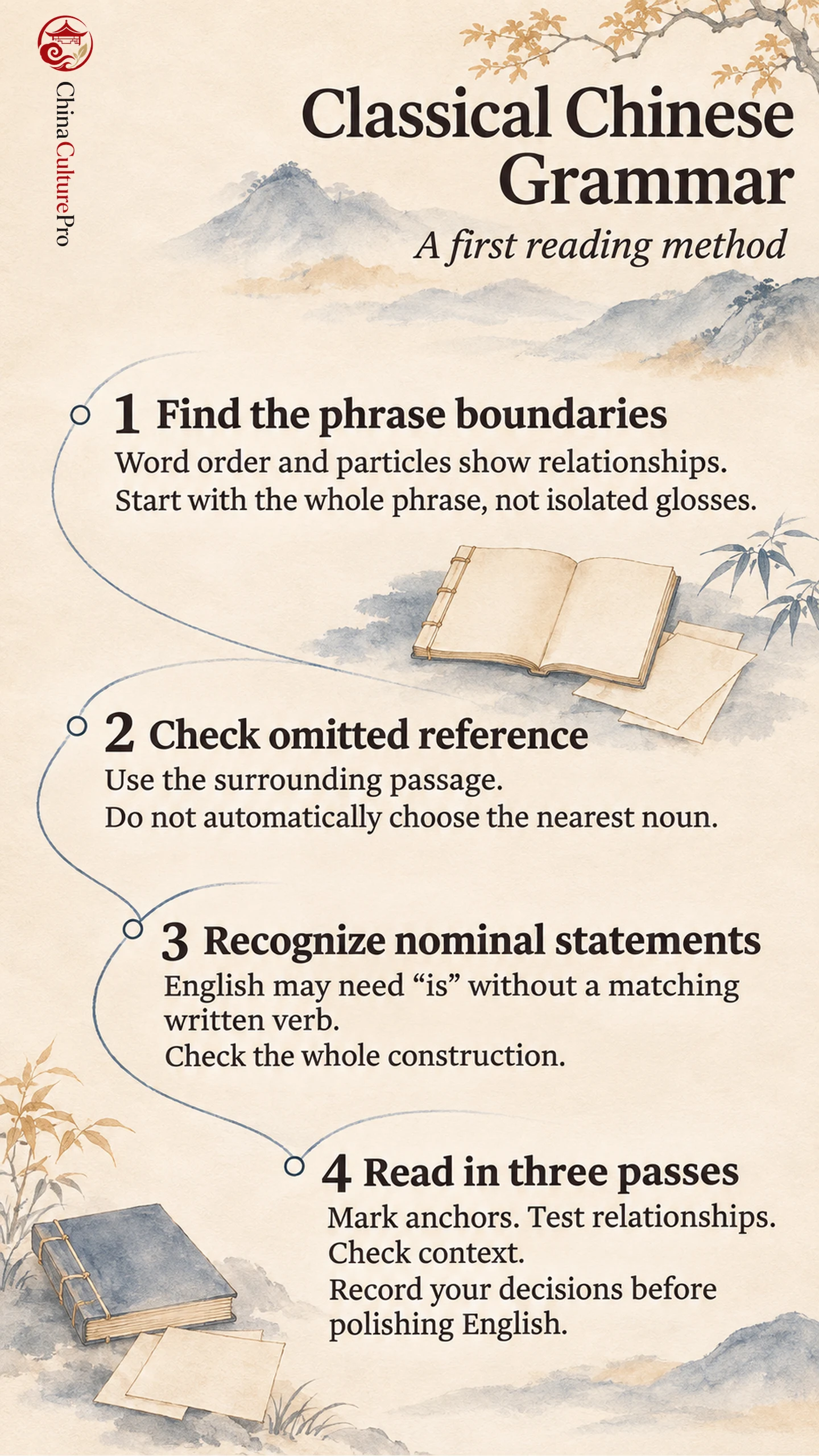
Word order and particles carry important grammatical information. Subject–verb–object is a useful starting pattern, while modifiers generally precede what they modify. Actual sentences can contain topics, time expressions and other structures, so this is not a rule that every clause has three visible pieces. [1]
Take the original practice sentence 王愛民, wáng ài mín: the ruler cares for the people. Read 王 as the subject, 愛 as the verb and 民 as its object. Rearranging the same characters would change the proposed relationships; familiarity with their dictionary meanings is not enough. [1]
First mark whole phrases. If a description belongs to a noun, keep it with that noun before deciding how the larger clause works. The function-words guide develops the small grammatical forms that help identify those boundaries.
Recover Omitted Information Carefully
A subject or object may be omitted when the context makes it recoverable. The understood participant can also change between clauses; the nearest preceding noun is not a reliable automatic answer. [2]
For an original exercise, consider 王至,問之, wáng zhì, wèn zhī: the ruler arrives; [someone] questions him, her or it. The fragment alone leaves more than one reference question open. A larger scene might establish the ruler as the questioner or the person questioned. Do not force that decision from the short fragment alone.
Use square brackets in a draft translation for supplied material. Then note why you supplied it: a named speaker, a continuing action or a clear referent in the surrounding text. This is a working habit for making your interpretation reviewable, not a claim that every edition must print brackets.
The historical pronouns guide helps with explicit forms. Omitted reference needs the passage as well as the vocabulary list.
Recognize a Nominal Statement
Some sentences identify or classify something through adjacent noun expressions, often with final 也, yě. An English translation can need “is” even though the Chinese construction has no corresponding written copular verb. [3]
An original miniature model is 王,君也, wáng, jūn yě: the king is a ruler. The point is the relationship between the noun expressions. Do not insert modern 是, shì, into the source merely because English needs a verb. [3]
Keep this pattern distinct from a sentence reporting an action. A final particle helps you investigate the structure, but it is not a substitute for reading the entire clause. For the written units themselves, consult the Chinese characters guide.
Make a First Reading in Three Passes
Use this short routine on a manageable passage with an annotated edition available. Record the structural decisions first; polish the English after checking them.
- Mark the visible anchors: Identify named people, key nouns, explicit pronouns and sentence-final particles. Keep the edition’s punctuation visible while you make a provisional clause division.
- Test the grammatical relationships: Identify the predicate and its associated phrases. Check modifiers and pronoun reference; mark anything you supply in square brackets rather than silently adding it.
- Compare the reading with the passage: Read the neighboring clauses again. Check an annotated edition for the disputed construction, then write a fluent translation that preserves any material uncertainty.
Parallel phrasing can offer another comparison point; the rhetorical parallelism guide explains that reading aid. Similar-looking clauses still need individual checking.
FAQs About Classical Chinese Grammar Basics
Does Classical Chinese have grammar?
Yes. The absence of English-style verb endings does not remove grammatical relationships. Word order, particles and context still matter.
Is every character a complete word on its own?
No. Do not assume every neighboring pair forms a modern word, or that every unit must be interpreted in isolation. Check the expression in its passage. [2]
Is the Pinyin here ancient pronunciation?
No. It gives modern Mandarin reference readings so readers can identify the examples.
Sources
[1] Stanford University, Chinese Texts. Classical Chinese: Introductory grammar
[2] Andrew Schonebaum and contributors. Introduction to Classical Chinese: Introductory observations and lessons
[3] Robert Eno, Indiana University. Introduction to Literary Chinese, Part I: Lesson1 grammar