


Quick Answer: What Does Chinese Reduplication Do?
Reduplication (重叠, chóng dié) repeats all or part of a linguistic form. In Chinese, its effect depends on the word and grammatical construction, rather than one universal meaning of “more.”
- Verbs: Repetition can suggest a brief action, a trial or a softer invitation.
- Adjectives: Certain repeated forms give a vivid description of a state.
- Distribution: Some expressions refer to every member of a group.
- Limits: Matching letters in an AA or AABB pattern does not make every word eligible.
The examples below illustrate selected Mandarin patterns and their distinct reading jobs.
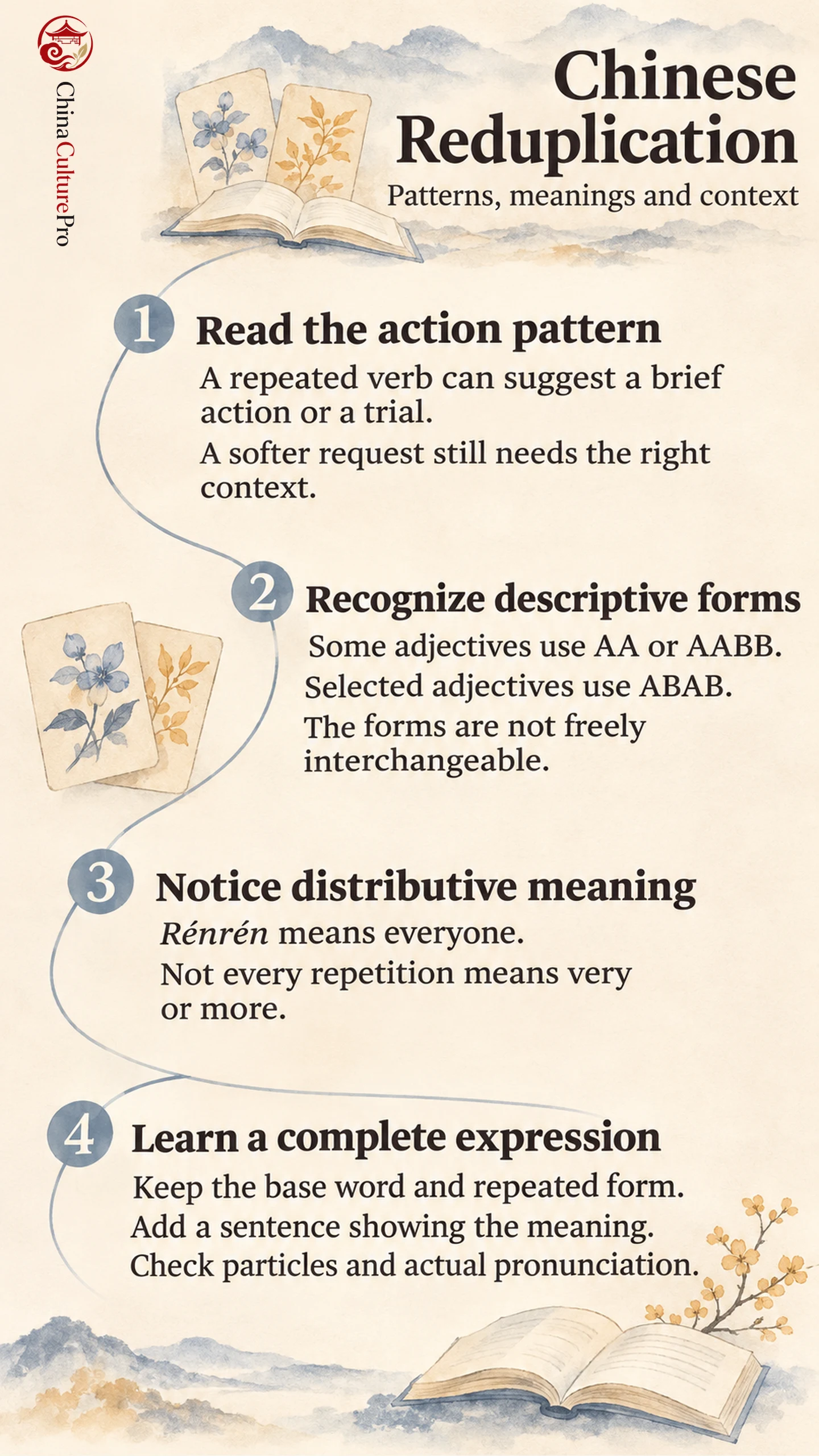
A repeated character is easy to notice. Interpreting it requires a second step: identify what kind of word it forms and what the sentence asks it to do. The same visible repetition can support a short action, a descriptive state or a reference to everyone.
Read Verb Repetition as an Action Pattern
With a one-syllable verb, the AA pattern can describe doing something briefly or trying it: 看看, kànkan, means have a look in a suitable context. The repeated portion is commonly light in pronunciation. Its meaning concerns a brief or trial action, rather than a fixed count of two looks. [1]
Two-syllable verbs can use ABAB: 考虑考虑, kǎolǜkaolü, means consider it a little. One-syllable verbs also allow patterns such as 看一看, kàn yi kàn, and a completed-action form such as 想了想, xiǎng le xiang. Their internal pieces belong to a grammatical construction, not random repetition. [1]
The softer effect can be useful in a request, but relationship, wording and situation still matter. Do not treat a repeated verb as a guarantee that an instruction will sound considerate. The apologies and politeness guide addresses that broader social task.
Recognize Descriptive Adjective Patterns
Adjective reduplication can present a state vividly. Different adjective types support different shapes; an ABAB form is not automatically interchangeable with an AABB form. [2]
| Schéma | Example with reference reading | Descriptive role |
|---|---|---|
| AA | 高高的, gāogāo de | tall; standing high in the described scene |
| AABB | 高高兴兴, gāogāoxìngxìng | in a cheerful manner or state |
| ABAB | 雪白雪白, xuěbáixuěbái | vividly snow-white |
The table uses reference-tone pinyin for recognizing the forms. Connected pronunciation may be lighter or otherwise adjusted; learn it with a suitable recording. The particle 的, de, commonly accompanies descriptive adjective forms in relevant sentence positions. Do not add it mechanically to every repeated expression. [2]
Notice how the adjective’s job differs from the verb’s. A vivid state is not the same semantic effect as doing an action briefly. Read the construction rather than assigning “a little” or “very” to repetition everywhere.
Distinguish Distributive Meaning from More Intensity
人人, rénrén, means everyone or every person. Its interpretation distributes the reference across people; it does not mean “very person” or simply two people. This useful lexical example demonstrates why repetition needs its own whole-expression meaning. [3]
Keep it in a vocabulary note as a complete form. Recognition does not establish that any noun can be doubled to make an equivalent distributive expression. If you want to create a new phrase, check an attested construction rather than extend one example by analogy.
Learn the Pattern Together with the Whole Expression
Research on verbal reduplication treats it as a grammatical construction with structural and contextual conditions. A beginner’s AA or ABAB label is useful for recognition, but it is not a full account of which words and sentence types work together. [4]
A practical note needs three items: the original word, its repeated form, and one sentence showing the intended meaning. Label the intended job: brief action, description or distribution. Then check pronunciation and any particle attached to the form.
Use pinyin alongside the actual Chinese characters. Repeated grammatical forms are also distinct from rhetorical parallelism, which concerns the relationship between larger phrases or clauses.
FAQs About Chinese Reduplication
Does every repeated form mean very?
No. A brief action, a descriptive state and “everyone” represent different jobs. Identify the whole expression before assigning an English meaning.
Are AABB and ABAB interchangeable?
No. They describe different structures, and a particular adjective must be learned with an accepted form and use. Letter patterns are not a free word-building recipe. [2]
Should every repeated syllable keep the same spoken tone?
No. The repeated portion of a verb construction is commonly pronounced lightly. Check whole-word audio instead of copying a base tone onto every spoken syllable. [1]
Sources
[1] Tokyo University of Foreign Studies. Verb reduplication
[2] Tokyo University of Foreign Studies. Adjective reduplication
[3] Ministry of Education, Taiwan. Concise Mandarin Dictionary: 人人
[4] Journal of Linguistics, Cambridge University Press. Deliminative verbal reduplication in Mandarin Chinese