


Quick Answer: What Are Sweet Water Noodles?
Tian Shui Mian (甜水面, tián shuǐ miàn), or sweet water noodles, are a Chengdu snack of thick wheat noodles dressed with a sweet, savoury and spicy sauce.[2][4]
- The noodles are substantial and chewy, rather than thin and delicate.
- Sweetness comes chiefly from concentrated, seasoned soy sauce.
- Chili oil and aromatic seasonings give the bowl more than a sugary flavour.[2][3][4]
Despite the name, this is a dressed noodle dish, not a dessert soup.[3]
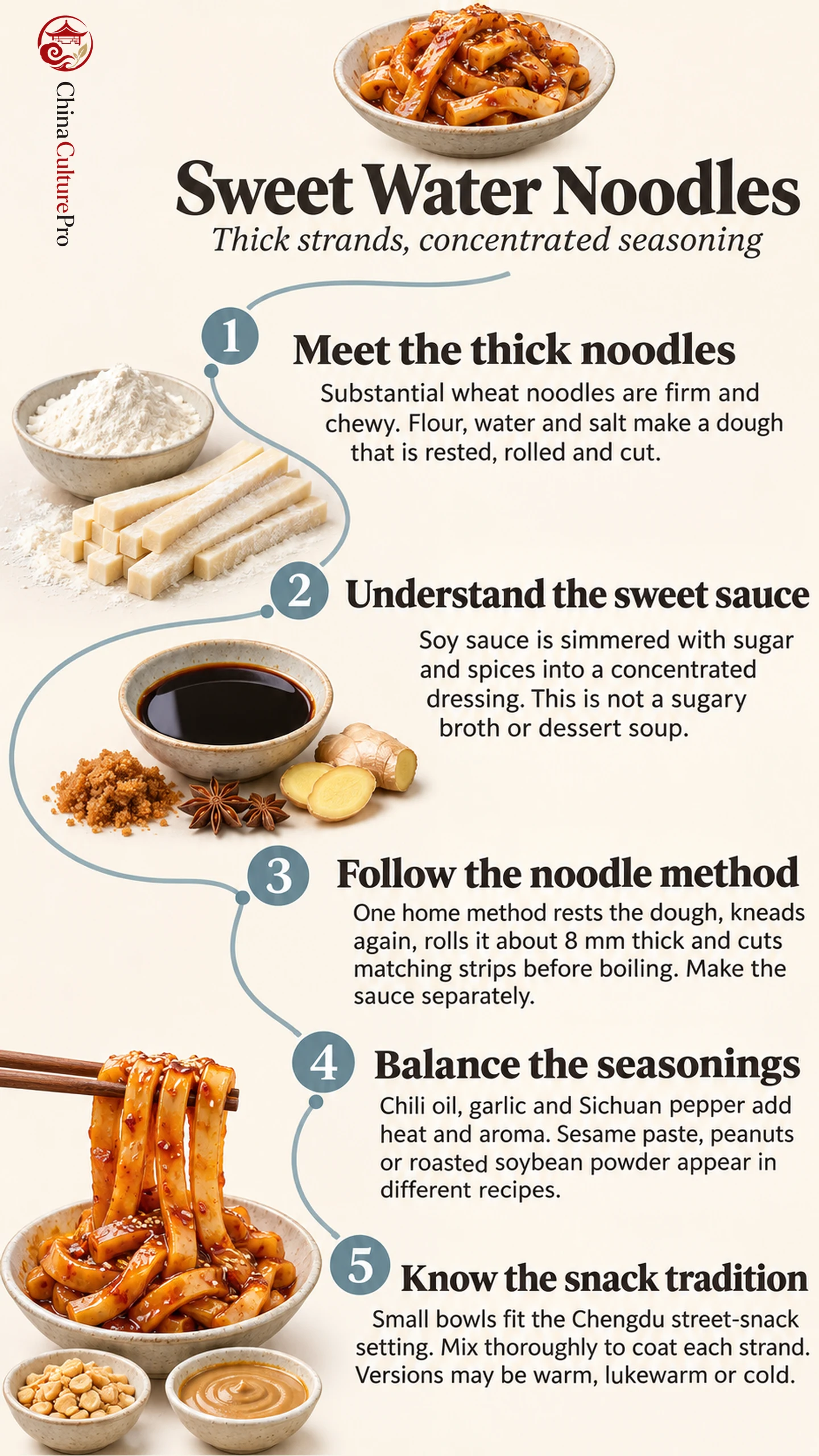
Thick Wheat Noodles and Concentrated Sweet Soy
Wheat flour, water and salt form the basic noodle dough. The restrained amount of water produces a firm dough that is rested, rolled and cut into chunky strands.[1][2]
The key sauce is Fu Zhi Jiang You (复制酱油, fù zhì jiàng yóu): soy sauce simmered with sugar and aromatics until concentrated. Cinnamon, star anise and ginger are examples; the precise spice mixture varies.[2][3]
| 部分 | Main contribution |
|---|---|
| Thick wheat noodles | A firm, satisfying chew |
| Sweet spiced soy sauce | Concentrated salty-sweet flavour |
| 辣椒油 | Heat and a red sheen |
| Sesame paste or other toasted accents | Nutty richness, depending on the recipe |
The finished dressing clings to the noodles instead of forming a large bowl of broth.[2][3]
How the Thick Noodles Are Made
One home formula for two servings uses 200 g all-purpose flour, 90 g water and ¼ teaspoon salt. Its noodle-making sequence is:[1]
- Mix flour and salt, then add water gradually and press the mixture into a firm dough.
- Cover and rest for about 15 minutes.
- Knead for two to three minutes, then rest for another 10 minutes.
- Roll to about 8 mm thick and cut strips approximately as wide as they are thick.
- Gently stretch the strands, boil until cooked through but still firm, then rinse to cool with drinking-quality water, or coat lightly with oil and let cool naturally.[1]
Flours absorb water differently, so this is one formula rather than a fixed ratio for every kitchen. The sauce is prepared separately.[1]
Balancing Sweet, Spicy and Nutty Seasonings
Garlic, chili oil and Sichuan pepper create pungency, heat and a tingling accent around the sweet soy. Sesame paste adds richness when used. Some versions add crushed peanuts; another home interpretation uses roasted soybean powder.[1][2][4]
The variations matter because a thick, creamy-looking sauce does not mean every bowl has the same ingredients. Mix thoroughly so the dressing reaches each strand instead of remaining underneath the noodles.[2]
A Chengdu Snack Rather Than a Sweet Soup
Small bowls suit the dish’s role among Chengdu street snacks. A firsthand account describes ordering a snack-sized portion near Wenshu Temple, placing the dish in an everyday Chengdu snack setting.[3]
Within Sichuan cuisine, the distinctive pairing is thick noodles with concentrated seasoning. Serving temperature varies: versions may be warm, lukewarm or cold.[3][4]
FAQs About Sweet Water Noodles
Does sweet water mean sugary broth?
No. The name points to the sweet note in the seasoning; the noodles are coated with sauce rather than served in a sweet broth.[3][4]
Are these noodles always served cold?
No. Cold and room-temperature servings are familiar, but a home recipe also allows warm or lukewarm noodles.[1][3]
Can ordinary soy sauce replace the seasoned sauce?
It will not give the same result on its own. The concentrated sauce includes sugar and aromatic spices, supplying sweetness and a thicker coating.[2]
資料來源
[1] Wei Guo. Tian Shui Mian
[2] WoonHeng. Chengdu Sweet Water Noodles
[3] Xueci Cheng. Sweet-Water Noodles
[4] Ministry of Commerce Digital Museum. Dongzikou Zhang: Noodle-Making Profile