
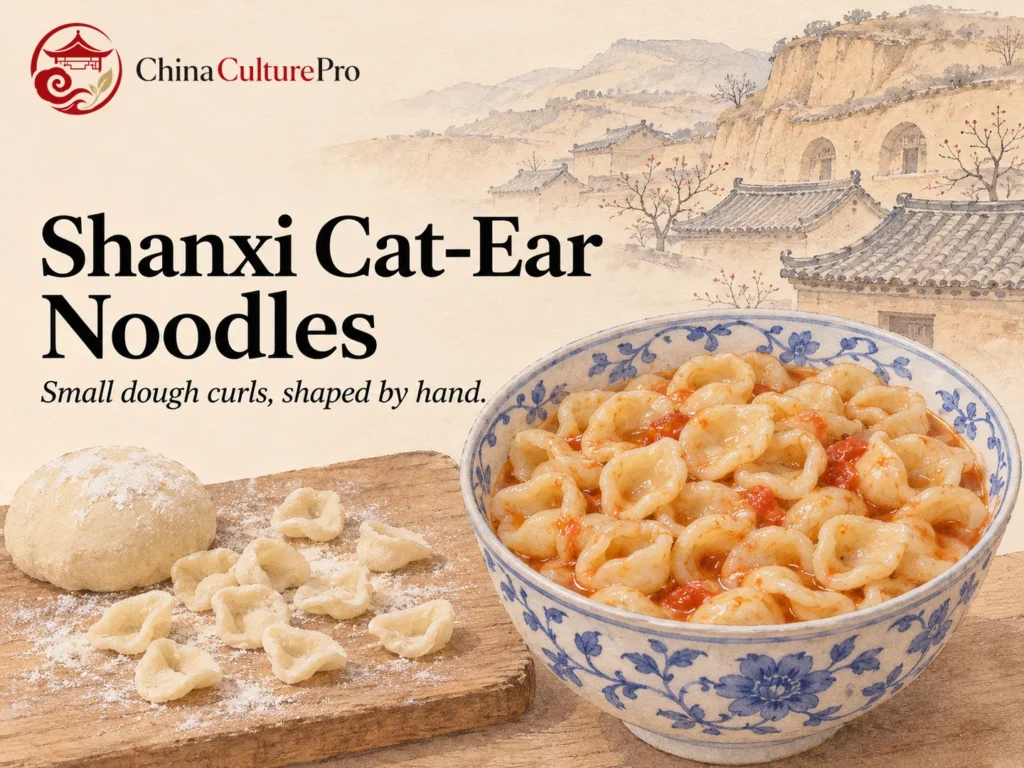

Quick Answer: What Are Shanxi Cat-Ear Noodles?
Cat-ear noodles (猫耳朵, māo ěr duo) are small pieces of dough pressed and dragged into curled, hollow shapes. They are a traditional specialty of central and northern Shanxi.[1]
- The name describes the ear-like shape.
- The curl creates a thinner centre than an unshaped lump.
- Cooked ears can be served with sauce, in soup or in a stir-fry.[2]
This guide teaches one wheat-flour dough; the shape does not require one universal topping.

These small curls show the range of Shanxi cuisine. They sit within the wider family of Chinese noodles and shaped doughs, even though their short shape looks more like pasta than a long strand.
A Three-Ingredient Wheat Dough
Use 300 g all-purpose flour, 150 ml room-temperature water and ½ tsp salt. Dissolve the salt in the water, add gradually to the flour and gather a firm dough.[2]
Knead for 8–10 minutes, cover and rest 30 minutes, knead briefly again, then rest another 20 minutes. Keep it covered so the surface does not dry out.[2]
The dough should be firm but workable. Flour absorption varies: correct a crumbly mixture with small additions of water rather than turning it into a soft, sticky dough. This is a plain wheat version, not a formula for every possible mixed-grain noodle.
Shape a Hollow Ear, Not a Solid Lump
- Divide the dough and roll into ropes about 2 cm thick. Cut roughly 1 cm pieces and dust lightly with flour.[2]
- Press a piece with your thumb and drag it across the work surface so it thins and curls into a hollow ear. Keep pieces separate.[1]
- Work with a small portion at a time, keeping the remaining dough covered. Aim for similar sizes and a thin centre rather than an especially tight roll.
- Boil in a large pot of water. Begin checking around three to four minutes; thicker pieces take longer. Cut open a large piece and continue cooking if the centre is still chalky or floury.[2]
Do not taste raw dough. Keep raw flour away from ready-to-eat food, and clean flour-covered tools before using them with cooked noodles.[4]
If a piece only slides across the board, use firmer thumb contact to thin its centre. If it sticks and smears, check whether the dough or surface is too wet. A well-shaped ear should have a visible hollow without becoming paper-thin and tearing.
Choose a Finish for the Cooked Noodles
Two approaches make different use of the same boiled dough:
- Sauced or soupy: serve with a prepared tomato-based sauce or suitable hot broth.[2]
- Stir-fried: drain boiled ears, then toss with cooked vegetables and savory sauce.[2]
A little Shanxi black vinegar can supply a sharp condiment contrast. Choose a complete topping recipe if adding meat or seafood; the noodle-boiling time does not establish those ingredients’ cooking requirements.
Refrigerate cooked leftovers promptly in shallow containers, within two hours or one hour above 90°F/32°C. Use within three to four days and reheat to 165°F/74°C.[5]
Shanxi and the Hangzhou Namesake
The making skill is included in a national heritage entry for Shanxi traditional noodles published in 2008. Its documented methods include pressing cut dough pieces on a board or forming them against the palm.[1]
Hangzhou also has an ear-shaped noodle specialty. A local description presents small curls in a rich soup with ingredients such as scallops, shrimp, ham and peas. This is a regional example, not proof that every dish with the same name uses that broth.[3]
Compare the broader Zhejiang food tradition, or explore other Shanxi shaping techniques through knife-cut noodles 及 tiao jian noodles.
FAQs About Shanxi Cat-Ear Noodles
Does this dough need eggs?
No. This formula uses only flour, water and salt; other recipes may differ.[2]
Do I need a pasta machine?
No. A board, knife and your thumb are enough for the hand-shaped method described here.[1]
Can buckwheat replace all the wheat flour?
Choose a separate buckwheat or mixed-grain formula. Do not assume this wheat dough’s hydration, elasticity and boiling time will remain unchanged after a complete flour substitution.
資料來源
[1] China Intangible Cultural Heritage Digital Museum. 传统面食制作技艺(抿尖面和猫耳朵制作技艺)
[2] Tea & Oranges. Shanxi Stir-Fried Cat’s Ears
[3] Jin Minghua, Hangzhou Daily. 纸上好食光:《猫耳朵》
[4] U.S. FDA. Handling Flour Safely: What You Need to Know
[5] FoodSafety.gov. Leftovers: The Gift that Keeps on Giving