


Quick Answer: How Do Quanzhen and Zhengyi Differ?
Quanzhen (全真, Quánzhēn), often translated as “Complete Perfection” or “Complete Reality,” and Zhengyi (正一, Zhèngyī), often “Orthodox Unity,” are major Daoist traditions. Their institutional histories and clerical models differ.
- **Quanzhen:** Its influential monastic model emphasizes celibacy, communal discipline and cultivation.
- **Zhengyi:** Its clerical traditions include priests who may marry and serve local communities.
- **Shared ground:** Both participate in Daoist religious life, including ritual and transmitted teachings.
These are starting points for understanding religious Daoism, not a rule that identifies every practitioner from residence or marital status.[1]
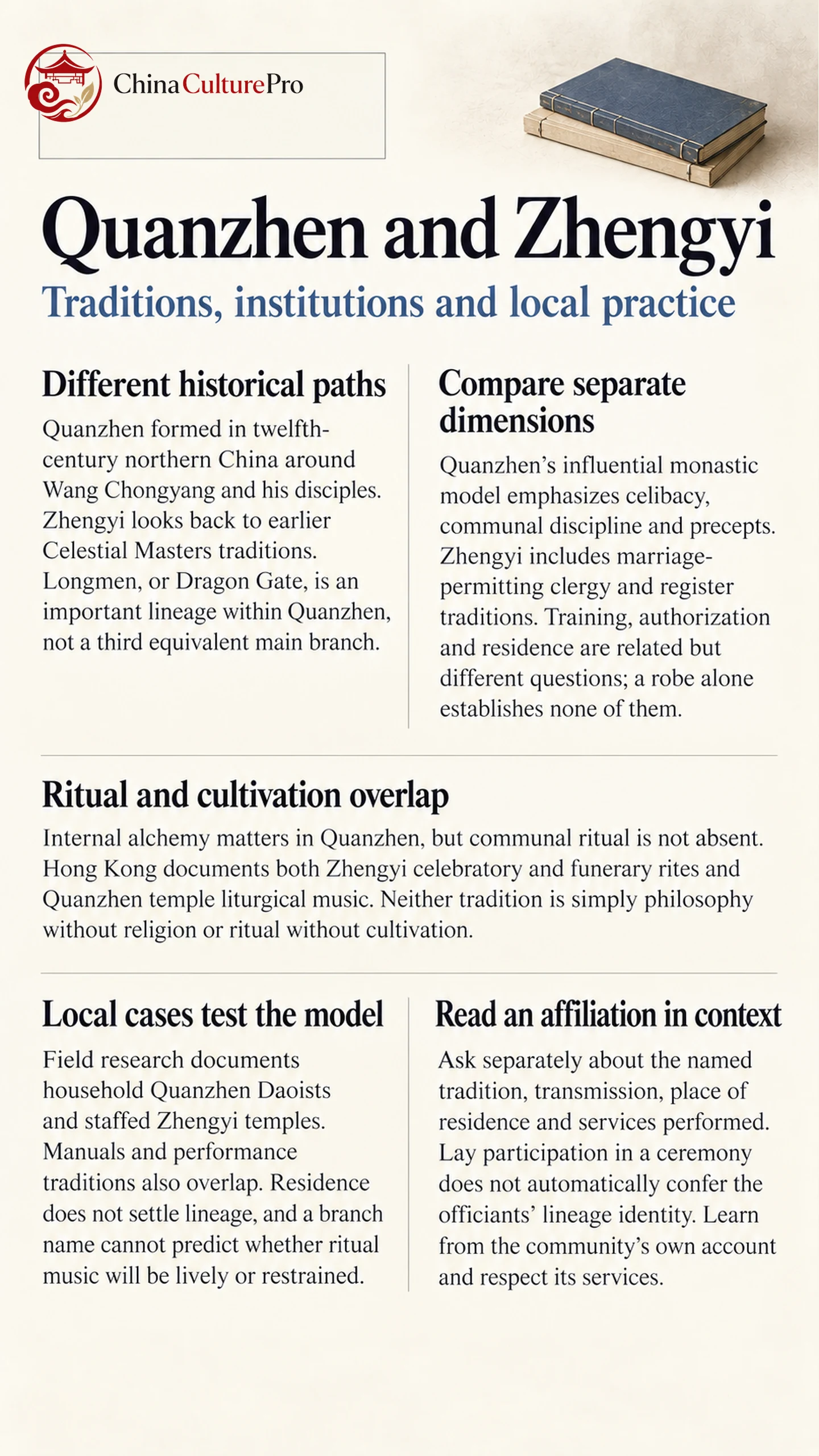
The familiar contrast between Quanzhen monks and Zhengyi household priests is useful until it becomes absolute. History, ordination, residence and ritual repertoire need separate attention. Local cases show why the same two labels cannot answer every question about a Daoist community.
Different Historical Paths within Daoism
Quanzhen took shape in northern China during the twelfth century. Wang Chongyang (王重阳, Wáng Chóngyáng) and his disciples were central to its formation. His preaching in Shandong in the late 1160s belongs to documented historical discussion; stories of encounters with immortals are religious biography rather than independently verified meetings.[2]
Zhengyi looks back to the second-century Way of the Celestial Masters and later institutional developments. Longmen (龙门, Lóngmén), or “Dragon Gate,” is a lineage within Quanzhen, not a third equivalent main branch.[1]
Training, Ordination and Ways of Living
A daoshi (道士, dàoshì) is a Daoist religious specialist or cleric. Training, initiation and ordination belong to relationships of transmission and religious authority; they are not supplied merely by wearing a robe or reading a book.[8]
| 問題 | Quanzhen | Zhengyi |
|---|---|---|
| Institutional emphasis | Monastic discipline and precept transmission | Clerical transmission and ritual authorization, including register traditions |
| Marriage and residence | Celibacy and communal residence in its influential monastic model | Marriage permitted; household-based and temple-based clergy both occur |
| What the label does not settle | Every affiliated practitioner’s residence or entire ritual repertoire | Whether a priest lives outside a temple or follows an identical local ritual system |
These differences are real without being exhaustive. Goossaert’s historical analysis stresses the importance of the two ordination institutions while questioning whether laypeople’s dealings with Daoists were always organized by the same categories.[3]
The discussion of Daoist temples helps distinguish a building’s community functions from the affiliation of clergy who serve there.[4]
Ritual and Cultivation: An Overlapping Repertoire
Neidan (内丹, nèidān), or internal alchemy, is important in Quanzhen cultivation. That emphasis does not make Quanzhen a nonritual philosophy. Equally, Zhengyi ritual service does not imply an absence of self-cultivation or ethical discipline. These traditions belong within a shared Daoist religious world.[1]
Hong Kong provides concrete counterexamples to a simplistic division. Its heritage record describes Zhengyi services for celebratory occasions, funerals, temple renewal and jiao (醮, jiào) communal offering festivals. The same record distinguishes urban and New Territories ritual systems, showing variation within the Zhengyi label.[6]
A separate heritage record documents Quanzhen temple liturgical music at Fung Ying Seen Koon. Its development includes Cantonese musical influences. Thus “Quanzhen means meditation without communal ritual” fails even in a specific, publicly documented case. Temple festivals supply a wider context for community ceremonial occasions.[7]
Why Local Daoists Complicate the Two-Branch Model
Household residence is not a dependable shortcut to Zhengyi identity. In a 2024 discussion of his fieldwork, Jones points to household Daoists affiliated with Quanzhen traditions in northern China. His earlier research also describes staffed Zhengyi temples and the local networks served by household ritual specialists.[4][5]
Ritual manuals and performance traditions likewise cross the neat boundary of a two-column introduction. Jones documents overlaps in texts and warns against assuming that Zhengyi music is always lively while Quanzhen music is always restrained. Those claims require listening to particular traditions, not inferring musical style from a branch name.[5]
A village committee or household may employ Daoists for a ceremony without every participant becoming a formal member of the officiants’ lineage. The relation between clerical institutions and local religious communities therefore needs its own explanation.
Reading a Lineage Claim in Context
When interpreting a lineage claim, separate four questions: what affiliation is named, how teaching or authorization is transmitted, where practitioners live, and what services they actually perform. Agreement on one field does not establish the others. Clothing, a temple photograph or a claim of ancestral descent is insufficient on its own.
For a cultural visit, use the community’s own explanation of its tradition and follow its guidance during services. Respectful temple conduct applies without requiring a visitor to classify every person or intervene in a ritual.
FAQs About Quanzhen and Zhengyi
Is Longmen separate from Quanzhen?
Longmen is an important lineage within Quanzhen. Its prominence does not make it a third main tradition equivalent to Quanzhen and Zhengyi.
Are all household Daoists Zhengyi?
No. Field research documents household practitioners with Quanzhen affiliations as well. Residence, lineage and ritual work should be examined separately.
Does Quanzhen mean philosophy and Zhengyi mean religion?
No. Both are religious traditions with institutions, transmitted teachings and ritual practices. Differences of emphasis do not reproduce a simple philosophy-versus-religion split.
Can a temple’s appearance identify its lineage?
Not reliably. A temple’s architecture and public deities do not establish every officiant’s training or affiliation. Local institutional history and the community’s own account provide better evidence.
資料來源
[1] Fabrizio Pregadio, Stanford Encyclopedia of Philosophy. Religious Daoism
[2] Fabrizio Pregadio, Golden Elixir Press. Wang Chongyang
[3] Vincent Goossaert, Institute of East Asian Studies. Quanzhen, What Quanzhen? Late Imperial Daoist Clerical Identities in Lay Perspective
[4] Stephen Jones, Daoism: Religion, History and Society. Yinyang: Household Daoists of North China and Their Rituals
[5] Stephen Jones. Rethinking Zhengyi and Quanzhen
[6] Hong Kong Intangible Cultural Heritage Office. Taoist Ritual Tradition of the Zhengyi School
[7] Hong Kong Intangible Cultural Heritage Office. Quanzhen Temples Taoist Ritual Music
[8] Taoist Federation Singapore. Shi Cheng Dao Jiao: Daoist Knowledge and Ordination