


Quick Answer: What Is Chinese Joss Paper?
Chinese joss paper is paper prepared for offerings in particular religious and family traditions. Paper money (纸钱, zhǐqián) is an important part of the category, alongside crafted objects representing goods. Burning is understood by participants as a way of conveying offerings to intended spiritual recipients.[1]
- Forms: foil sheets, folded ingots, imitation banknotes and modeled goods have different appearances.
- Recipients: deities, ancestors and other spirits are distinct categories.
- Context: locality, occasion and the host’s tradition determine appropriate use.
This guide explains meaning and variation within Chinese popular religious life; it does not prescribe one shopping list or ritual sequence.
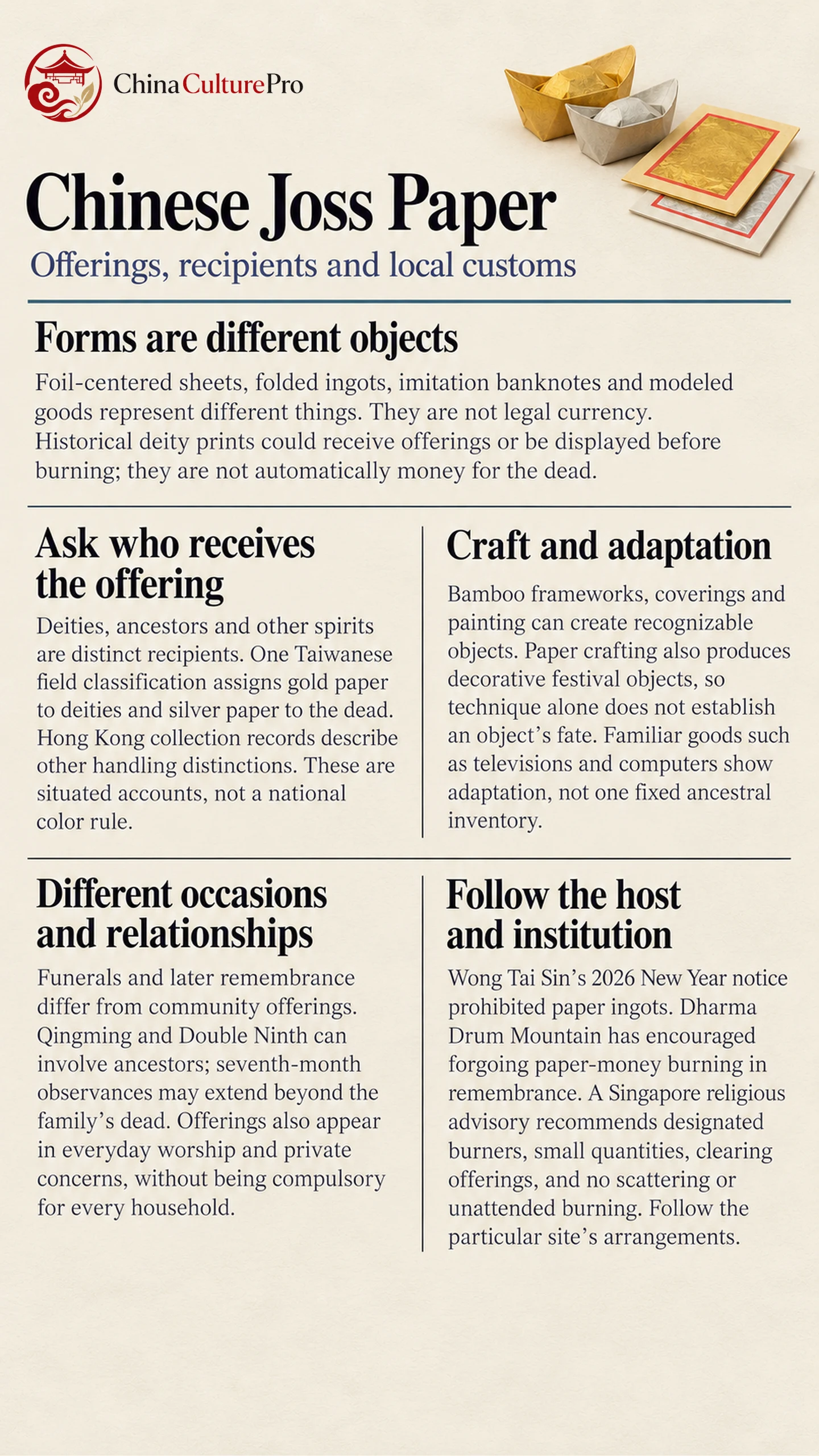
A stack of foil-centered paper and a miniature paper house may belong to the same offering tradition, but they are different objects. Reading them requires more than spotting a metallic color: the recipient, family occasion and local custom matter too.
Forms: Foil Sheets, Banknotes and Paper Objects
| 形式 | 可見特徵 | 辨識重點 |
|---|---|---|
| Foil-centered sheets | Paper carrying a metallic-looking patch | Color alone cannot establish the full ritual context |
| Folded paper ingots (元宝, yuánbǎo) | Three-dimensional shapes referring to older ingots | Represented wealth rather than usable metal |
| Imitation banknotes | Printed denominations, portraits or bank-like names | Ritual representations rather than legal currency |
| Modeled goods | Clothing, houses or other recognizable objects | Paper offerings extend beyond money |
A Hong Kong museum collection includes imitation banknotes among a wider set acquired with a local adviser’s help. The object’s design and the explanation supplied with it are stronger evidence than assuming that all offerings resemble modern notes.[2]
Religious paper images need another distinction. A historical Beijing collection contains deity prints intended for immediate ceremonial use and others displayed in homes before eventual burning. Such images can represent or address a deity; they are not automatically banknotes or miniature possessions for the dead.[4]
Recipients and Regional Differences
Gods, ancestors and wandering spirits are not interchangeable recipients. Offerings may express gratitude, continuing kinship or care for beings outside one’s family. Ancestor veneration centers a relationship with deceased relatives; that relationship differs from honoring a deity or making a communal offering to other spirits.[1]
In a Taiwanese field study, a collector distinguished gold paper (金纸, jīnzhǐ) for deities, silver paper (银纸, yínzhǐ) for the dead and ancestors, and other printed papers with particular ritual roles. This is a documented classification, not a license to use any gold-colored sheet in any ceremony.[3]
The Hong Kong collection record also describes differences in how paper offerings were grouped or offered separately in its Hakka and Cantonese contexts. Read those as situated accounts, not rules defining every member of a language community. When joining a family occasion, ask the host what each item is for.[2]
Craftsmanship and Changing Everyday Objects
Paper offering craftsmanship involves structure as well as decoration. Bamboo splints can provide a framework, with paper and other coverings shaped and painted into recognizable forms. Hong Kong’s heritage record places paper offerings within a broader craft that also produces lanterns and festival objects. Material or technique alone therefore cannot tell you an object’s intended fate.[5]
The represented goods can change with everyday life. Television sets, computers and other familiar goods occur in the Taiwanese study. Contemporary possessions make continuing care recognizable, rather than establishing one fixed ancestral inventory for every household.[3]
Funerals, Remembrance and Community Occasions
Paper offerings occur in funeral traditions and later remembrance. A Hong Kong collection record associates them with grave visits at Qingming (清明, Qīngmíng) in spring and the Double Ninth (重阳, Chóngyáng) in autumn. Its account also distinguishes offerings to other spirits in the seventh lunar month.[2]
These occasions have different participants and purposes. Qingming remembrance usually concerns ancestors and family continuity; seventh-month offerings can extend beyond one’s own deceased relatives. Neither should be used as a blanket name for every paper-burning event.
Paper offerings also appear outside major festivals. Hong Kong field research records private concerns and everyday worship alongside calendar occasions. This helps explain why a shop stocks different objects throughout the year, without implying that every household must burn them regularly.[1]
Respectful Handling and Local Burning Arrangements
Follow the family’s or institution’s arrangements rather than lighting unfamiliar items by imitation. Incense and paper offerings are different materials, and a site permitting one may restrict the other. Temple etiquette begins with asking what is permitted, where offerings belong and whether an activity is open to observers.
For a concrete dated example, Wong Tai Sin Temple (黄大仙祠, HuángdàxiānCí in Mandarin) prohibited bringing paper ingots in its 2026 Lunar New Year notice. That demonstrates an institutional arrangement, not a nationwide ban or a statement that every Daoist temple rejects paper offerings.[6] A different practitioner example is Dharma Drum Mountain (法鼓山, FǎgǔShān), which has published encouragement to forgo paper-money burning in ancestor remembrance. Paper offerings are not a compulsory feature of all Chinese Buddhist practice.[8]
A Singapore advisory jointly issued by religious organizations recommends designated burners, smaller quantities and clearing offerings afterward. It discourages scattering paper and leaving burning materials unattended. These are community instructions for considerate practice; local premises may have additional restrictions.[7]
FAQs About Chinese Joss Paper
Is joss paper real money?
No. Printed values represent offerings in a ritual setting. They do not create legal tender, a bank account or an exchange rate for ordinary purchases.
Is all joss paper called hell money?
No. That English expression is associated with some imitation banknotes. Foil sheets, folded ingots and crafted goods are a wider category; the word also cannot define everyone’s beliefs about the afterlife.
Is burning paper compulsory for all Chinese Buddhists?
No. Chinese ethnicity, Buddhist affiliation and participation in a paper-offering custom are separate questions. Family and local religious arrangements differ, and no outsider should assume one practice is compulsory.
Are all traditional paper crafts meant to be burned?
No. Paper crafting includes decorative and festival objects as well as offerings. Even historical deity prints could have a period of display before burning; the object’s context determines its role.
資料來源
[1] Janet Lee Scott, original Hong Kong field research, Hong Kong University Press. For Gods, Ghosts and Ancestors: Introduction
[2] Museum of Anthropology at UBC, own collection record Edz1170. Offering Paper
[3] Paul van der Grijp, Taiwan Journal of Anthropology. Private Collectors in Taiwan: Their Motivations for Collecting and Relations with Museums (2016)
[4] Columbia University Libraries, own historical collection. Chinese Paper Gods
[5] Hong Kong Intangible Cultural Heritage Office. Paper Crafting Technique
[6] Sik Sik Yuen, own2026 notice. Wong Tai Sin Temple: 2026 Lunar New Year Arrangements
[7] Religious Federations and Alliance for Action, hosted by Singapore NEA. Responsible Burning of Joss Paper and Incense Sticks/Candles
[8] Dharma Drum Mountain, own practitioner statement. DDM Wins Big Applause on Promoting Environmentalism