


Quick Answer: What Is Chinese Buddhist Monastic Life Like?
Chinese Buddhist monastic life combines religious training with the practical work of maintaining a community. This guide focuses on Han Chinese Buddhism (汉传佛教, Hànchuán Fójiào), including examples from Taiwan and Chinese-tradition communities overseas.
- **Clothing:** Daily garments and ceremonial robes have different functions.
- **Food:** Vegetarian meals and communal discipline are important; meal schedules require local context.
- **Routine:** Chanting, meditation, study, work and rest share the day.
It does not describe every Tibetan or Theravada monastery in China. The broader introduction to Chinese Buddhism explains that wider diversity.
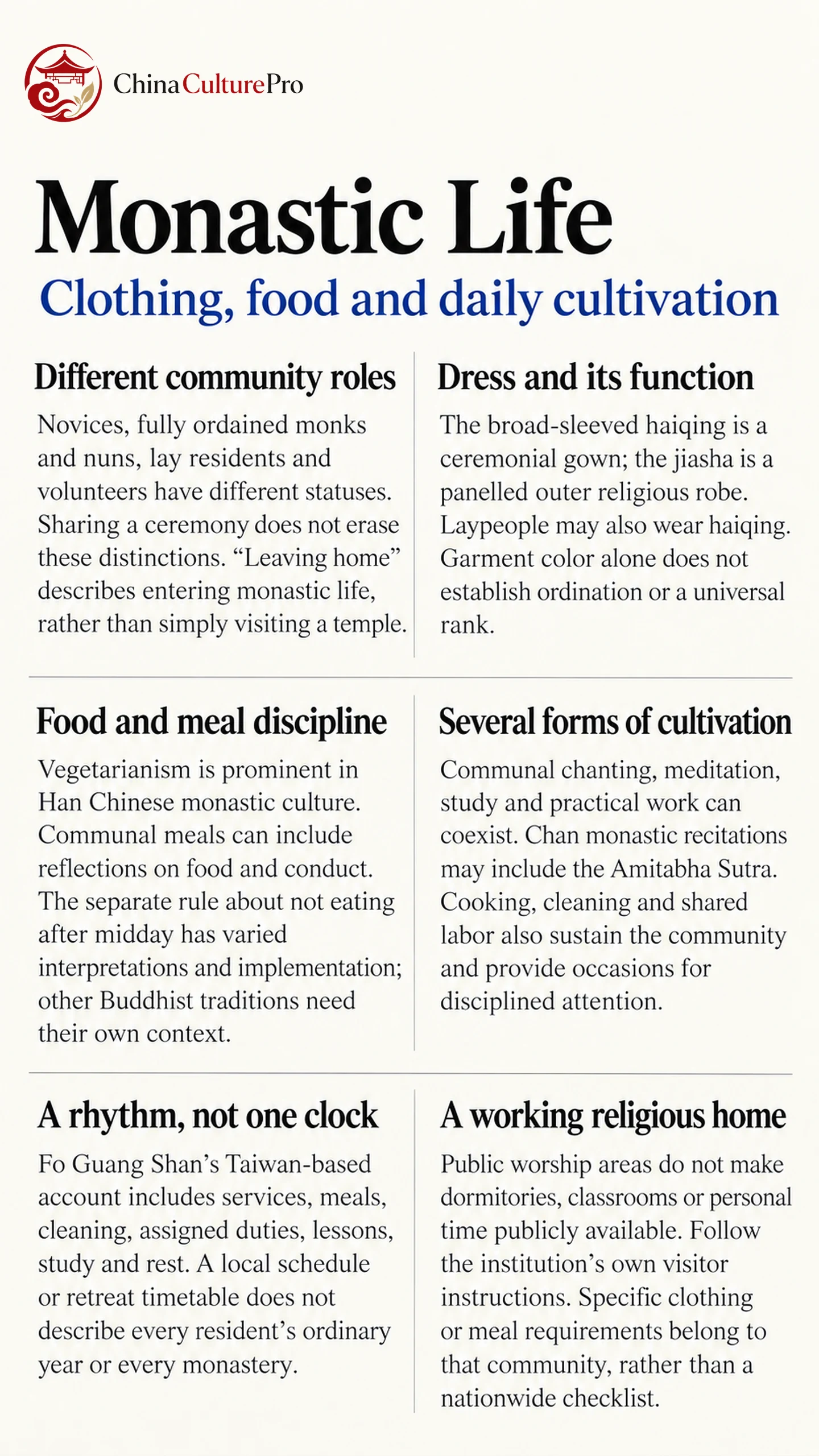
Monastery life is easier to understand when religious cultivation and ordinary tasks are considered together. A meal, a cleaning assignment and a chanting service can all express discipline, while clothing and a daily schedule reveal only part of someone’s role.
Monastics, Novices and Lay Residents
Chujia (出家, chūjiā), often translated as “leaving home,” refers to entering monastic life.[8] Training and ordination distinguish novices from fully ordained monks and nuns. Lay residents, volunteers and retreat participants can also contribute to a monastery without holding the same religious status.
The City of Ten Thousand Buddhas’ own description, for example, distinguishes fully ordained monks and nuns, several training categories, and laywomen and laymen who gather for ceremonies. Sharing a hall or joining a service does not erase those differences.[1]
A Buddhist temple may therefore be both a place of public devotion and the workplace and residence of a trained religious community.
Robes: Everyday Clothing and Ceremonial Dress
Clothing serves practical, ceremonial and institutional purposes. A haiqing (海青, hǎiqīng) is a broad-sleeved ceremonial gown used in Chinese Buddhist settings. A jiasha (袈裟, jiāshā), derived from the Buddhist kāṣāya tradition, is a panelled outer religious robe; it is not simply another name for the underlying gown.
Nan Tien Temple’s explanation distinguishes the wide sleeves of the haiqing from a narrower-sleeved long gown associated there with monastics. It also notes that both lay and monastic practitioners may wear haiqing for worship. An observer should therefore avoid using a broad-sleeved black gown alone as proof of ordination.[2]
Colors and combinations depend on institution, occasion and tradition. A photograph of one monastery’s ceremonial dress is insufficient to establish a universal Chinese Buddhist color-to-rank code.
Food, Communal Meals and the Midday Rule
Lifelong avoidance of meat and fish became a prominent expectation in Chinese Buddhist monastic culture. Historical research shows a complex development rather than a simple rule followed identically by all Buddhist communities from the beginning. Tibetan and Theravada settings require their own context.[3]
Buddhist vegetarian cuisine concerns ingredients, but eating can also be a communal practice. Fo Guang Shan describes meal reflections on the labor behind food, one’s conduct, restraint and the use of nourishment to sustain cultivation.[5]
The discipline of not eating solid food after midday is a separate question from vegetarianism. Chiu’s study, published in 2015 and examining nunneries in Taiwan and mainland China, found differing interpretations and implementation. Neither “all eat only before noon” nor “the rule no longer matters” captures that evidence.[4]
For a visitor’s ingredient needs, clarify the actual meal rather than assuming a label settles everything. The broader vegetarian food guide distinguishes dietary categories.
Chanting, Meditation, Study and Work
Morning and evening communal recitation give many monasteries a shared rhythm. Dharma Drum Mountain describes services involving sutras, dharanis and Buddha-name recitation. This illustrates why chanting is part of monastic training, rather than merely a performance for visitors.[6]
The relationship between Chan (禅, Chán) practice 及 Pure Land devotion should not be reduced to a choice between silent sitting and chanting. The same institutional account discusses Chan monastic recitations that include the Amitabha Sutra. Different forms of cultivation can coexist.[6]
Fo Guang Shan’s account also assigns importance to lessons, individual study, cleaning, cooking and shared labor. These activities support the institution and are understood by the community as opportunities for disciplined attention. Daily life includes responsibilities beyond the meditation hall.[5]
Shared Rhythms, Local Schedules
A published schedule is a description of one community’s organization, not a timetable for every Chinese monastery. Fo Guang Shan’s Taiwan-based account includes communal services, meals, cleaning, assigned duties, lessons and personal study. It also includes rest; continuous public ritual is not the whole day.[5]
An institution’s size, training emphasis, duties and special observances affect how these activities are arranged. A retreat timetable likewise should not be used to describe every resident’s ordinary year. Ask which community and which occasion a schedule represents before treating its details as typical.
Encountering a Working Monastery Respectfully
Public access to a worship hall does not imply access to dormitories, kitchens, classrooms or a monastic’s personal time. Follow the institution’s guidance and allow services and work to proceed without interruption. Temple etiquette provides the wider framework.
Local instructions can be quite specific. The City of Ten Thousand Buddhas in California asks visitors to wear modest, comfortable clothing and describes its own vegetarian ingredient exclusions. Those instructions belong to that community; they should not become a national checklist for every Chinese Buddhist monastery.[7]
FAQs About Chinese Buddhist Monastic Life
Do Chinese Buddhist monks and nuns meditate all day?
No. Religious life also includes communal recitation, study, meals, assigned work and rest. Particular institutions may emphasize different forms of training.
Does a robe’s color tell you someone’s rank?
Not reliably. Garment type, occasion and institution matter. A ceremonial gown may also be worn by lay practitioners, so color alone cannot establish ordination or rank.
Do all Buddhist monastics follow the same diet?
No. This article describes the vegetarian emphasis of Han Chinese Buddhist monastic culture. Ingredient rules and meal timing also vary locally; other Buddhist traditions need separate explanation.
Does visiting a monastery make someone a monastic?
No. Visiting, volunteering or joining a retreat differs from entering monastic training and receiving ordination. Shared activities do not confer the same religious status.
資料來源
[1] Dharma Realm Buddhist Association. City of Ten Thousand Buddhas: History and Background
[2] Nan Tien Temple. Haiqing, Jiasha and Changshan
[3] Eric M. Greene, Asia Major. A Reassessment of the Early History of Chinese Buddhist Vegetarianism
[4] Tzu-Lung Chiu, Journal of the Oxford Centre for Buddhist Studies. The Practice of Fasting after Midday in Contemporary Chinese Nunneries
[5] Fo Guang Shan. One Day Life in the Temple
[6] Dharma Drum Mountain. Daily Morning and Evening Chanting
[7] Dharma Realm Buddhist Association. Visiting the City of Ten Thousand Buddhas
[8] Dharma Drum Mountain. Beginning Monastic Life at Dharma Drum Mountain