
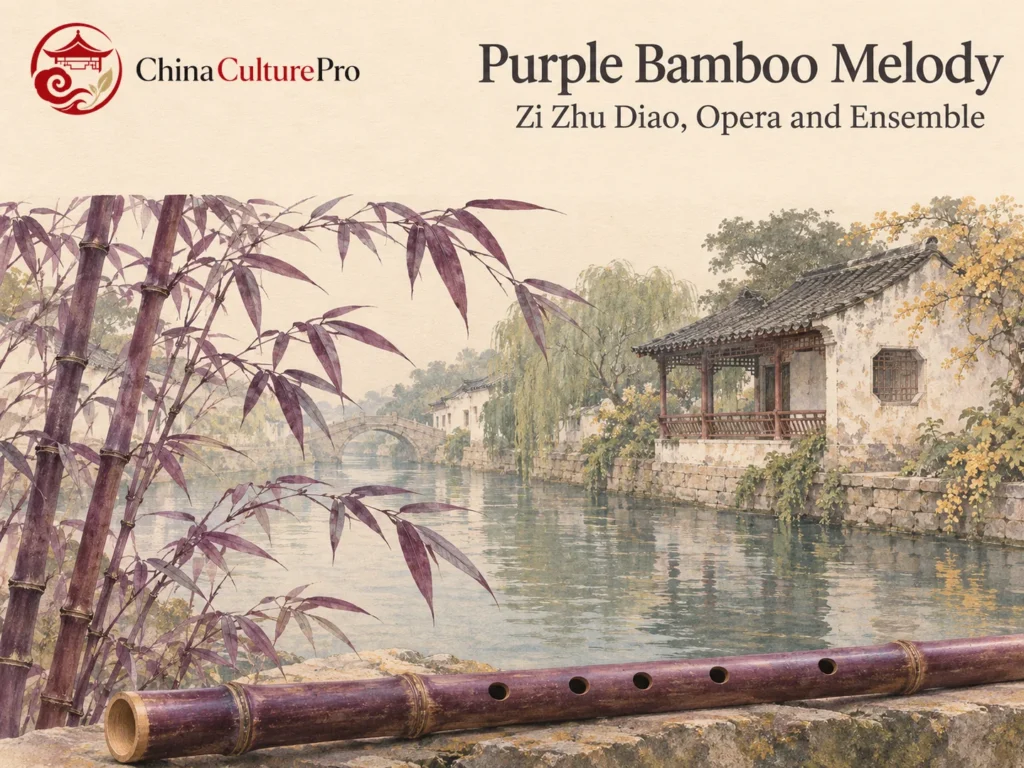

Quick Answer: What Is Purple Bamboo Melody?
Purple Bamboo Melody (Zi Zhu Diao, 紫竹调, Zǐzhú Diào) is a tune heard in Shanghai opera, or Huju (沪剧, Hùjù), and in instrumental arrangements. It is associated with folk music from the Wu-speaking parts of the lower Yangtze region.[1][2][5]
- Stage: In Huju it is a qupai (曲牌, qǔpái), a named tune used in performance.[2][4]
- Ensemble: It also appears in Jiangnan sizhu (江南丝竹, Jiāngnán Sīzhú), or silk-and-bamboo music.[1][3]
- Recording: The Chinese Music Archive lists a 1962 performance by the Chinese Movie Traditional Orchestra at 3:29.[2]
Follow the melody as its lead passes between instruments.

Start with the same short phrase in two versions and notice who carries it. A singer can give it the rhythm of speech. In an instrumental version, a flute and a string player can share the line between them.
A Jiangnan Tune on the Shanghai Stage
The China National Opera and Dance Drama Theater identifies the piece with Jiangsu folk music and a wider Wu-speaking area. In Shanghai’s Huju repertory, the same name identifies a set tune. The guide to 中國戲曲 provides context for the regional styles that use named melodies in performance.[1][2][5]
An opera credit is useful when a recital version gives only the title. In the Toronto festival’s syllabus, Purple Bamboo Melody is classified as a Shanghai opera tune even though its selected score is for solo pipa.[4]
How the Melody Moves Between Instruments
The Australian National University ensemble describes a setting by Chai Changning in which the dizi shares the melody with bowed and plucked strings. The tune’s notes may carry on while the breath of the flute gives way to the sharper beginning of a plucked note. It also illustrates the blend of timbres in Jiangnan silk-and-bamboo music.[3]
For a larger group, the guide to the Chinese orchestra explains where these sounds sit among other instrument sections.
Three Credits That Identify a Version
| 來源 | Credit | 場合 |
|---|---|---|
| China National Opera and Dance Drama Theater | Peng Xiuwen | Chinese orchestra program |
| ANU Chinese Classical Music Ensemble | Chai Changning | Flute and strings share the melody |
| Toronto International Music Festival syllabus | Tang Liangzhou | Pipa performance score |
Each row refers to an arrangement or a performance score. The Toronto list also gives separate entries for Jasmine Flower 及 《金蛇狂舞》.[1][3][4]
Hear What Stays Recognizable
Start with the Chinese Music Archive’s historical track and listen for the beginning and ending of a phrase. Then try a version for solo pipa or a small ensemble. A different pluck or ornament can change the sound while the shape of the phrase remains recognizable.[2]
FAQs About Purple Bamboo Melody
What is Zi Zhu Diao in Shanghai opera?
It is a named tune in the Huju repertory, also known in instrumental settings.[2][3]
Who arranged the orchestral version?
The China National Opera and Dance Drama Theater credits Peng Xiuwen for the arrangement in its program. Other settings have separate credits.[1][3]
Is there a solo pipa version?
Yes. The Toronto International Music Festival syllabus lists a pipa performance score by Tang Liangzhou.[4]
資料來源
[1] China National Opera and Dance Drama Theater. Program Guide of the Chinese Orchestra
[2] Chinese Music Archive. Small Ensemble Programme Notes: Purple Bamboo Tune
[3] Australian National University Chinese Classical Music Ensemble. Repertoire: Purple Bamboo Melody
[4] Chinese Cultural Centre of Greater Toronto. Chinese Instruments Solo Classes Syllabus
[5] New Zealand Chinese Orchestra. Repertoire: Purple Bamboo Melody