

Quick Answer: What Is a Chinese Orchestra?
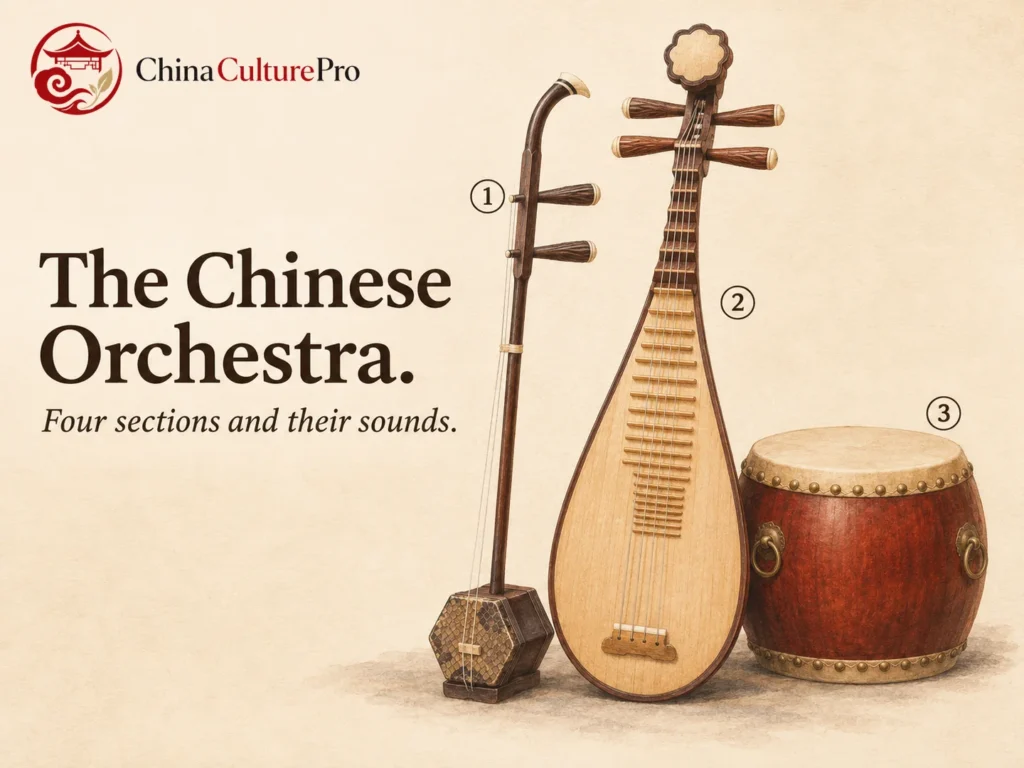
A modern Chinese orchestra(民族管弦乐团,mínzú guǎnxián yuètuán)is a large instrumental ensemble typically organized into winds, bowed strings, plucked strings and percussion. Conductors coordinate the sections, and instruments in higher and lower registers give composers a wide range of sounds.
The format took shape in the twentieth century, drawing on older instruments and regional repertories. It accommodates both arrangements of existing tunes and music written for a large orchestra. Smaller Chinese ensembles continue to perform in their own settings and styles.

A flute carries the opening of a phrase, bowed strings take up the line, and a gong marks a change. Those are three ways an orchestra can distribute musical work. Understanding the instrument families helps you follow the exchange even when the melody moves from one part of the stage to another.
The Four Instrument Sections
A modern Chinese orchestra usually groups instruments by how they are played. This organization puts contrasting ways of starting and sustaining sounds within reach of the conductor. It also gives an arranger more than one register within a family. The lineup below uses instruments found in documented orchestral teaching materials, with room for differences between ensembles.[1]
| Section | Representative instruments | What to listen for |
|---|---|---|
| Winds | Dizi (笛子,dízi), sheng (笙,shēng)and suona(唢呐,suǒnà). | A flute can lead with a clear high tone, a mouth organ can sustain several pitches, and a double reed can bring a penetrating attack. |
| Bowed strings | Erhu (二胡,èrhú)and the lower zhonghu(中胡,zhōnghú). | Bowed notes can carry a long melodic line, with lower parts reinforcing or answering it. |
| Plucked strings | Pipa (琵琶,pípa)and other plucked instruments, often joined by the struck yangqin (扬琴,yángqín). | Individual attacks can articulate a pulse. Repeated strokes or plucks can extend a sound. |
| Percussion | Drums, gongs, cymbals and other instruments selected for the score. | A stroke can mark an entrance or ending, while a series of strokes can carry its own rhythm. |
The yangqin illustrates the difference between an instrument’s section and the way it is played. Its player strikes strings with bamboo beaters. A section can group related string sounds even when the players use different techniques. Some pieces leave an instrument out, and others add instruments or use different low strings. The Hong Kong Chinese Orchestra’s lineup, for example, uses both older forms and instruments redesigned for its sections.[2]
How the Modern Orchestra Took Shape
Large Chinese instrumental ensembles developed in the early twentieth century as musicians adapted existing repertories for organized concert and broadcast groups. Like a symphony orchestra, a modern Chinese orchestra can distribute music across groups of players and registers under a conductor. The actual instruments, local traditions and resulting sound give it a character of its own.
One documented example is the China Broadcasting Chinese Orchestra, founded in 1949. Its concert presenter credits conductor and composer Peng Xiuwen(彭修文,Péng Xiūwén)with helping establish the four-section configuration in that organization. Peng also arranged earlier tunes and composed larger works. The Hong Kong Chinese Orchestra, founded in 1977, offers another institutional example. These founding dates track particular institutions within a longer period of experimentation.[3]
Separate wind and string registers allow a composer to move a theme from a higher instrument to a lower part, or to give the same tune different colors in successive phrases. Scoring can also introduce independent bass lines or percussion patterns where a smaller arrangement leaves the texture more open.
Full Orchestras and Smaller Ensembles
The word “ensemble” covers many performance settings. Compare the concert orchestra with Nanyin (南音,nányīn), a tradition rooted in southern Fujian’s Minnan communities and maintained overseas. Its repertoire includes singing and instrumental music, and distinctive instruments include an end-blown flute and a lute held horizontally. A singer may also play clappers. These roles follow the tradition’s own repertory and social settings.[4]
Scale alone cannot identify a tradition. A full orchestral institution can present chamber groups as well. The Singapore Chinese Orchestra’s 2025 Chamber Charms program, for example, announced separate projects built around small plucked and bowed string groups. “Chinese orchestra” can name the institution while the specific performance calls for only a handful of its musicians.[5]
What to Hear in an Orchestral Performance
Begin with the instrument named in the program. In a solo with orchestra, listen for how its attack stands out from the backing parts. The China Broadcasting Chinese Orchestra’s October 2023 Hong Kong program lists Celebrating a Bumper Harvest for suona and orchestra, and Reflection of the Moon on the Water for erhu and orchestra. The first foregrounds a double-reed instrument, while the second foregrounds a bowed string. The same program lists The Drums and Gongs of Harvest with a featured part for a set of drums.[3]
Try following one short phrase across its repetitions. Notice whether a wind, a bowed section or a group of plucked instruments begins the phrase. Then listen for what the lower instruments and percussion do around it. In Chinese traditional music, a familiar tune can take on a different shape when it is scored for different players and registers.
FAQs About the Chinese Orchestra
What are the four sections of a Chinese orchestra?
They are winds, bowed strings, plucked strings and percussion. Their precise instruments and registers depend on the ensemble and piece.
Why is the yangqin in the plucked-string section?
It shares that section with plucked instruments in many modern orchestras. The player produces notes by striking its strings with beaters.
Do all Chinese orchestras use the same instruments?
The four-section pattern is widespread. Instrument choices, low-register parts and the number of players vary with the orchestra and the score.
資料來源
[1] Hong Kong Education Bureau. Listening to Chinese Music, Instruments Used in the Modern Chinese Orchestra
[2] Hong Kong Chinese Orchestra. About the Hong Kong Chinese Orchestra
[3] Hong Kong Leisure and Cultural Services Department. China Broadcasting Chinese Orchestra
[4] UNESCO Intangible Cultural Heritage. Nanyin
[5] Singapore Chinese Orchestra. Chamber Charms Series Concerts