
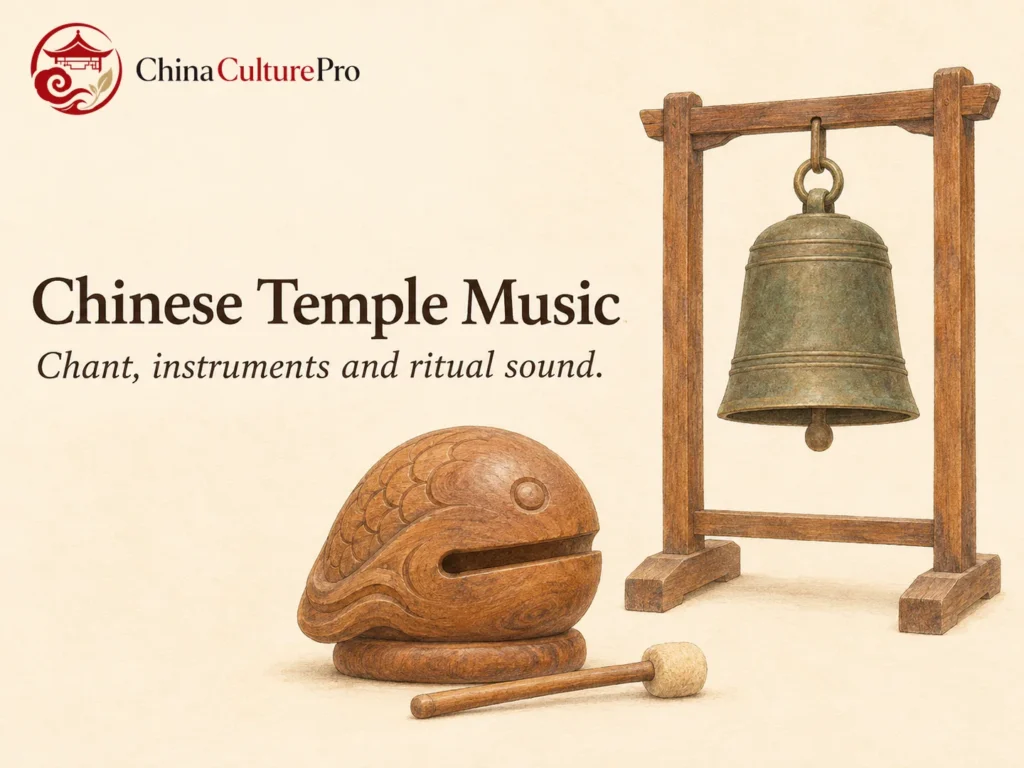

Quick Answer: What Is Chinese Temple Music?
Chinese temple music is an umbrella term for chants, instrumental pieces and sound cues used around religious and community observances. Buddhist monasteries, Daoist communities and local associations draw on different texts and repertories. Their music can include voices, percussion and wind instruments.
The function of a sound depends on its setting. A chant can carry words or coordinate voices, and a drum or gong can mark a transition. Music associated with a temple can also be performed as a concert excerpt.
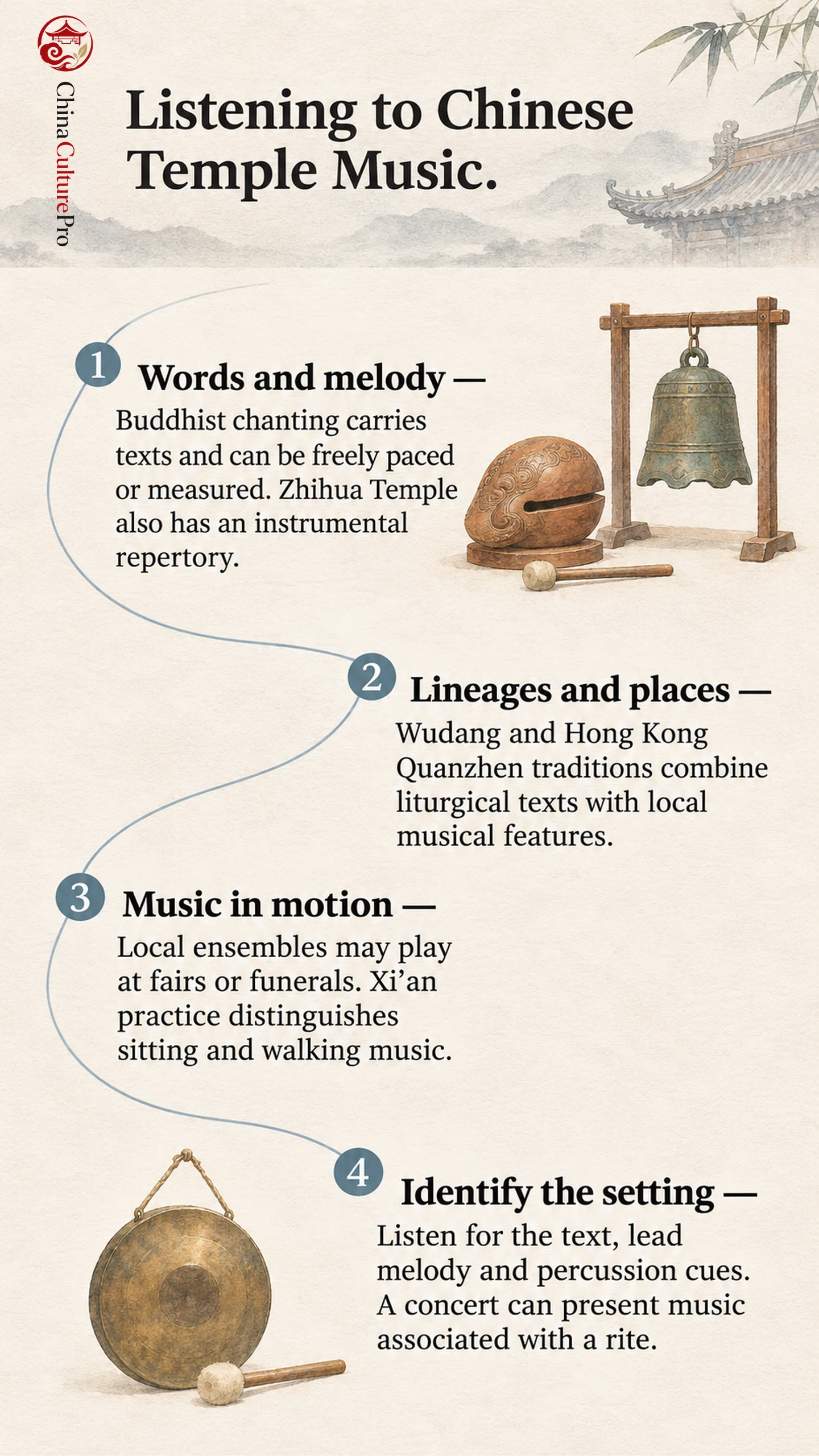
A chant can extend the last syllable of a line while a bell or percussion stroke marks the next moment. Elsewhere, a double reed can lead an instrumental melody. The setting gives each sound its role. To hear what they are doing, start with who is performing and what is happening around them.
Buddhist Chant and Instrumental Repertoire
Fanbai(梵呗,fànbài)refers to Buddhist liturgical chanting. In traditions of Chinese Buddhism, a chant may carry praise, vows or a passage used in daily practice. Dharma Drum Mountain’s account describes both flexible pacing and more regularly measured singing. A regularly measured chant gives a shared pulse, while a freely paced passage can hold a syllable across a longer span.[1]
Beijing’s Zhihua Temple(智化寺,Zhìhuà Sì)preserves an instrumental tradition alongside its history of chanting. The Smithsonian’s October 2017 recording identifies the guanzi(管子,guǎnzi), a double reed, and the sheng (笙,shēng), a mouth organ, among six musicians. The flute can ornament the reed’s melody while drum, gong-chime and cymbals add their own attacks. The program also describes a manuscript copied in 1694 that preserves part of the repertoire.[2]
That manuscript helps document the tradition, and the recording gives a contemporary example of the instrumental sound. In a service, singers and instrumentalists may have different roles. The concert recording preserves the instrumental program and names the performers.
Daoist Liturgy at Wudang and in Hong Kong
Daoist liturgical music includes sung or chanted texts and instrumental passages. The national heritage inventory’s Wudang entry describes music used for morning and evening recitation and other observances. It associates part of the repertoire with the Quanzhen(全真,Quánzhēn)tradition’s Shifang Yun(十方韵,Shífāng Yùn)chanting style and also records a mixture of local and lineage influences.[3]
Hong Kong’s Quanzhen hall ritual music offers another example. The inventory describes professional chanting teams at particular halls and notes musical influences from Cantonese song and opera. The inventory locates those influences in the vocal melodies. The words and ritual sequence retain their particular liturgical roles.[4]
These cases give listeners concrete entry points into religious Daoism. A similar instrument or melodic gesture can occur in two settings. The words, lineage and sequence of the observance help identify its specific function.
Local Ensembles and Processions
Temple fairs and funerals can involve local music associations as well as temple personnel. The UNESCO record for the Xi’an wind and percussion ensemble describes community musicians performing at such occasions. Its documentation distinguishes sitting music and walking music, and notes that walking repertory may include a male chorus. The place and movement of the performance affect the way listeners encounter it.[5]
A stationary ensemble can draw an audience toward a single place, while a moving group carries its music through changing spaces. In a walking performance, listen for recurring strokes as the ensemble moves past. Local traditions may also share melodies and musicians with temples. Those connections make the particular association and occasion more informative than an all-purpose temple label.
Listening to Ritual Sound in Context
Begin by identifying the setting from a program, caption or recording credits. Then listen for who carries the text, who carries the melody and what signals a change.
| 場合 | A concrete example | What to listen for |
|---|---|---|
| Buddhist chanting | A measured or free-paced fanbai passage. | The shaping of syllables and the point at which voices enter together. |
| Daoist liturgy | A Wudang recitation with its own chant repertory. | The distinction between words carried by the voice and instrumental passages. |
| Local wind and percussion | A Xi’an ensemble associated with a fair or procession. | Recurring drum patterns, wind melody and any chorus identified by the program. |
| Concert presentation | The 2017 Zhihua ensemble performance. | The double reed’s main line and the way flute and percussion frame it. |
For the Zhihua recording, the program marks the opening of Zhong-Tang Qu at 0:00. Follow the lead instrument, then pay attention to the next percussion accents. In a temple setting, attend to the local guidance described in Chinese temple etiquette. The way people gather and respond can help explain what the music is doing.
FAQs About Chinese Temple Music
Is Chinese temple music always chanting?
It includes chanting as well as instrumental pieces and percussion cues. The combination varies with the community and observance.
Do Buddhist and Daoist temples use the same music?
They have their own texts and repertoires. They may share instruments or regional musical features, with different uses in particular rites.
Is a concert recording the same as a temple rite?
A concert can present repertoire associated with a rite. The complete rite also has its own sequence, participants and setting.
資料來源
[1] Dharma Drum Mountain. What You Should Know about Chinese Buddhist Chanting
[2] Smithsonian National Museum of Asian Art. Buddhist Music from Zhihua Temple
[3] China Intangible Cultural Heritage Digital Museum. Daoist Music of Wudang Mountain Temples
[4] China Intangible Cultural Heritage Digital Museum. Daoist Music, Quanzhen Hall Ritual Music
[5] UNESCO Intangible Cultural Heritage. Xi’an Wind and Percussion Ensemble