
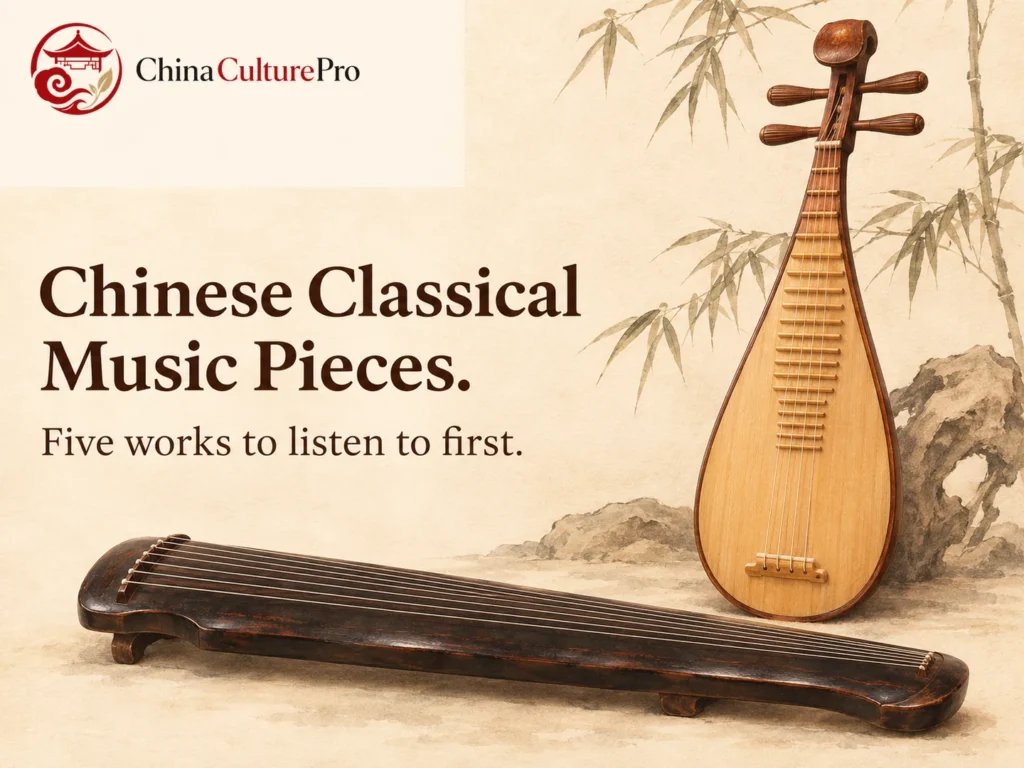

Quick Answer: Which Chinese Classical Music Pieces Should You Hear First?
Start with Flowing Waters(流水,Liúshuǐ) for quiet plucked strings, Ambush on All Sides(十面埋伏,Shímiàn Máifú) for a sharply articulated lute solo and Moon Reflected on the Second Spring(二泉映月,Èrquán Yìngyuè) for a bowed melody. Add a flute and zither duet and a small ensemble arrangement to hear how a tune changes when several musicians share it.
Choose a named performer and version when you search for each piece. English translations of a title can vary, and recordings with the same title may use different instruments, sections or arrangements.

Two recordings with the same title can feel like different pieces until you hear what they share. Start with one clear sound in each performance, such as a note fading after a pluck or a bowed phrase that continues to grow. Then use the title and recording credits to connect that sound with its tradition.
Five Pieces and Versions to Start With
These selections cover five contrasting textures within Chinese traditional music. The version column identifies the recording or archival program to look for. The Smithsonian Folkways album China, for example, lists a specific flute-and-zither track under the romanized title Meihua San Nong.[1]
| Piece | A version to find | First listening cue |
|---|---|---|
| Flowing Waters | Bell Yung playing solo guqin(古琴,gǔqín)in Painting with Music. | Compare resonant single plucks with rapid strings of notes. |
| Three Variations on the Plum Blossom(梅花三弄,Méihuā Sānnòng) | Fu Xuezhai and Zha Yiping on China, track 106, for guqin and xiao(箫,xiāo). | Hear the flute sustain a line as the plucked notes fade. |
| Ambush on All Sides | Wu Man’s 1999 Smithsonian concert performance on solo pipa(琵琶,pípa). | Listen for changes from separated strokes to dense bursts of sound. |
| Moon Reflected on the Second Spring | Hua Yanjun’s recorded erhu(二胡,èrhú)performance, or a clearly credited later version. | Follow the bowed melody through slides and held notes. |
| Spring River in the Flower Moon Night(春江花月夜,Chūnjiāng Huāyuèyè) | The Han Tang Ensemble’s 2002 Smithsonian concert recording. | Follow a melodic phrase as its color changes among instruments. |
Guqin and Xiao: Listen to How a Note Ends
Flowing Waters appears in a surviving qin handbook dated 1425. That date identifies a written source for the piece. Bell Yung learned his version from Yao Bingyan. The handbook and the recorded performance preserve different stages of transmission. In the Smithsonian’s recording of Bell Yung, the music begins at 24:56 after his spoken introduction. Listen to the first few plucks and the spaces between them.[2]
The guqin can carry a phrase through an isolated pluck, a change in resonance or a moving pitch after the attack. In Three Variations on the Plum Blossom, the xiao adds another way to continue a phrase. Try following the flute for one phrase and the plucked strings for the next. The duet format gives you a simple way to hear what breath and strings each contribute.
Pipa: Listen to Changes in Attack
Ambush on All Sides belongs to the martial repertoire of the pipa. The Smithsonian’s notes connect its sections to a narrative of the Chu–Han conflict. Changes in pace, articulation and density can suggest preparation, movement and conflict. The program’s story gives the listener a framework for hearing how one performer changes the texture.
In Wu Man’s 1999 concert recording, the work runs from 8:36 to 14:43. Compare a passage with a few distinct attacks with a passage where strokes arrive close together. Notice when the texture feels percussive and when a clear pitch rings through. This comparison works even before you know which part of the story a passage is meant to evoke.[3]
Erhu and Ensemble: Follow the Moving Line
Hua Yanjun, known as Abing, left a recorded performance of Moon Reflected on the Second Spring in 1950. The date marks a recorded performance, which gives later listeners a reference when they compare arrangements. The melody is carried by a bowed erhu, which gives a performer time to shape the note after it starts. Listen for how a held tone changes as it approaches the next phrase.[4]
Spring River in the Flower Moon Night gives the listener a wider palette. The Smithsonian describes its Han Tang Ensemble performance as based on a Datong Music Club arrangement from 1925. The version in this guide is the ensemble’s 2002 concert recording. Follow the melody first, then listen for the accompanying instruments and the spaces they leave around it.[5]
How to Compare Two Recordings of a Piece
Use the Chinese title to find alternate translations, then read the performer and instrumentation credits. A solo recording can place all the weight of a phrase on one musician. A Chinese orchestra arrangement can keep the featured melody while adding a changing background. For example, an October 2023 program lists Peng Xiuwen’s arrangement of Moon Reflected on the Second Spring for erhu and orchestra.[6]
Choose one short recurring phrase and compare its pace, attack and ending across the two recordings. If the credits name an arranger, look for what the added instruments contribute around that phrase. This is often more revealing than comparing total track lengths, since performers can omit sections or take different amounts of time over the same material.
FAQs About Chinese Classical Music Pieces
Which piece is a good introduction to guqin music?
Flowing Waters is a useful starting point. Bell Yung’s recorded introduction and performance let you hear one named version in context.
Are all Chinese classical music pieces ancient?
The repertoire includes pieces known from old handbooks, works preserved in twentieth-century recordings and later compositions and arrangements.
Why do English titles vary between recordings?
Translators can render the same Chinese title in different ways. Compare the Chinese characters, the credited performer and the instruments to identify the version.
資料來源
[1] Smithsonian Folkways Recordings. 中國
[2] Smithsonian National Museum of Asian Art. Painting with Music: Bell Yung, Qin
[3] Smithsonian National Museum of Asian Art. Master of the Chinese Pipa: Wu Man
[4] Hong Kong Education Bureau. Listening to Chinese Music
[5] Smithsonian National Museum of Asian Art. Traditional Chinese Music: The Han Tang Ensemble
[6] Hong Kong Leisure and Cultural Services Department. China Broadcasting Chinese Orchestra