

Quick Answer: What Is Night-Shining White?
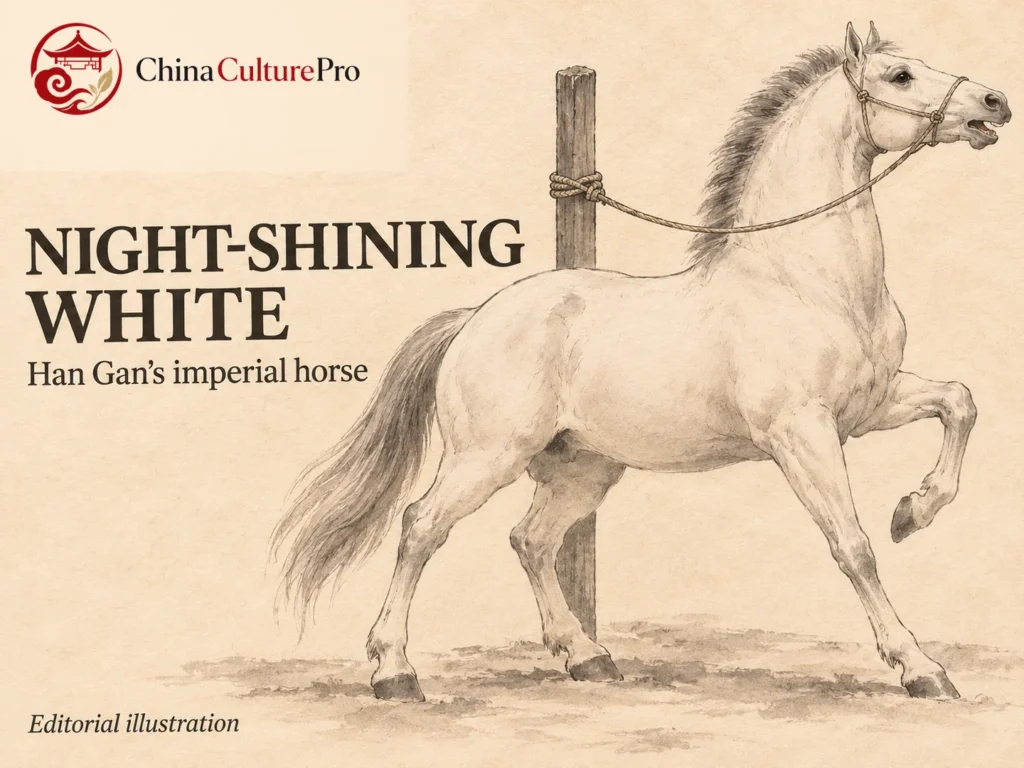
Night-Shining White (照夜白图, Zhào Yè Bái Tú) is a Tang-dynasty horse portrait, dated about 750 and attributed to Han Gan (韩干, Hán Gàn). It depicts a charger of Emperor Xuanzong (唐玄宗, Táng Xuánzōng). The ink-on-paper image measures 30.8 × 34 cm and belongs to the Metropolitan Museum of Art, New York. Its raised head, animated legs, taut tether and subtle shading convey a powerful animal whose energy presses against restraint.[1][2]
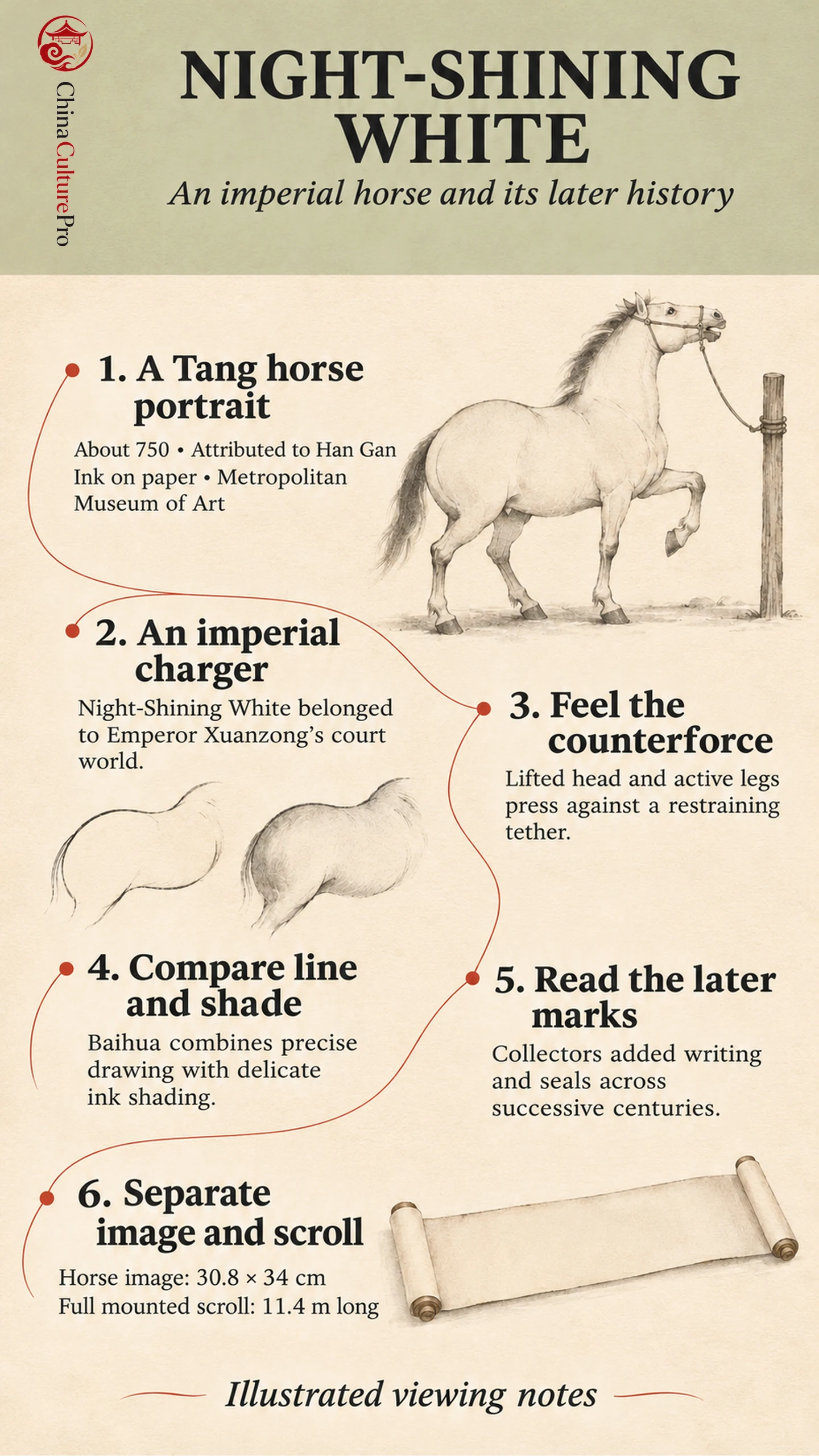
The horse commands attention at the center. Later writing and seals crowd around its body, making this small portrait part of a much larger story of viewing and collecting.
The Painting at a Glance
| 欄目 | Identification |
|---|---|
| 傳統歸屬 | Han Gan |
| 日期 | About 750 |
| 時期 | Tang dynasty |
| Medium and format | Ink on paper, mounted as a handscroll |
| Horse image | 30.8 cm high × 34 cm wide |
| Overall with mounting | 35.4 cm high × 11.4 m long |
| Collection | Metropolitan Museum of Art, New York |
| Accession number | 1977.78 |
The horse image occupies only a small part of the full mounted object. The latter includes additional papers and later writing.[1]
For context on the painter, see Han Gan’s works and artistic legacy. This portrait is especially useful for considering how an animal’s physical appearance can also convey character.
An Imperial Charger with the Force of a Celestial Steed
Night-Shining White was associated with Xuanzong’s imperial stable. A court horse could embody prestige and power as well as an individual animal’s appearance. The portrait’s intensity also evokes traditions about exceptional Central Asian horses understood as celestial steeds or dragons in disguise.[1][2]
Those are cultural associations surrounding a painted charger. They help explain the force of the image without requiring the viewer to treat the horse as a literal supernatural creature.
Look at how little scenery is needed. The body, head, legs and tether provide most of the pictorial argument. Attention stays with the animal’s presence and with the tension between its vigorous movement and the means holding it in place.
The wider guide to horse symbolism in Chinese culture explores related associations. The Tang dynasty context helps place this imperial animal within a court culture in which horses carried considerable status.
Movement Presses Against the Tether
The head rises and the mouth opens, while the mane and alert eye sharpen the sense of animation. The legs take different positions beneath the rounded body. Following them individually helps you see how the animal’s movement is constructed.
Now trace the line of the tether toward the post. Its comparatively firm direction counters the curves and changing angles of the horse. The animal appears capable of movement beyond the small space that contains it.
The post also supplies a strong vertical against the body’s broad horizontal extent. Compare that upright with the lifted head, then follow the curved back toward the hindquarters. The composition develops several directions without needing a landscape around the horse.
This is a useful way to understand the traditional distinction between an animal’s likeness and its spirit. Expression comes through relationships among visible forms: an eye, an open mouth, a lifted hoof and a restraining line work together. You can judge those relationships before assigning a larger allegorical meaning.
Baihua Uses Both Line and Delicate Shading
Two terms help clarify the relationship between contour and modeling in this work:[2]
| 用語 | 意思 |
|---|---|
| Baihua (白画, Bái Huà) | Monochrome ink painting that includes ink shading |
| Baimiao (白描, Bái Miáo) | Line drawing without shading |
Night-Shining White exemplifies the first approach. Its precise drawing is reinforced by delicate tonal shading, so the body acquires volume while the surrounding field remains relatively open.[2]
Compare a contour along the body with the softer tone beside it. The line establishes a boundary; the shading helps a surface turn. Then inspect the head or legs, where smaller changes in the marks can suggest a more angular or tense form.
The distinction matters because monochrome painting is not a single uniform method. Calling every ink image a line drawing would obscure the work done by light washes here. Chinese ink painting provides the broader technical context.
Later Writing and Seals Turn the Image into a Long-Lived Scroll
Successive owners and viewers added seals, inscriptions and comments to the image and its surrounding papers. Those interventions record more than a thousand years of reception and transmission.[1][3]
Examples show how different kinds of response accumulated:
| Later contributor | Contribution to the object’s history |
|---|---|
| Li Yu (李煜, Lǐ Yù), Southern Tang ruler, tenth century | An inscription identifying the portrait with Han Gan |
| Mi Fu (米芾, Mǐ Fú), Song connoisseur, eleventh–twelfth centuries | A written mark and seal associated with his appreciation |
| Qianlong (乾隆, Qiánlóng), Qing emperor, eighteenth century | Poems, inscriptions and imperial seals |
These additions belong to people living after the Tang painter’s time. In particular, a later inscription naming Han Gan should be distinguished from an autograph written by the artist himself.[3]
The marks can initially seem to interrupt the animal. Read them on a second pass as evidence of the work’s changing life: admiration, ownership and historical claims became visible parts of the object. A painting could continue to acquire meaning after its maker put down the brush.[4]
The guide to Chinese painting inscriptions and seals supports this distinction between maker and later appreciator. Chinese hanging scrolls and handscrolls explains how mounting and added papers help present such an extended history.
How to Read the Horse Before the Collectors’ Marks
- Follow the silhouette. Trace the lifted head, curved back and separate legs. Notice how the body’s rounded weight meets more angular gestures.
- Find the counterforce. Follow the tether toward the post. Compare its direction with the animal’s apparent movement.
- Compare line and tone. Inspect a clear contour and a lightly shaded surface. Consider how each contributes to volume and expression.
- Read the later layers. Return to the surrounding writing and seals. Identify them as responses from different periods, keeping them distinct from the horse image.
FAQs About Night-Shining White by Han Gan
Is the entire 11.4-meter scroll a painting of the horse?
No. The horse image measures 30.8 × 34 cm. The overall mounted scroll includes additional papers and later written material.[1]
Did Han Gan add all the red seals and writing?
No. Many marks were added by later collectors and viewers across successive centuries. Their presence is part of the painting’s collecting history.[3]
Does Night-Shining White depict a real horse or a dragon?
It is a portrait of an imperial charger. The dragon and celestial-steed associations belong to the cultural interpretation of the horse’s exceptional force and character.[1][2]
資料來源
[1] Metropolitan Museum of Art. Night-Shining White: collection record, attribution, dimensions and court context
[2] Metropolitan Museum of Art. Anatomy of a Masterpiece: Night-Shining White and the distinction between baihua and baimiao
[3] Metropolitan Museum of Art. Traces of History: Inscriptions, Colophons, and Seal Impressions
[4] Maxwell K. Hearn, Metropolitan Museum of Art. Chinese Painting: reading an image and its accumulated responses