


Quick Answer: Who Was Huang Binhong?
Huang Binhong (黄宾虹, Huáng Bīnhóng; 1865–1955) was a Chinese painter, scholar and teacher known especially for landscape painting. His later reputation centers on dense, layered ink, but his work also includes lighter studies and calligraphy.[1][3][6]
- Medium: Chinese painting in ink, sometimes with color.
- 風格: Interwoven strokes and washes can create depth without covering every opening.
- Approach: Earlier art and encounters with natural scenery informed each other.[5][6][7]
Darkness is an entry point into his paintings, rather than a complete account of their variety.
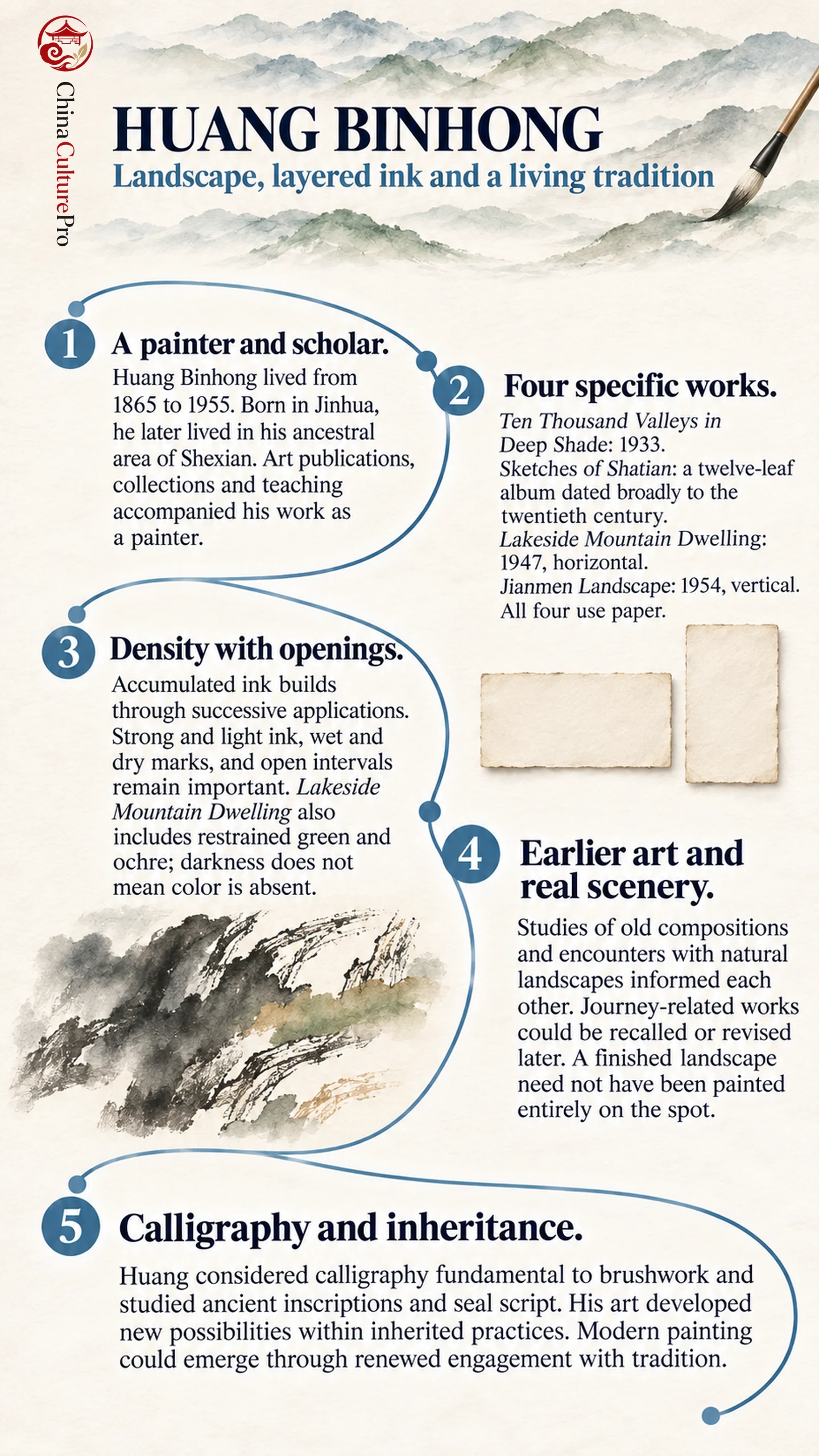
A dense mountain scene can appear almost solid at first, then open into paths, water and intervals between strokes. Huang Binhong’s art rewards this slower looking. Comparing particular works reveals how scholarly study, travel and expressive brushwork contributed to his distinctive landscapes.
A Painter, Scholar and Teacher
Born in Jinhua (金华, Jīnhuá), Zhejiang (浙江, Zhèjiāng), Huang later lived in his ancestral area of Shexian (歙县, Shèxiàn), Anhui (安徽, Ānhuī). Birthplace and family roots should not be conflated.[1]
He worked on art publications in Shanghai and encountered important private collections. After years in Beijing, he became a professor at an art college in Hangzhou in 1948. Writing, examining earlier art and teaching belonged to the same career as painting.[1][2]
Four Works That Show His Range
| Work | Date and medium | Collection |
|---|---|---|
| Ten Thousand Valleys in Deep Shade (万壑深阴图, Wànhè Shēnyīn Tú) | 1933; ink and color on paper | The Metropolitan Museum of Art |
| Sketches of Shatian (沙田即景, Shātián Jíjǐng) | 20th century; twelve-leaf album, ink on paper | The Metropolitan Museum of Art |
| Lakeside Mountain Dwelling (湖滨山居, Húbīn Shānjū) | 1947; ink and color on paper | National Art Museum of China |
| Jianmen Landscape (剑门山水, Jiànmén Shānshuǐ) | 1954; ink and color on paper | National Art Museum of China |
The 1933 landscape was made during travel in Sichuan. The Shatian album’s fresh linear handling offers a contrast to the idea that every work must be heavily darkened. Its museum record gives a broad century date, not a precise year.[2][3]
Lakeside Mountain Dwelling extends horizontally, while Jianmen Landscape is a vertically proportioned work. Their catalogue dimensions make the difference clear: the same painter worked across distinct compositional formats.[4][5]
Layered Ink, Brushwork and Open Spaces
Accumulated ink (积墨, jīmò) builds density through successive applications. In Huang’s practice, stronger and lighter ink, wet passages and drier marks can remain distinguishable within a richly worked surface. The aim is more complex than an opaque black coating.[6]
In Lakeside Mountain Dwelling, the museum identifies concentrated dry ink alongside other ink treatments, with restrained green and ochre. Color and varied moisture contribute to the effect, even when darkness initially dominates.[5]
When looking at ink painting, compare the dense marks with the spaces they leave. Open intervals allow the composition to breathe; rounded, deliberate strokes can retain their identity inside layered masses. Density and legibility work together.[6]
Learning from Earlier Paintings and Real Landscapes
Huang’s studies of earlier paintings (钩古, gōugǔ) extracted compositional relationships. A 2023 China Academy of Art Art Museum exhibition examined this practice alongside his encounters with natural scenery.[7]
The Met connects the 1933 Valleys scroll with Juran (巨然, Jùrán), an earlier landscape painter. Looking at nature and learning from old paintings were compatible activities.[2]
The exhibition account distinguishes travel observation from later recollection and revision. A journey’s landscape might be revisited years afterward, rather than completed entirely on the spot.[7]
Calligraphy and a Legacy within Tradition
Huang considered calligraphy fundamental to brushwork. His interest in ancient inscriptions included seal script (篆书, zhuànshū); the Smithsonian preserves a pair of his calligraphic scrolls.[1]
His legacy lies partly in developing new possibilities within scholarly painting traditions. Earlier models, inscriptions and natural observation became resources for experimentation. His art demonstrates how renewed use of tradition could contribute to modern painting.[6][7]
FAQs About Huang Binhong
Are all Huang Binhong paintings dark landscapes?
No. His reputation includes dense landscapes, but lighter linear studies and calligraphy also survive.[1][3]
Did Huang Binhong paint only in black ink?
No. Several works listed above combine ink with color. Dark ink does not mean color is absent.[2][4][5]
Are his landscape paintings direct records of a single view?
Not necessarily. Travel observation could be revisited through memory, revision and study of earlier compositions.[7]
Is Huang Binhong the same artist as Huang Gongwang?
No. Huang Gongwang (黄公望, Huáng Gōngwàng) belongs to the much earlier Yuan painting tradition. The similar names identify different artists.[8]
資料來源
[1] Smithsonian, National Museum of Asian Art. Couplet in seal script
[2] The Metropolitan Museum of Art. Ten Thousand Valleys in Deep Shade
[3] The Metropolitan Museum of Art. Sketches of Shatian
[4] National Art Museum of China. Jianmen Landscape
[5] National Art Museum of China. Lakeside Mountain Dwelling
[6] Qingdao Art Museum. An analysis of Huang Binhong’s brush and ink
[7] China Academy of Art Art Museum. Night Mountains and Studies of Earlier Painting
[8] Cleveland Museum of Art. Summer Mountains: Huang Gongwang attribution