


Quick Answer: What Are Macau Almond Cakes?
Macau almond cakes are small, pressed biscuits made with mung bean flour and almonds. They have a delicate, crumbly texture rather than the springy crumb of a sponge cake.[1][2]
- Base: mung bean flour, almonds, sugar and fat.
- Shape: often round, with a pattern pressed by a mould.
- Tradition: a Chinese pastry closely associated with Macau’s edible souvenirs.[1][2]
Ingredients vary: some versions contain pork, dairy, peanuts or wheat.[1][3][4]
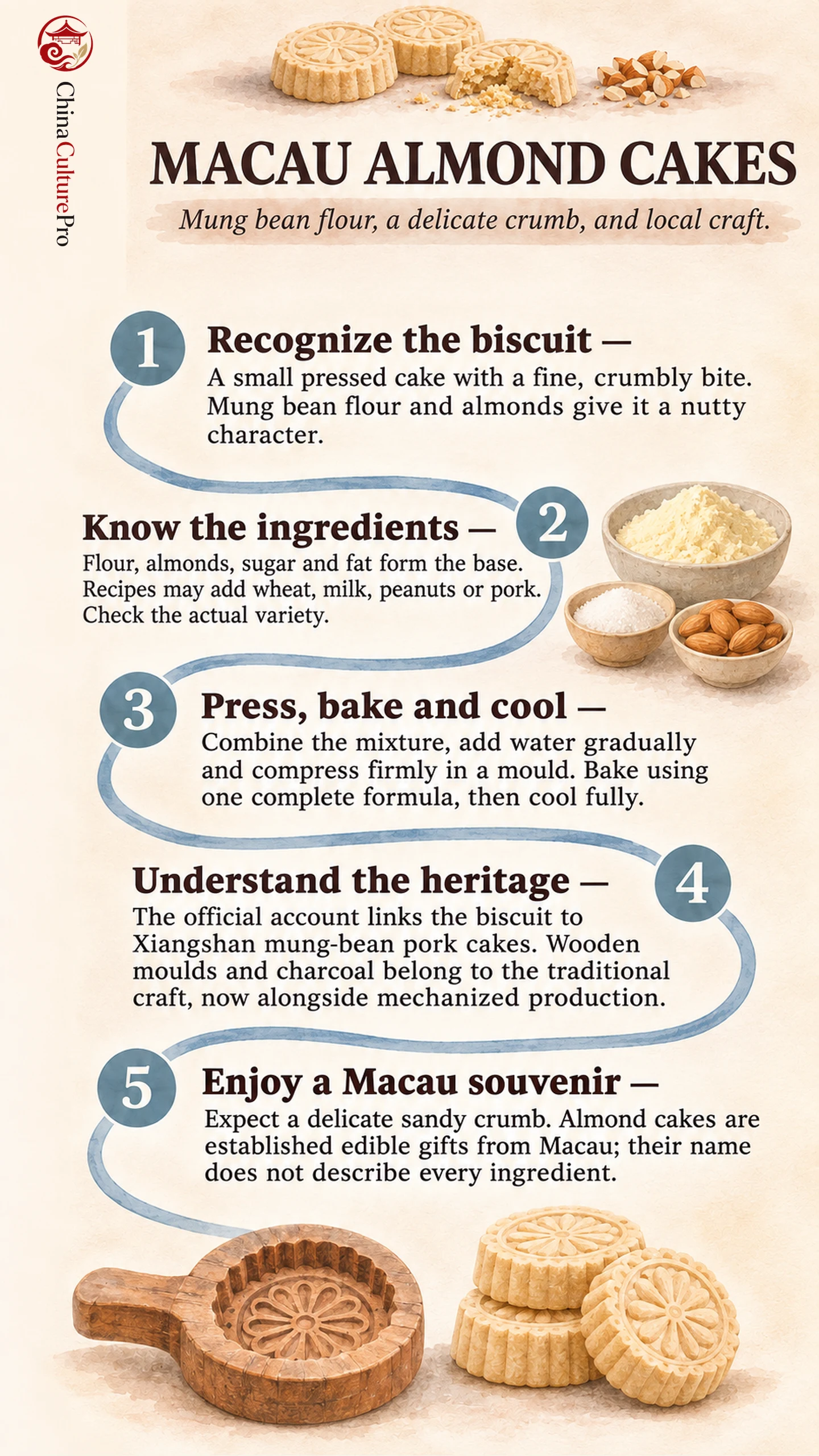
A patterned surface and fine crumb distinguish these small biscuits.[2]
Xing Ren Bing: A Pressed Biscuit, Not a Sponge Cake
Xing Ren Bing (杏仁餅, xìng rén bǐng) is the Chinese name. In Macau, the familiar biscuit is generally round and marked by its mould.[1]
Pressing a sandy mixture firmly into a mould creates its patterned shape before baking.[2]
Mung Bean Flour, Almonds and Changing Recipes
The core ingredients have different jobs:
- Mung bean flour forms the powdery base.
- Ground or chopped almonds bring nut flavour and small pieces of texture.
- Sugar sweetens the mixture.
- Fat helps the mixture bind when compressed.[4]
A commercial example lists vegetable oil, peanut butter and milk powder alongside almonds, mung bean powder and sugar.[3] A home recipe uses butter and a little all-purpose flour.[4]
Traditional meat-filled versions also exist. The heritage description includes sugar-preserved pork among their ingredients.[1]
How Pressing and Baking Create the Biscuit
One home-oven recipe illustrates the process:[2]
- Mix the dry ingredients, then distribute the fat evenly.
- Add water gradually, just until a handful holds together when squeezed.
- Compress the mixture firmly into the mould and release it onto a lined tray.
- Bake and cool completely; this formula uses 135°C for 15–20 minutes.
Use that complete recipe’s quantities and mould size. A different mixture may need different handling and baking.
Traditional craft uses wooden moulds and charcoal ovens; plastic mooncake moulds and domestic ovens are practical home adaptations.[1][2]
From Xiangshan Roots to a Macau Souvenir
The official heritage account traces the biscuit to mung-bean-flour pork cakes from Guangdong’s Xiangshan area, already popular in Macau during the first half of the twentieth century.[1]
It also records the earlier almond-like shape and fragrance behind the name, although present-day biscuits are usually round. Their development into a widely recognized gift connects pastry-making with Macau’s local food culture.[1]
Reading Labels and Enjoying the Crumbly Texture
Expect a biscuit that crumbles easily, with a sandy interior and almond pieces rather than a chewy cake centre.[2]
Read the exact variety before buying. A mung-bean base does not tell you whether wheat, milk, peanut ingredients, lard or meat filling are present.[1][2][3][4] Treat “almond cake” as the pastry name, not a complete ingredient declaration.
FAQs About Macau Almond Cakes
Do Macau almond cakes contain wheat?
Some do. One home recipe includes all-purpose flour, so check the actual ingredient list.[4]
Are all almond cakes vegetarian?
No. Traditional versions can contain pork, and some recipes use lard. Other formulas use vegetable fats.[1][2][3]
Are they all still handmade over charcoal?
No. The heritage account distinguishes surviving handcraft from widespread mechanized production.[1]
資料來源
[1] Macao Cultural Heritage. Confection of almond biscuits
[2] Shiokman Eddie. Macau mung bean almond cookies
[3] Macao Ideas, IPIM. Almond cookies: product ingredients
[4] PY’s Kitchen. Almond Macau cookies