


Quick Answer: What Is Laba Garlic?
Laba garlic(腊八蒜,làbāsuàn)is vinegar-pickled garlic associated particularly with northern Chinese winter food traditions. Its green cloves are a distinctive condiment, with a sour taste and a gentler garlic pungency than the raw ingredient.[1]
- Ingredient: Peeled garlic cloves preserved in vinegar.
- 外觀: Blue-green to jade-green cloves, produced by reactions within the garlic.
- Use: A small accompaniment to meals, especially familiar alongside festive dumplings.
The colour is a recognizable feature of the food. It is not, by itself, a test of whether a particular jar is safe to eat.
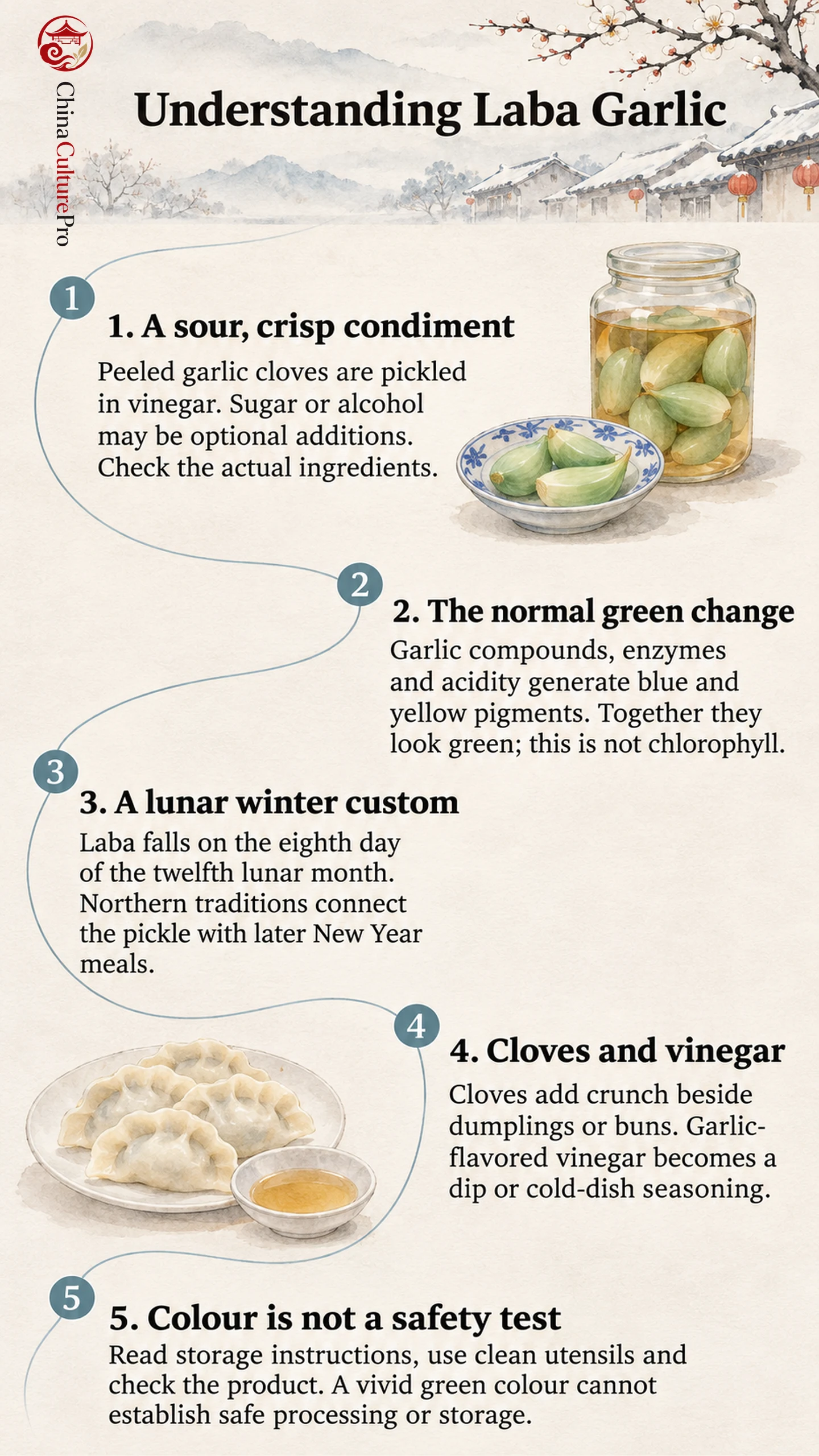
A small dish of jade-green garlic beside steaming dumplings offers two contrasts: a crisp bite against soft dough and a sharp sour flavor against a rich filling. The cloves and the surrounding vinegar have separate uses at the table. Understanding both helps explain why this modest pickle remains part of the northern winter food calendar.
Cloves, Vinegar and the Finished Flavor
In the familiar whole-clove version, the garlic keeps its recognizable shape. Vinegar provides acidity, while processing changes the garlic’s flavor compounds and reduces its intense raw pungency. The resulting taste can combine sourness, a little sweetness and a lingering garlic bite. “Milder” describes a comparison with raw garlic, rather than a promise that every finished clove tastes delicate.[1]
Rice vinegar is a familiar choice. Sugar may be added to adjust flavor, and some versions include alcohol among the additional ingredients. These additions belong to the particular recipe, not to an obligatory national formula.[2] A product containing garlic and vinegar can taste quite different from one with substantial sweetening.
The heat comes primarily from garlic’s own pungency unless chili has been added. Someone who avoids chili should therefore distinguish “no chili” from “no sharp or pungent taste.”
Why Laba Garlic Turns Green
The colour develops through reactions involving garlic’s sulfur-containing compounds, its enzyme alliinase and acidic conditions. Both enzymatic and nonenzymatic stages contribute. Yellow and blue pigment products together create the visible green, and their balance can change as processing continues.[3]
This greening is not the production of chlorophyll by exposure to sunlight. The normal greening of vinegar-pickled garlic does not require added colouring.[4]
The reaction also explains why the calendar date cannot make garlic green on its own. The condition of the raw garlic and the processing environment matter. Different jars need not reach the same shade together. Nor should a laboratory study’s conditions or color-development timetable be treated as a complete home-preservation method.
Greening does not require deliberately adding a microbial starter. That makes the colour reaction different from using a starter culture to ferment a food; it does not establish that a jar is free of microorganisms or contamination.
The Laba Date and Winter Preparation
The Laba Festival(腊八,làbā)falls on the eighth day of the twelfth lunar month. It belongs to the seasonal lead-up to Lunar New Year. Northern traditions include preparing vinegar-pickled garlic for later festive meals, especially dumplings around New Year’s Eve.[5]
The name links the pickle to a customary occasion, rather than requiring preparation on that day. The festival date is not January 8 in the Gregorian calendar. Laba’s Gregorian date changes from year to year.
臘八粥 belongs to the same festival landscape, but a household need not prepare both dishes or follow one uniform menu. Likewise, the winter solar terms and the lunar festival are related seasonal reference points with different ways of fixing their dates.
Serving the Garlic and Its Vinegar
Whole cloves are served in small amounts beside Chinese dumplings or steamed buns. Their crunch and acidity change the balance of a bite rather than replacing the main food. Chopped cloves can also enter a dressing or another dish, where the flavor is distributed instead of concentrated in a whole clove.[6]
The surrounding liquid is commonly called Laba vinegar(腊八醋,làbācù). It picks up garlic aroma and pungency and can serve as a dumpling dip or a seasoning for cold dishes.[5] Cloves add crunch; the vinegar carries the sour-garlic flavor into a dip or dressing. Both appear within the wider range of Chinese New Year foods.
Buying, Handling and Storage Checks
For a ready-made jar, read the ingredient list, storage directions and instructions after opening. Sugar, alcohol or other additions should be checked individually if they matter to your diet. Choose an intact, properly labelled product rather than judging its quality only by how vivid the green looks.
Use clean utensils to remove cloves and avoid introducing food residues into the remaining pickle. Refrigerated storage is part of published guidance for finished Laba garlic; a commercial product’s label provides its specific handling requirements.[2] A traditional winter setting does not make a jar suitable for indefinite storage on a kitchen shelf.
If a product has visible mould, damaged packaging or uncertain storage history, a normal-looking green colour does not resolve the concern. Vinegar pickling belongs within Chinese food preservation, where safe processing and handling are separate questions from a food’s attractive appearance.
FAQs About Laba Garlic
Why does Laba garlic turn green?
Reactions involving garlic compounds, enzymes and acidity produce blue and yellow pigments that appear green together.
Must Laba garlic be made on the Laba Festival?
No. The festival explains the customary timing and name; it does not control the chemical reaction.
Can you use the vinegar as a dipping sauce?
Yes. The garlic-flavored vinegar is a familiar accompaniment to dumplings and a seasoning for cold dishes.
Does green colour prove the garlic is safe?
No. Colour cannot replace checking the product, its processing and its storage conditions.
資料來源
[1] RSC Advances. Chemical changes in Laba garlic during traditional processing
[2] State Administration for Market Regulation, China. Consumer guidance on Laba garlic
[3] Journal of Agricultural and Food Chemistry. Mechanism of green colour formation in Laba garlic
[4] Shanghai Municipal Agriculture and Rural Affairs Commission. Why pickled garlic turns green
[5] China Intangible Cultural Heritage Network. Laba customs and the approach of New Year
[6] Beijing Administration of Traditional Chinese Medicine. Ways of serving Laba garlic