

Quick Answer: Who Was Kublai Khan?
Kublai Khan (忽必烈, Hūbìliè) was a grandson of Genghis Khan and the founder of the Yuan dynasty. He claimed the position of great khan in 1260, proclaimed the Yuan in 1271 and completed the conquest of the Southern Song in 1279.[1][2][3][4]
- Succession: A rival claim divided the Mongol ruling family after the death of the previous great khan.
- Dynasty: The Yuan became a Chinese imperial dynasty under Mongol rule.
- Government: Its court combined existing institutions with people and practices from across Mongol domains.
- Exchange: Passes, ports and trade objects show how people, information and goods moved.[1][2][4][5][6][7][8]
The three dates refer to a claim within the Mongol Empire, a dynastic proclamation and the defeat of a rival state.
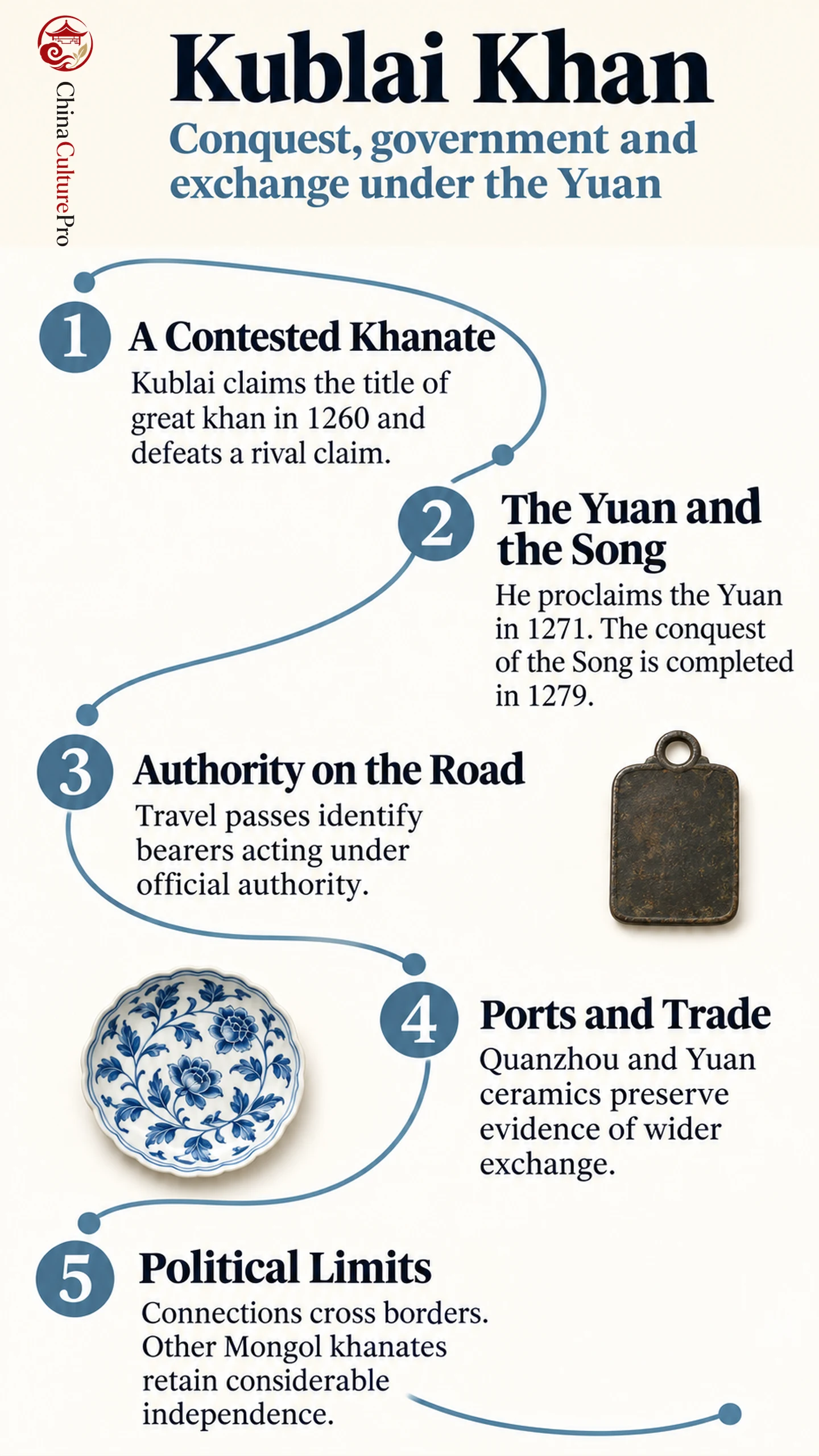
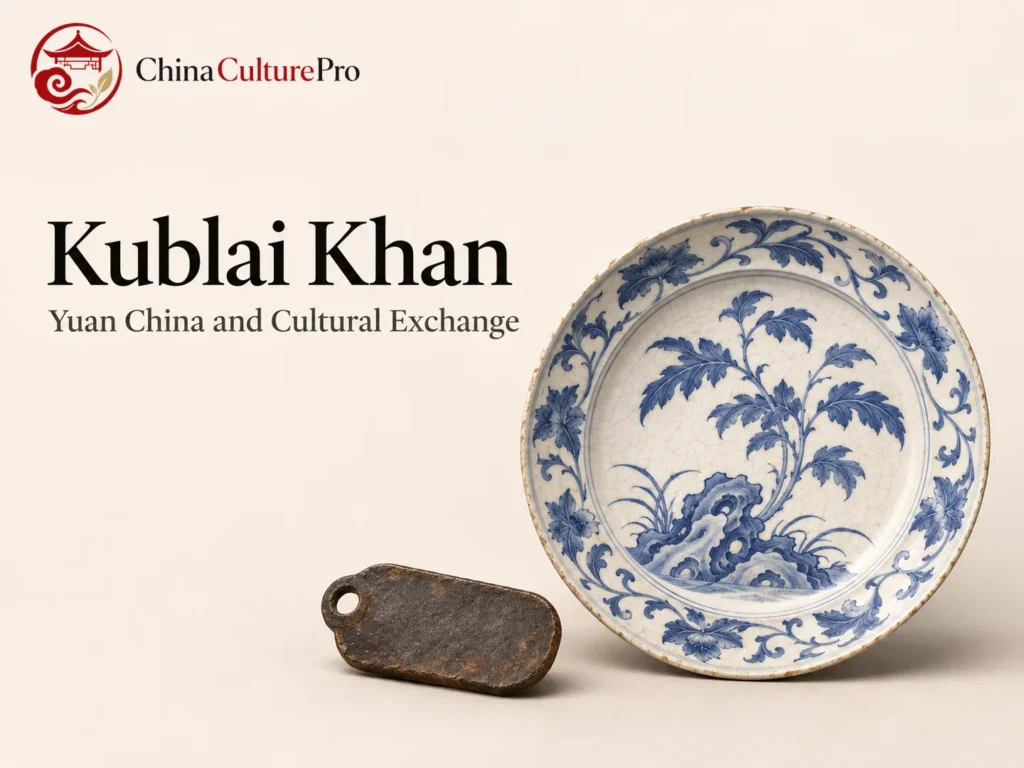
A Yuan travel pass in the Metropolitan Museum of Art is a metal object carrying an order in a script promoted by Kublai’s court. It shows one way the state authorized movement. A ceramic plate and the remains of a busy port provide different evidence about how goods moved between communities.[5][7][9]
From Mongol Succession to Yuan Rule
Kublai claimed the office of great khan in 1260. His brother Ariq Böke claimed it as well, and a succession war followed. Kublai prevailed, but Mongol rulers elsewhere continued to exercise considerable independence. His title expressed a claim to a wider authority than he could consistently exercise across all the khanates.[1][2][4]
He proclaimed the Yuan dynasty in 1271 and made Dadu (大都, Dàdū), in what is now Beijing, the main seat of his government. The dynasty’s Chinese name and capital helped define how Kublai governed his eastern territories. The court could present itself in the language of Chinese dynasties while relying on relationships formed across Mongol domains.[1][3][4]
Conquering the Southern Song
When Kublai proclaimed the Yuan, the Southern Song still ruled much of southern China. Yuan armies continued the campaign, took the Song capital at Hangzhou in 1276 and defeated the last major Song resistance in 1279. The conquest brought populous farming regions and important trading cities under the new court.[2][3][4]
A Chinese dynasties timeline may emphasize 1271 as the beginning of the dynasty or use 1279 to mark the end of the Song and the completion of the conquest. The dates answer different questions about when the court claimed authority and when it took control of the south.[1][3][4]
Governing a Diverse Empire
The Yuan court drew on Chinese administrative practices while employing people with different languages, loyalties and kinds of expertise. Officials had to circulate orders and travel through territories whose local institutions and populations varied. Communication helped a geographically wide government operate, although access to authority was uneven.[4][6]
A safe-conduct pass, or paiza, illustrates that work. The metal example in the Metropolitan Museum bears writing in Phagspa script (八思巴文, Bāsībā Wén), a script developed under Kublai’s patronage. A bearer could present the pass to establish authorization. Its text and portability made official status visible away from the court.[5][6]
Travel, Ports and Objects of Exchange
Quanzhou (泉州, Quánzhōu) was an important port in both the Song and Yuan periods. Surviving sites include places of worship, bridges and places where goods were made. Together with evidence of port administration, they connect ocean routes to work in the city and its hinterland. They show the activity of different communities in a port connected to the Maritime Silk Road before and during Yuan rule.[7]
A fourteenth-century blue-and-white plate in the Metropolitan Museum comes from Jingdezhen. Plants, rocks and melons are painted in cobalt under a transparent glaze. The object illustrates technical developments in wares made during the dynasty and traded beyond China. It was made after Kublai’s death. Its date makes it evidence of a longer pattern of exchange under the Yuan. It offers a point of entry into the history of Chinese porcelain patterns and ceramics traded overseas.[8][9]
Marco Polo’s account offers another view of the court and its routes. As a travel narrative, it preserves what its author chose to relate to readers. Administrative objects and port archaeology help assess particular details independently of the most famous traveler’s account.[5][7][10]
Kublai’s Legacy and the Limits of His Rule
Kublai died in 1294. His successors inherited Yuan institutions and connections, while Mongol states farther west followed their own political courses. Connections across the overland Silk Roads persisted across political boundaries. The extent of those connections and the reach of a ruler’s administration are separate questions.[1][2][3][6]
Among Chinese historical figures, Kublai is a starting point for studying how conquest, government and exchange could develop on different timelines. A proclamation dates a court’s claim. A pass documents one kind of mobility. A port or a ceramic can reveal exchanges that outlasted a single reign.[3][5][7][8][9]
FAQs About Kublai Khan
When did Kublai Khan found the Yuan dynasty?
He proclaimed the Yuan dynasty in 1271. His armies completed the conquest of the Southern Song in 1279.[1][3][4]
Did Kublai Khan rule the entire Mongol Empire?
He claimed the title of great khan and won the succession struggle against his brother. Other Mongol khanates retained considerable independence. His strongest authority was in the eastern territories governed by the Yuan court.[2][4]
What evidence shows cultural exchange under the Yuan?
Safe-conduct passes show how authorities managed some travel. The remains at Quanzhou document port activity, trade and different religious communities. Yuan ceramics show the circulation of materials and designs.[5][7][8][9]
資料來源
[1] The Metropolitan Museum of Art. The World of Khubilai Khan
[2] OpenStax. The Mongol Empire Fragments
[3] The Metropolitan Museum of Art. Yuan Dynasty
[4] The Cambridge History of China. Chinese Society under Mongol Rule
[5] The Metropolitan Museum of Art. Safe Conduct Pass with Inscription in Phakpa Script
[6] Journal of Chinese History. Communications and Communicators in the Yuan and Early Ming
[7] UNESCO World Heritage Centre. Quanzhou: Emporium of the World in Song-Yuan China
[8] Victoria and Albert Museum. Chinese Blue-and-White Ceramics
[9] The Metropolitan Museum of Art. Foliated Plate with Rocks, Plants, and Melons
[10] European Review. Kublai Khan in the Eyes of Marco Polo