

Quick Answer: Who Was Emperor Kangxi?
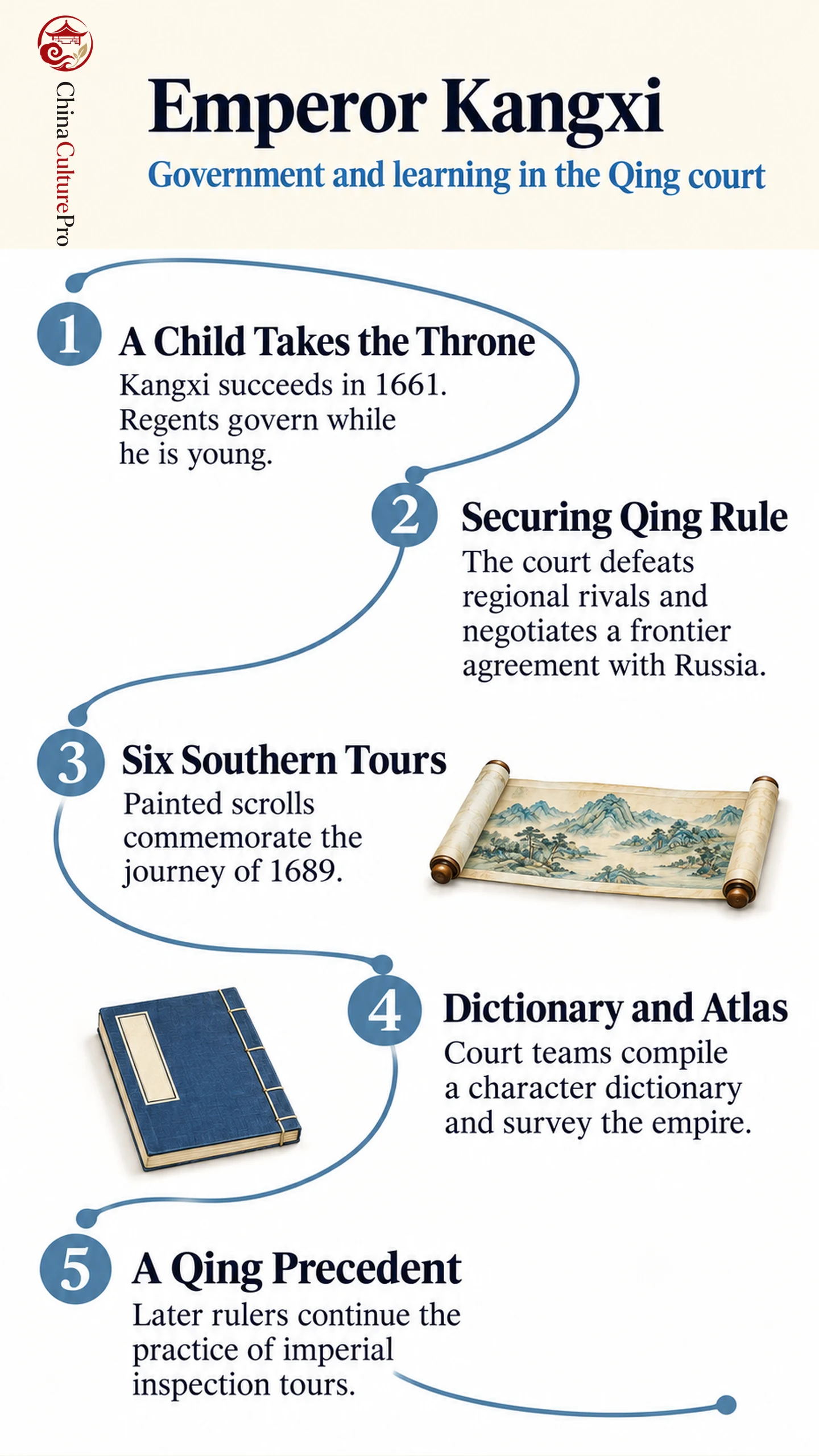
The Kangxi emperor (康熙帝, Kāngxī Dì) was a Qing ruler who took the throne in 1661 as a child and died in 1722. His long reign saw the court consolidate control, conduct repeated southern tours and sponsor projects in language, mathematics and cartography.[1][2][3][6][8][9][10]
- Accession: Regents governed at first. The Kangxi era began in 1662.
- Government: His court faced regional rebellion and negotiated a frontier agreement with Russia.
- Southern tours: Six tours brought the emperor and his entourage into important cities and regions.
- Learning: Scholars and specialists working under the court produced a major character dictionary and a surveyed atlas.[1][2][3][4][6][8][9]
Kangxi was a reign name. The emperor’s personal name was different.
A handscroll of the Kangxi emperor’s southern tour shows a ruler traveling through a landscape his court wanted people to recognize. A surveyed atlas from the same reign shows the Qing world in another format. One arranged the imperial journey as a painted scene. The other organized measurements and place names into maps. Both depended on the work of specialists under court patronage.[7][9]
From Child Emperor to Personal Rule
The emperor’s personal name was Xuanye (玄烨, Xuányè). He succeeded his father in 1661. Accounts sometimes give 1662 as the start because that was the first year of the Kangxi era. A group of regents governed while he was young. One of them, Oboi (鳌拜, Áobài), accumulated considerable influence before his removal in 1669.[1][2][3]
After Oboi’s removal, the Manchu ruling house still needed officials who could administer the Qing dynasty across different regions. Kangxi drew on existing administrative practices and cultivated ties with the scholarly elite. Those efforts belonged to a dynasty whose rulers maintained ties to Manchu culture while governing a diverse empire.[1][3]
Consolidating Qing Power
The Revolt of the Three Feudatories (三藩之乱, Sānfān Zhī Luàn) began in 1673. Powerful regional commanders who had held extensive authority in the south rebelled. The Qing prevailed by 1681, reducing the threat from these large regional military bases.[3]
In 1683 Qing forces defeated the Zheng regime in Taiwan. The court then established Qing administration in parts of Taiwan formerly governed by the Zheng. The northern frontier called for a different approach. The Treaty of Nerchinsk in 1689 set terms between the Qing and Russia after conflict in the frontier region. Defeating an armed rival and negotiating with a neighboring empire were distinct ways of extending or securing the court’s authority.[3][4][5]
The Southern Tours in Paint and Politics
Kangxi made six southern tours. They gave the emperor occasions to see places important to trade and administration, meet officials and make his presence visible. Parts of the itinerary followed the Grand Canal, which carried grain and other goods between regions. Traveling along it put the emperor in view of people living and working on a route that the government depended on.[6]
The court commissioned a set of twelve handscrolls recording the second tour of 1689. In the third scroll, the painter Wang Hui (王翚, Wáng Huī) and his assistants show the journey from Ji’nan toward Mount Tai. The Metropolitan Museum of Art dates its silk scroll to about 1698, several years after the journey. Wang used maps and printed images for a mountain he had never visited. He combined those references with landscape conventions to present the emperor’s journey as an orderly progress through a recognizable world.[7]
The Dictionary, the Atlas and Court Learning
The Kangxi Dictionary (康熙字典, Kāngxī Zìdiǎn) was compiled by scholars under imperial direction. A woodblock edition appeared in 1716. The date refers to the publication, while the name associates the work with the court that ordered it. The work drew on earlier reference books and arranged more than 47,000 entries under 214 radicals. Within a radical group, stroke count helped readers locate Chinese characters. Pronunciations, meanings and quotations made the entries useful for reading older texts.[8]
The Kangxi Atlas (皇舆全览图, Huángyú Quánlǎn Tú) grew out of field surveys conducted from 1708 to 1718. Chinese officials and Jesuit specialists participated. They used measurements and methods including triangulation to map extensive parts of the empire. Other specialists at court worked on astronomy and the calendar. The atlas puts place names and measured positions into a form officials could consult. Calendar work applied a different kind of calculation to a responsibility long associated with the court.[9][10]
Kangxi’s Legacy in the Qing Court
The Qianlong emperor, Kangxi’s grandson, also made six southern tours and commissioned paintings of imperial travel. Comparing their tours shows how a later emperor could use a practice established by his predecessor while directing new projects for his own court.[1][6]
Among Chinese historical figures, Kangxi is often associated with a long reign and the Qing state’s consolidation. The scrolls, dictionary and maps give a more specific record. A painted scroll asks how the court chose to portray the ruler. Dictionary entries and map sheets show how collaborators organized knowledge that could be consulted after his reign.[1][7][8][9]
FAQs About Emperor Kangxi
When did the Kangxi emperor rule?
He took the throne in 1661 and died in 1722. The first calendar year of the Kangxi era was 1662, so some histories give 1662–1722 as the reign dates.[1][2][3]
Did Emperor Kangxi write the Kangxi Dictionary?
He commissioned it. Scholars compiled the entries using earlier dictionaries and other texts. An edition was printed in 1716.[8]
Why did Kangxi travel to southern China?
The tours allowed him to inspect regions, meet officials and display Qing authority. The second tour in 1689 was later represented in a twelve-scroll series.[6][7]
資料來源
[1] Columbia University Asia for Educators. The Kangxi and Qianlong Emperors
[2] The Journal of Asian Studies. Policies and Institutions of the Oboi Regency
[3] Academy of Chinese Studies. Kangxi Emperor
[4] Wiley Encyclopedia of Diplomacy. Treaty of Nerchinsk
[5] University of Washington Taiwan Studies Program. The Real Reason for How Taiwan Became Chinese
[6] Columbia University Asia for Educators. Imperial Inspection Tours
[7] The Metropolitan Museum of Art. The Kangxi Emperor’s Southern Inspection Tour, Scroll Three
[8] The Palace Museum. Compilation of the Kangxi Dictionary
[9] Academia Sinica. Kangxi Atlas
[10] Oxford University Press. The Emperor and His Astronomer