
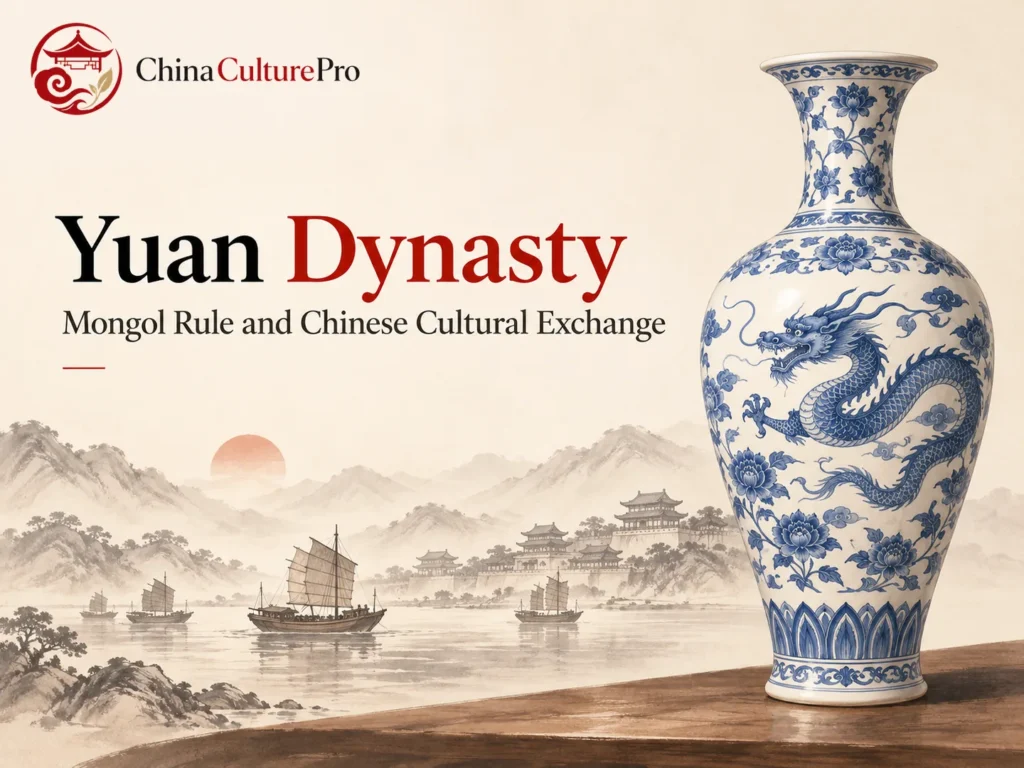

Quick Answer: What Was the Yuan Dynasty?
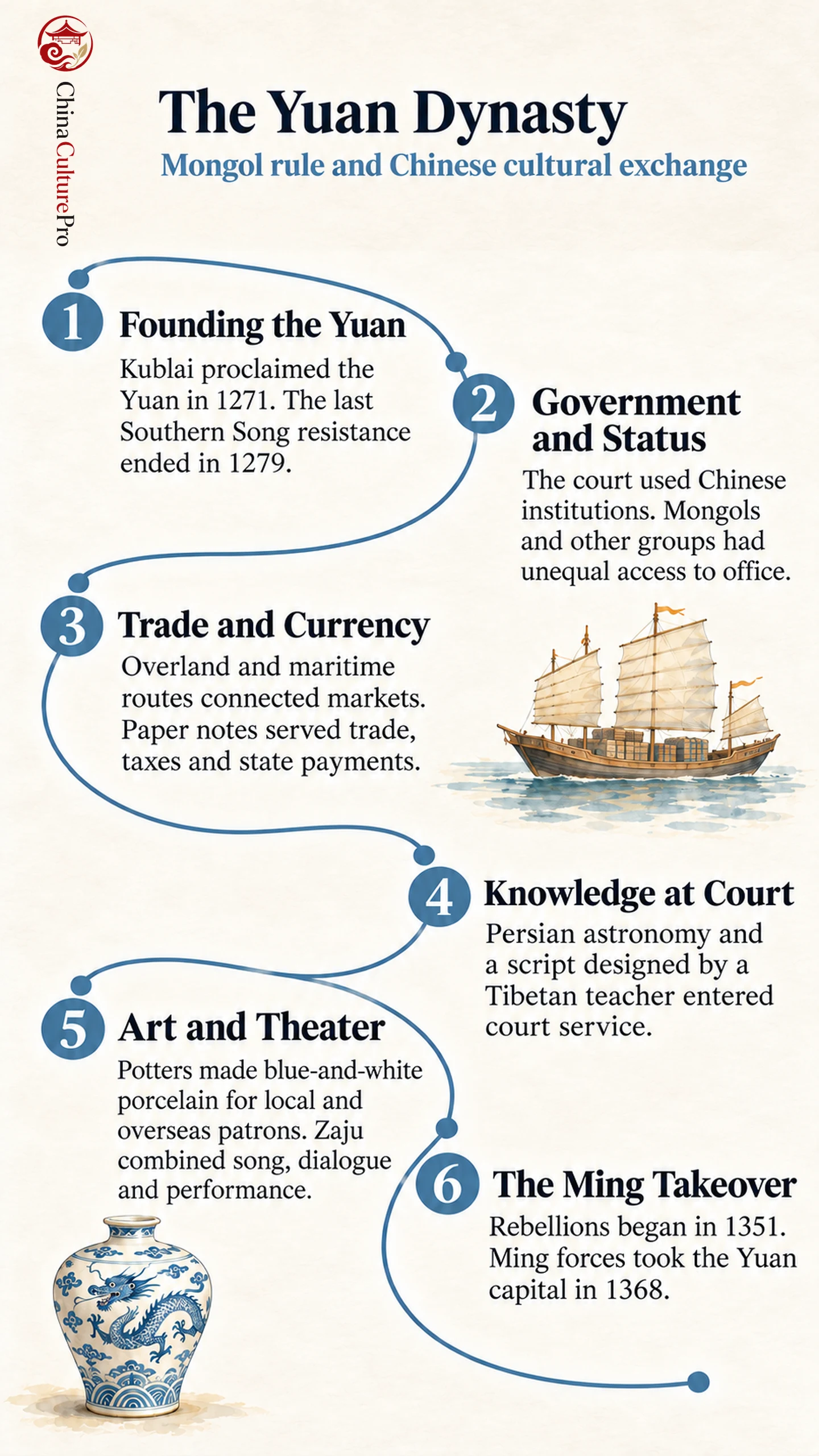
The Yuan dynasty (元朝, Yuán Cháo) was the Mongol-led dynasty proclaimed by Kublai Khan (忽必烈, Hūbìliè) in 1271. His forces defeated the Southern Song (南宋, Nán Sòng) in 1279. The Ming dynasty (明朝, Míng Cháo) took the Yuan capital in 1368.[1][2][3][16]
- Founding: The dynastic proclamation and the completion of the conquest came eight years apart.[1][3]
- Government: Mongol rulers used institutions familiar in China while giving different groups unequal access to power.[1][3][4]
- Exchange: Ports, merchants and court specialists moved goods and knowledge across regions. Chinese workshops and writers also developed work for local audiences.[2][6][7][10][12][15]
The Yuan formed one part of a wider Mongol world whose regions had their own rulers and institutions.
A pair of blue-and-white vases made in 1351 carried a dedication to a temple in China. Their material and their destination tell different parts of the Yuan story. International trade and local patronage could sustain the same craft.[12][13]
Kublai Khan and the Founding of the Yuan
The Mongol conquests began before the Yuan had a dynastic name. Kublai Khan took the title of great khan in 1260, then proclaimed the Great Yuan in 1271. His government built its principal capital at Dadu (大都, Dàdū), on the site of present-day Beijing. The court’s establishment in northern China and the campaign to conquer the south were distinct developments.[1][3][15]
When the last Song dynasty resistance ended in 1279, the court extended its authority over territories with long-established administrative and commercial institutions. Northern China had come under Mongol rule earlier. The sequence matters because a new dynastic title in 1271 and territorial consolidation by 1279 answer different questions.[1][3]
Kublai’s claim to be great khan was contested. His brother Ariq Böke (阿里不哥, Ālǐbùgē) also claimed the title, and the resulting war lasted until Ariq Böke submitted in 1264. Elsewhere in Eurasia, other Mongol khanates developed their own centers of power. Calling Yuan China a part of the Mongol world helps explain the movement of people and goods. It does not make the administration of all those regions identical.[3][6][20]
How the Yuan Governed
The Yuan court employed Chinese officials and drew on previous Chinese administrative practice. It also reserved advantages for Mongols and relied on officials recruited from other parts of Eurasia. Language, a family’s political ties and the region from which a subject came could shape the opportunities available to that person.[1][2][3][4]
Yuan records distinguish categories that are often presented in four broad groupings. Alongside Mongols were semu (色目, sèmù), a grouping that included people of several Inner and West Asian origins. The term hanren (汉人, hànrén) could include subjects from territories formerly ruled by the Jin. The category nanren (南人, nánrén) referred to subjects from the former Southern Song territories. These were historical administrative labels, with meanings shaped by conquest and by the rules for a given office or process.[3][4]
Civil examinations resumed under the Yuan, with examination records from 1315. Groups faced different examination arrangements. The exams show both the return of a familiar institution and the persistence of unequal treatment within it. Holding an examination was one way to recruit officials alongside other forms of entry into government service.[4][5]
Overland Routes, Sea Trade and Paper Money
Mongol support for merchants helped people travel along routes connecting China with Central and West Asia. Maritime networks had a different geography and a longer local history. At Quanzhou (泉州, Quánzhōu), surviving docks, religious buildings and kiln sites connect the coastal city to an inland production network. The Qingjing Mosque (清净寺, Qīngjìng Sì) dates to the Song period. Its presence puts the port’s Muslim community and overseas ties in context before the Mongol conquest.[6][7]
Water routes also connected regions within Yuan territory. The Yuan reconfigured the Grand Canal on a more direct north–south course through Shandong. Moving grain toward the capital depended on infrastructure of this kind, even as seaborne merchants connected the coast with overseas markets.[19]
In the history of Chinese currency, Yuan paper money stands out for the range of payments the state made and accepted in notes. The Yuan used notes for payments such as taxes and official expenses and made them part of everyday transactions. The Zhiyuan notes (至元钞, Zhìyuán Chāo), introduced in 1287, survive in denominations such as two guan. The two-guan inscription records a face value set by the state. To estimate what it would buy at a particular time, historians need a separate record of prices.[8][9]
The same administration that printed the notes had to manage their value. Money could circulate widely while losing purchasing power. Research using recorded issues and prices has found substantial periods of inflation, particularly toward the beginning and end of Yuan rule.[7][8]
People and Knowledge at the Yuan Court
The court recruited specialists from outside China. The Persian astronomer Jamal al-Din brought diagrams and instruments from the Islamic world. His work helped establish an observatory and contributed to the court’s efforts to improve its calendar. The instruments mattered because they gave specialists ways to observe and measure, alongside the techniques already used by astronomers in China.[10]
Kublai also commissioned the Tibetan Buddhist teacher Phags-pa (八思巴, Bāsībā) to create a script for use with several languages of the Mongol domains. The resulting letters appeared on official objects and documents. The script’s intended range was wider than its actual use. Government backing gave it a place in administration, while other forms of writing remained in everyday and literary use.[11]
The script appeared on some Yuan paper notes. The note’s function as currency and the use of its surface for official writing show two ways the court tried to standardize practices across the territories it governed.[8][11]
Porcelain, Painting and Theater
Potters at Jingdezhen (景德镇, Jǐngdézhèn) refined porcelain decorated with cobalt blue beneath a transparent glaze during the Yuan. Their wares reached markets abroad and also served patrons within China. A pair now known as the David Vases carries a 1351 dedication by Zhang Wenjin. He gave the vases and an incense burner to a Daoist temple. The inscription gives a specific date and purpose for two objects in a tradition often discussed in terms of Chinese export porcelain.[12][13]
In painting, Zhao Mengfu (赵孟頫, Zhào Mèngfǔ) used forms and brushwork that referred to earlier art. He also served under the Yuan. In 1296 he painted a groom and horse for a senior official. The pairing could evoke the ability to recognize talent, because a connoisseur’s eye for a good horse served as a metaphor for choosing officials. Serving at court and experimenting with earlier styles could coexist in a single artist’s career.[2][14]
Yuan zaju (杂剧, zájù) combined spoken dialogue, song and staged action. The playwright Guan Hanqing (关汉卿, Guān Hànqīng), who worked in Dadu, is associated with The Injustice to Dou E (窦娥冤, Dòu É Yuān). The play dramatizes a wrongful conviction and the demand that the injustice be recognized. It offers a view of Yuan creative life beyond the court and international trade.[15][18]
The Fall of Yuan Rule in China
The Red Turban uprisings (红巾起义, Hóngjīn Qǐyì) began in 1351. Rebellion developed into prolonged competition among armies and local rulers. The court faced long-running political and financial pressures, while military leaders elsewhere built their own bases. In Huizhou, a general serving the future Ming founder took control in 1357, eleven years before the new dynasty was formally founded. The sequence helps explain why the transition had a different date for some local officials than it did for the royal court.[8][16][17]
Zhu Yuanzhang (朱元璋, Zhū Yuánzhāng) founded the Ming dynasty in 1368. Ming forces took Dadu, and the Yuan emperor Toghon Temür (妥懽帖睦尔, Tuǒhuān Tiěmù’ěr) withdrew north. Mongol political authority continued beyond the territory the Ming took over. The date 1368 marks the end of Yuan dynastic rule in China in the standard chronology.[1][2][16][17]
FAQs About the Yuan Dynasty
Why do the Yuan dynasty’s starting dates differ?
Kublai announced the dynasty in 1271 and his forces completed the conquest of the Southern Song in 1279. A timeline can use either date depending on whether it is tracking the founding proclamation or the completion of conquest.[1][3]
Was the Yuan dynasty the same as the Mongol Empire?
The Yuan was the dynasty ruled by Kublai and his successors in China and neighboring regions. The wider Mongol world also included separate khanates across Eurasia. Commercial and cultural contacts connected these domains even when their rulers pursued different policies.[3][6]
Did the Yuan invent paper money?
Paper money already circulated under the Song. The Yuan expanded the role of government-issued notes in taxation, payments and commerce. It introduced new issues, including the Zhiyuan notes in 1287.[8][9]
資料來源
[1] Smithsonian National Museum of Asian Art. Yuan Dynasty Overview
[2] The Metropolitan Museum of Art. Yuan Dynasty, 1271–1368
[3] Cambridge University Press. Chinese Society Under Mongol Rule, 1215–1368
[4] Harvard-Yenching Institute. Ethnicity, Political Institutions and the Yuan
[5] Princeton University Department of History. A Cultural History of Civil Examinations in Late Imperial China
[6] Columbia University Asia for Educators. Mongol Support for Trade
[7] UNESCO World Heritage Centre. Quanzhou: Emporium of the World in Song–Yuan China
[8] The Economic History Review. The Rise and Fall of Paper Money in Yuan China, 1260–1368
[9] National Museum of China. Zhiyuan Circulating Treasure Note, Two Guan
[10] Columbia University Asia for Educators. Astronomy in Mongol China
[11] Columbia University Asia for Educators. The Mongol Script
[12] British Museum. Chinese Ceramics Gallery Guide: The David Vases
[13] Victoria and Albert Museum. Chinese Blue-and-White Ceramics
[14] The Metropolitan Museum of Art. Zhao Mengfu: Grooms and Horses
[15] The Chinese University of Hong Kong. Guan Hanqing
[16] Journal of Chinese History. Dynastic Transition and Local Experience: Zhao Pang Between the Yuan and Ming
[17] Cambridge University Press. Shun-ti and the End of Yuan Rule in China
[18] Academy of Chinese Studies. Guan Hanqing and Yuan Zaju Drama
[19] ICOMOS and UNESCO World Heritage Centre. The Grand Canal: Advisory Body Evaluation
[20] ISEAS–Yusof Ishak Institute. Mongol Succession and Kublai’s War with Ariq Böke