
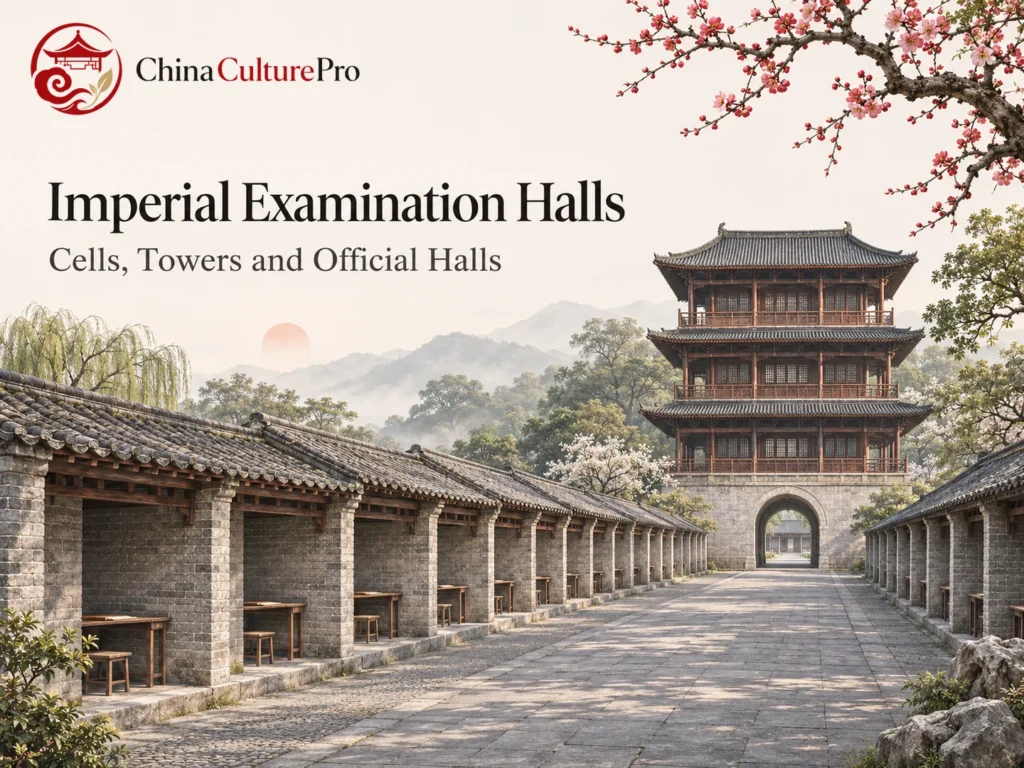

Quick Answer: What Was an Imperial Examination Hall?
A gongyuan (贡院, gòngyuàn) was an examination compound where candidates sat written papers for China’s civil service examinations. At Nanjing’s Jiangnan Gongyuan (江南贡院, Jiāngnán Gòngyuàn), rows of cells for candidates stood alongside buildings for supervision and administration.[1][5]
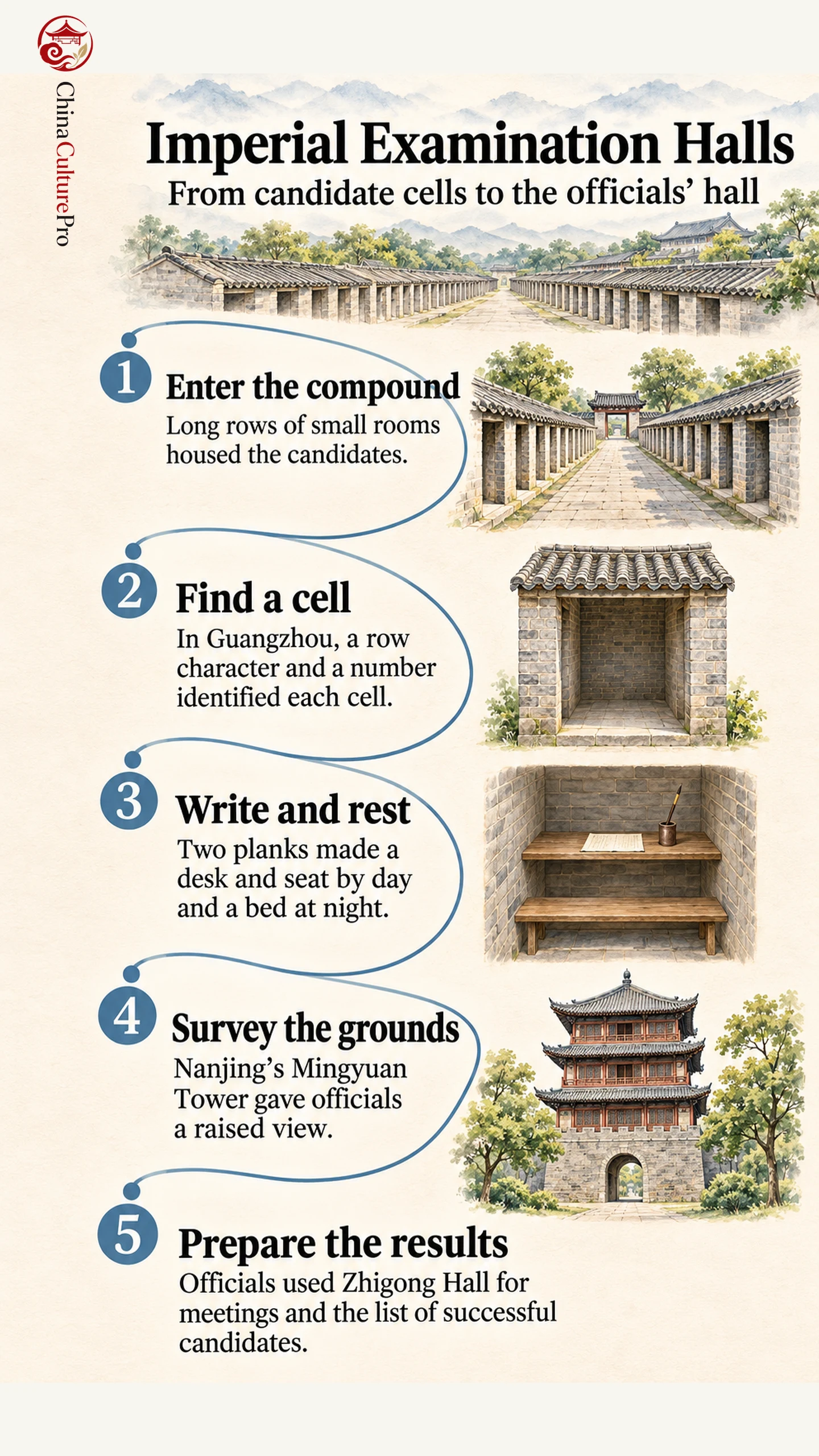
- One cell per candidate: A small compartment called a haoshe (号舍, hàoshè) served as a writing place and somewhere to sleep during a session.[2][3]
- Supervision: Officials used a high tower at Nanjing to survey the grounds.[1]
- Administration: A separate hall gave officials room for paperwork and preparing the list of successful candidates.[1]
The grounds tell one part of the story of the Chinese imperial examinations. These examples focus on provincial exams in the late imperial period.
A photograph taken in Guangzhou in the 1870s shows a straight path bordered by rows of low rooms. The Hong Kong Museum of History identifies the structure at the far end as a supervision tower. The low buildings on either side housed the candidates.[3]
How the Examination Cells Worked
In Guangzhou, each row took its name from one character in the Thousand Character Classic (千字文, Qiānzìwén). A number attached to that character identified the candidate’s particular compartment. An official could identify a cell by its row character and number.[3]
Nanjing’s museum describes how candidates shifted two wooden planks inside a cell. By day one plank served as a desk while the other served as a seat. When set together at the same height, the two formed a sleeping surface. Meals also took place in the cells during exam sessions.[2][5]
Where Supervisors and Officials Worked
At Jiangnan Gongyuan, supervisors used the elevated Mingyuan Tower (明远楼, Míngyuǎn Lóu) to look out over the grounds during provincial exams.[1] Its height gave it a different function from the rows of low candidate cells.
The nearby Zhigong Hall (至公堂, Zhìgōng Táng) accommodated officials’ meetings and administrative work. The successful candidates’ list was prepared there.[1] For those who passed, higher exams lay ahead on the route to a career as a scholar-official.
What Survives in Nanjing and Guangzhou
The Nanjing museum grew around historic remains at the old site, including the tower and a bridge. Its newer exhibition galleries extend underground.[4] The Guangzhou photograph shows the spacing and repeated forms in a different compound while it still had rows of cells.[3]
FAQs About Imperial Examination Halls
Why Were the Cells So Small?
Each cell served one candidate. A compact compartment could accommodate the desk, seat and sleeping surface within a row of many similar rooms.[2][5]
Were All Examination Levels Held at a Gongyuan?
Exam venues depended on the level and period. After the Ming capital moved to Beijing, the Nanjing compound continued to host provincial examinations. Later stages included a metropolitan examination and a palace examination.[1]
Can You Still See an Examination Compound?
At Nanjing’s Imperial Examination Museum, the site includes Mingyuan Tower and displays of examination cells alongside modern galleries.[4]
資料來源
[1] Nanjing Imperial Examination Museum. Permanent Exhibition
[2] Nanjing Imperial Examination Museum. An Introduction to Examination Cells and Museum Displays
[3] Hong Kong Museum of History. An Examination Compound in Guangzhou, Photo AC8.A.16
[4] Qinhuai District People’s Government. Nanjing Imperial Examination Museum and Jiangnan Gongyuan
[5] Nanjing Imperial Examination Museum. Experience an Examination from the Past