


Quick Answer: What Is Jingning Roast Chicken?
Jingning shao ji (静宁烧鸡; Jìngníng shāo jī) is a whole-chicken specialty from Jingning, Gansu. It is also called lu ji (卤鸡; lǔ jī), reflecting the importance of cooking in seasoned braising liquid.[4]
- Chicken: Local chicken is central to the regional description.[1]
- Flavor: A rich aromatic broth seasons the meat during gentle cooking.
- Method: Some accounts describe frying before braising; others document direct braising.[2][3]
The familiar English name “roast chicken” does not mean that an oven produces the dish’s defining flavor. Read the actual cooking method rather than translating the name into an oven recipe.
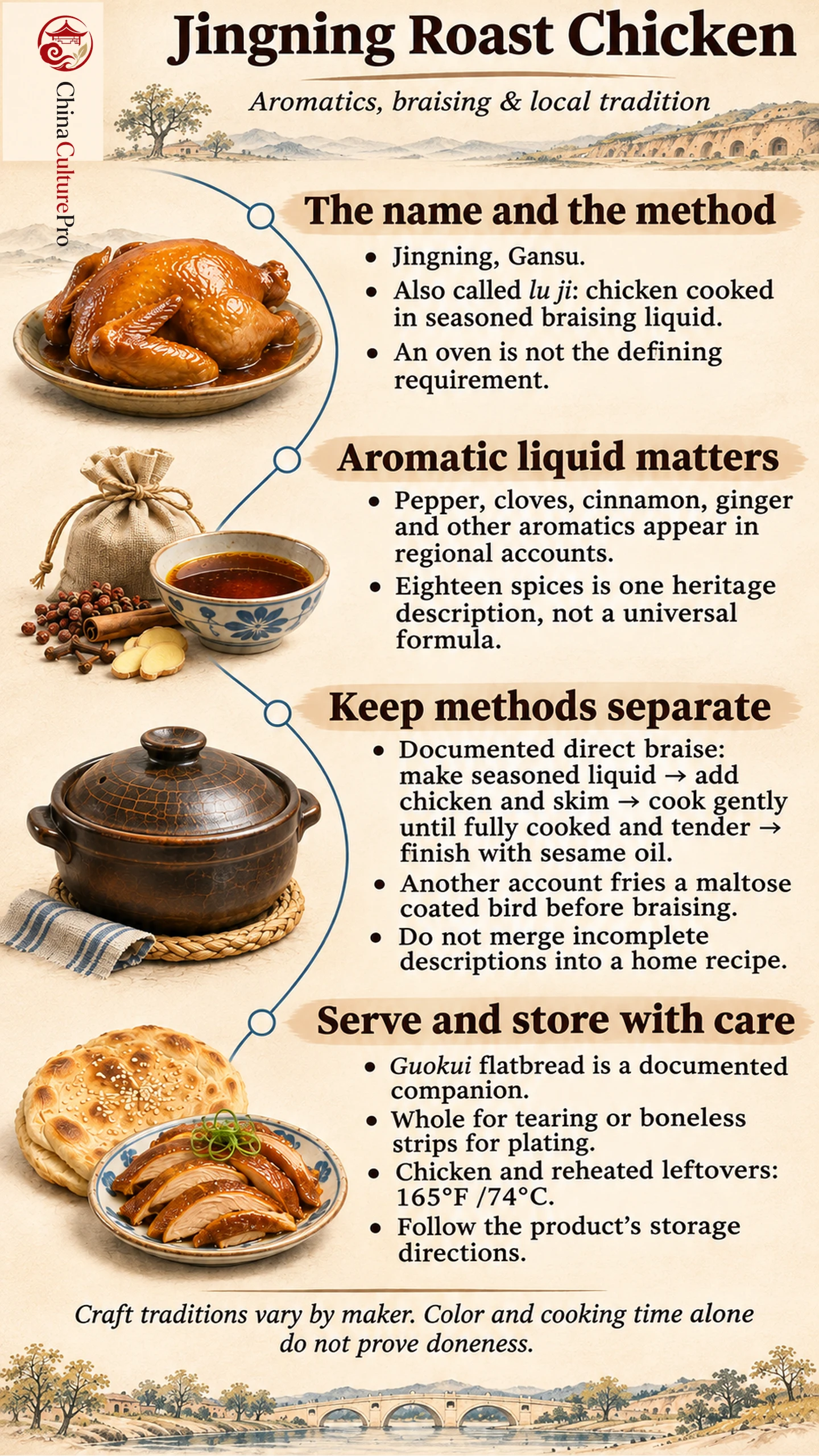
The golden to reddish-brown skin may suggest roasting, but aromatic liquid shapes the flavor. This guide separates documented cooking methods and explains the finished chicken’s place in local meals.
Chicken and the Aromatic Braising Liquid
The central cooking liquid is lu shui (卤水; lǔ shuǐ), a seasoned braising broth. One regional account lists pepper, cloves, cinnamon bark, dried tangerine peel, ginger, Sichuan pepper, tsaoko, angelica root, fennel, scallions and MSG among the seasonings.[2]
That list describes a cooking tradition, not a compulsory shopping formula. The official heritage profile mentions eighteen aromatics, including cloves and Chinese angelica, while other records give different selections. It would be misleading to turn those accounts into one universal eighteen-spice recipe.[1]
For an introduction to common blends, see Chinese five spice. A prepared five-spice powder, however, does not automatically reproduce a particular maker’s Jingning braising liquid. The spice selection and proportions belong to the chosen recipe.
An old broth is part of some makers’ identity. In a recorded interview, Wang Dongsheng describes a broth inherited from his father and maintained over many years. That is a family account of continuity, rather than evidence that keeping any pot of stock makes it safe indefinitely.[4]
How the Documented Braising Method Works
A regional method record describes a thirty-chicken batch. The following overview retains its cooking sequence without inventing a reduced home formula or copying its slaughter and cleaning instructions.[3]
- Prepare the braising liquid: Place the aromatics in a cloth bag and simmer them in water with salt and sugar.
- Braise the chicken: Add the prepared whole chicken, bring the liquid to a boil and skim the foam. Reduce the heat and cook gently until fully cooked and tender.
- Finish with sesame oil: Lift the chicken out and brush it with sesame oil. The regional method describes several hours of braising rather than one fixed cooking time.
A separate account describes coating the bird with maltose, frying it and then cooking it in aromatic braising liquid. That preliminary frying stage belongs to that version; it should not be silently added to the direct-braising method above.[2]
Neither outline supplies everything needed for a tested home recipe. If cooking the dish, use a complete recipe with a defined chicken size, liquid quantity and seasoning amounts. Do not use time alone to determine doneness.
Chicken must reach 165°F (74°C), checked with a food thermometer. Golden skin or tender-looking meat is not a reliable safety test.[6]
The guide to Chinese cooking methods places this gentle liquid cooking alongside other techniques.
Local Variations and the Jingning Tradition
Variation is clearest at the level of maker and process. Wang Dongsheng’s interview describes an older wood-fire smoking stage fading from production, with seasoned stock becoming the main cooking medium. That account should not be expanded into a claim that every shop follows the same historical sequence.[4]
The cooking craft entered Gansu’s provincial intangible cultural heritage list in 2011. The official profile also repeats a tradition connecting production with the Tongzhi reign, but presents it as something handed down in local accounts, not a documented invention date.[1]
A 2025 county development plan proposes further standardization, including a braising-time indicator of at least six hours. This is a policy proposal within an industry-development document, not proof that every historical or household preparation used six hours. Its proposed new flavors likewise do not establish existing regional schools.[5]
Serving, Buying and Keeping the Chicken
Guokui (锅盔; guōkuī), a substantial flatbread, is a documented companion to Jingning chicken. Restaurant presentation may use neatly arranged boneless strips, while informal meals may involve tearing meat from the whole bird.[2]
See Chinese flatbreads and pancakes for the wider bread family. For a shared meal, ask whether the seller will portion the chicken and whether bones remain, rather than assuming every platter is boneless.
The dish also has a gift-giving history. In the recorded family interview, Wang recalls travelers spreading its reputation and people taking chickens when visiting relatives. This is specific testimony about one family’s experience, not a requirement attached to every visit.[4]
For takeaway chicken, follow the package’s storage and reheating directions. Refrigerate perishables within two hours, or one hour above 90°F (32°C); divide large amounts into shallow containers for cooling. Reheated leftovers should reach 165°F (74°C).[6]
FAQs About Jingning Roast Chicken
Is Jingning roast chicken cooked in an oven?
The documented methods here center on braising in seasoned liquid. One also includes frying before the braise; an oven is not the defining requirement.[2][3]
Must every Jingning chicken use eighteen spices?
No. The official heritage profile mentions eighteen aromatics, but that description does not establish one universal formula for every maker.[1]
What is traditionally served with Jingning chicken?
Guokui flatbread is a documented local accompaniment. The chicken may be served whole for tearing or arranged as boneless strips.[2]
資料來源
[1] Pingliang Culture and Tourism Bureau. 静宁烧鸡制作技艺
[2] Lanzhou Morning Post, local food report via Gansu Economic Information. 【非遗】静宁烧鸡 边撕边吃,快乐旅途
[3] Gansu Economic Information, regional method record. 静宁烧鸡
[4] China News Service, original interview with Wang Dongsheng. 丝路驿站四代“烧鸡”:从“奢侈品”到家常美味
[5] Jingning County Government. 静宁县加快烧鸡大饼产业品牌建设实施方案
[6] US Food and Drug Administration. Safe Food Handling