


Quick Answer: What Is a Feiyu Robe?
The feiyu robe (飞鱼服, fēiyúfú) is a Ming garment with a mythical flying fish design. The court could grant garments with this motif as cifu (赐服, cìfú), or bestowed dress.[1][2]
- Motif: A dragon-like head and a fish tail are useful clues.[1]
- Cut: A surviving example has a crossed front and a pleated lower section.[3]
- Setting: Bestowal was a court privilege. Some palace attendants also wore the motif in ceremonial settings.[2][4]
Look at the decoration and the garment construction separately.
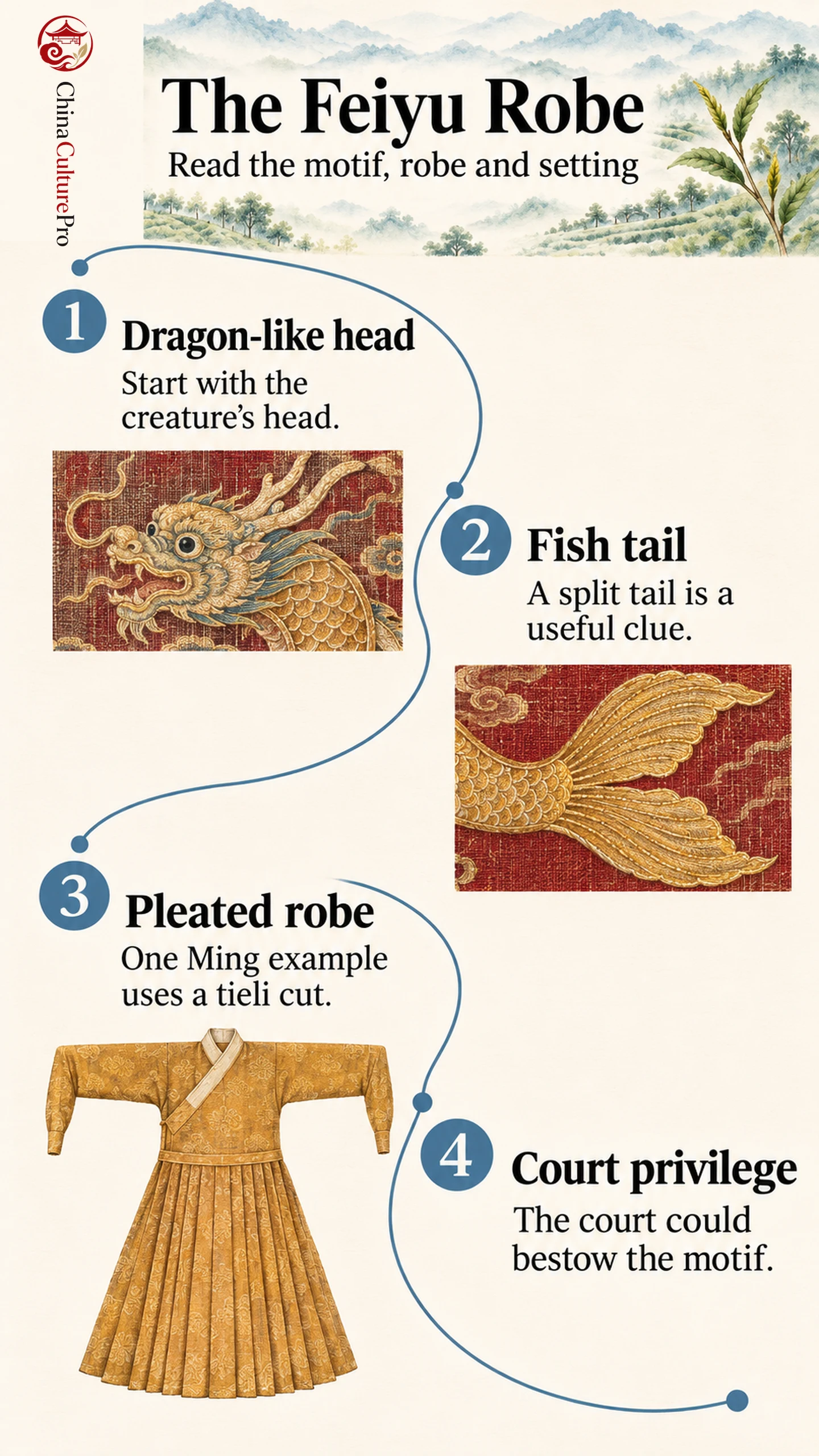
Reading the Flying Fish Motif
One version has a dragon’s head, fins or wings and a split fish tail. Variants can have different numbers of limbs. Some late Ming motifs look much closer to a mang (蟒, mǎng), a dragon-like design used on other bestowed clothes.[1][3]
Inside the Confucius Family Tieli
A Ming tieli (贴里, tiēlǐ) in the Shandong Museum survives from the Confucius family collection. The 125 cm robe has a right-closing overlap, broad sleeves that narrow at the cuffs, and a lower section joined at the waist and pleated.[3]
The shoulder, sleeve and knee areas of the garment carry the woven motif. Gold and coloured silk threads help define the pattern.[2][3]
Imperial Gifts and the Jinyiwei
Feiyu robes appear in accounts of the Jinyiwei (锦衣卫, Jǐnyīwèi), the Ming imperial guard. The court could also bestow them on other recipients.[2]
In 1537, the Jiajing emperor objected to what he took for a mang robe on the minister Zhang Zan. Grand Secretary Xia Yan explained that it was a bestowed feiyu robe. The episode shows why identifying the pattern by horns or colour alone can be difficult.[4]
Wearing a Modern Feiyu Robe
Ask for a close view of the creature’s tail and a full view of the waist seam. Check whether the pleats open enough for a normal stride and compare sleeve and cuff dimensions separately. For a historical interpretation, choose a reference from the same setting for belts 及 official headwear.
FAQs About the Feiyu Robe
Did Every Ming Guard Wear Feiyu?
Permission depended on the wearer and the occasion. Historical records also show bestowed examples outside the guard.[2][4]
Was Feiyu the Name of a Robe Cut?
Feiyu names the decoration. Tieli names the cut of the pleated Shandong Museum example.[1][3]
Do All Flying Fish Motifs Have Wings?
The motif varies. Some later examples resemble other dragon-like court motifs while retaining a fish tail.[1][3]
資料來源
[1] 故宮博物院。 The Flying Fish Motif in Ming Dress and Objects
[2] Shandong Museum and China Cultural Centre in Singapore. Flying Fish Tieli From the Confucius Family Collection
[3] Guo Zheng. Dress in the Confucius Family Collection
[4] History of the Ming. Dress Regulations for Civil and Military Officials