


Quick Answer: What Is a Feiyu Robe?
The feiyu robe (飞鱼服, fēiyúfú) is a Ming garment with a mythical flying fish design. The court could grant garments with this motif as cifu (赐服, cìfú), or bestowed dress.[1][2]
- Motif: A dragon-like head and a fish tail are useful clues.[1]
- Cut: A surviving example has a crossed front and a pleated lower section.[3]
- Setting: Bestowal was a court privilege. Some palace attendants also wore the motif in ceremonial settings.[2][4]
Look at the decoration and the garment construction separately.
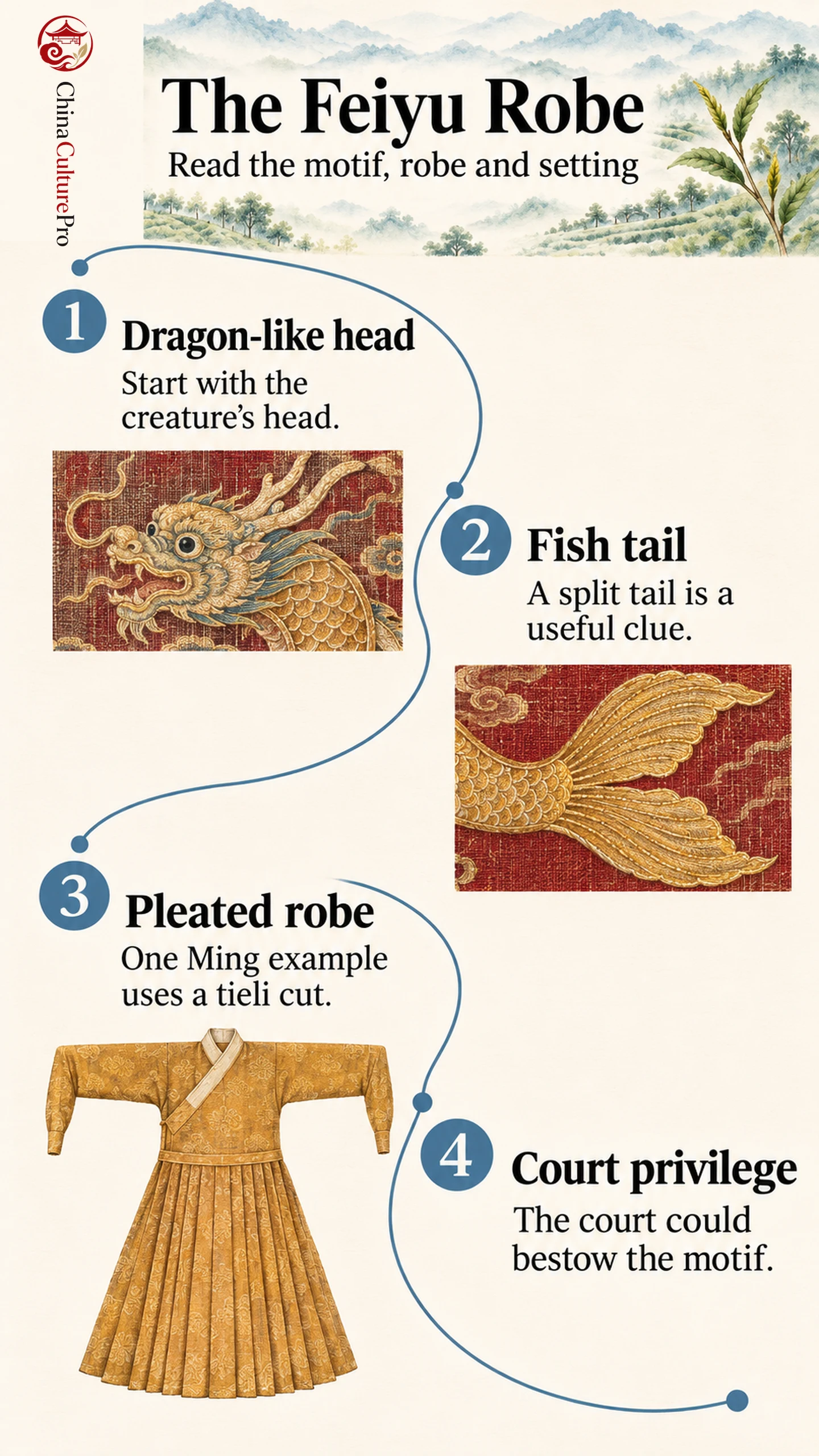
Reading the Flying Fish Motif
One version has a dragon’s head, fins or wings and a split fish tail. Variants can have different numbers of limbs. Some late Ming motifs look much closer to a mang (蟒, mǎng), a dragon-like design used on other bestowed clothes.[1][3]
Inside the Confucius Family Tieli
A Ming tieli (贴里, tiēlǐ) in the Shandong Museum survives from the Confucius family collection. The 125 cm robe has a right-closing overlap, broad sleeves that narrow at the cuffs, and a lower section joined at the waist and pleated.[3]
The shoulder, sleeve and knee areas of the garment carry the woven motif. Gold and coloured silk threads help define the pattern.[2][3]
Imperial Gifts and the Jinyiwei
Feiyu robes appear in accounts of the Jinyiwei (锦衣卫, Jǐnyīwèi), the Ming imperial guard. The court could also bestow them on other recipients.[2]
In 1537, the Jiajing emperor objected to what he took for a mang robe on the minister Zhang Zan. Grand Secretary Xia Yan explained that it was a bestowed feiyu robe. The episode shows why identifying the pattern by horns or colour alone can be difficult.[4]
Wearing a Modern Feiyu Robe
Ask for a close view of the creature’s tail and a full view of the waist seam. Check whether the pleats open enough for a normal stride and compare sleeve and cuff dimensions separately. For a historical interpretation, choose a reference from the same setting for belts および official headwear.
FAQs About the Feiyu Robe
Did Every Ming Guard Wear Feiyu?
Permission depended on the wearer and the occasion. Historical records also show bestowed examples outside the guard.[2][4]
Was Feiyu the Name of a Robe Cut?
Feiyu names the decoration. Tieli names the cut of the pleated Shandong Museum example.[1][3]
Do All Flying Fish Motifs Have Wings?
The motif varies. Some later examples resemble other dragon-like court motifs while retaining a fish tail.[1][3]
出典
[1] 故宮博物院。 The Flying Fish Motif in Ming Dress and Objects
[2] Shandong Museum and China Cultural Centre in Singapore. Flying Fish Tieli From the Confucius Family Collection
[3] Guo Zheng. Dress in the Confucius Family Collection
[4] History of the Ming. Dress Regulations for Civil and Military Officials