
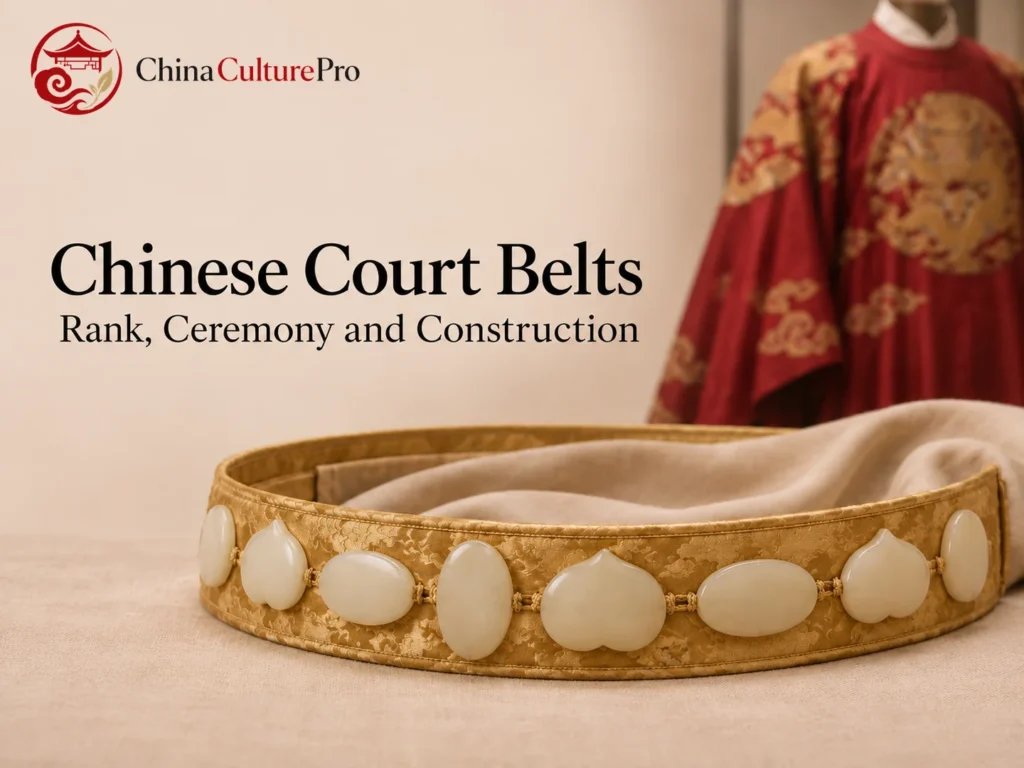

Quick Answer: What Is a Chinese Court Belt?
A Chinese court belt was a waist accessory worn with regulated dress. In Qing usage, a chaodai (朝带, cháodài) was the belt worn with chaofu (朝服, cháofú), or court dress. Its colour, fittings and stones could vary with the occasion and the wearer’s position.[3]
- Ming dress: An official’s ceremonial outfit could include both a silk belt and a separate decorated leather belt.[1]
- Qing dress: Court belts could carry fitted plaques and small hanging accessories.[3]
- Identification: The rest of the outfit helps establish the context for a belt.
A court belt belongs to the same dress system as Chinese official hats and other markers of office.

In a portrait, the visible belt surface may look like a single strip. Excavated examples can show the layered construction that held it in place.
The Belt Within Ming Court Dress
The History of the Ming lists a silk belt and a leather belt in the 1393 rules for officials’ court audience dress. It distinguishes materials by rank. The first rank used jade fittings, while the sixth and seventh used silver. The dress rules also specify a headpiece and a pendant sash, so the belt materials are one of several features that varied by rank.[1]
A belt from the imperial tomb of Dingling (定陵, Dìnglíng) has yellow satin over inner layers of gauze and leather. According to the excavation account quoted by the National Museum of China, an inner strap passed through the fastening and the outer band covered the clasp. The object preserves evidence of the hidden working parts beneath the jade belt ornaments.[2]
How Qing Court Belts Marked Occasion
The occasion could determine the shape of a Qing belt fitting. A Palace Museum account describes an emperor’s belt for court ceremonies with four round gold fittings and a belt for sacrifices with four square fittings. The square fittings carried different stones for different sacrifices.[3]
The same study describes a separate distinction among court ranks. For one set of titled ranks, the number of freshwater pearls attached to each fitting changed with the wearer’s position. A Palace Museum portrait study also distinguishes imperial bright yellow from other prescribed shades.[3][4]
Reading a Court Belt in Modern Dress
For a display or historical outfit, choose a period and ceremony before choosing the belt. Check a dated portrait or object record for the relation of the waist, robe and headwear. Fit a reproduction over the intended robe and see whether it still sits evenly when you stand and sit. Individual Chinese belt plaques show how ornaments can be separated from the strap.
FAQs About Chinese Court Belts
Did Every Court Belt Use Jade?
The Ming court dress rules list jade, gold, silver and other materials for different ranks.[1]
Can One Fitting Identify a Wearer’s Rank?
The relevant period, occasion, complete fittings and the rest of the outfit help establish rank.[1][3]
How Is a Court Belt Different From a Belt Plaque?
A belt is the complete waist accessory. A plaque is one of the fittings attached to the band.
出典
[1] History of the Ming. Volume 67, Dress and Regalia
[2] National Museum of China. Jade Belt Fittings From Dingling
[3] Palace Museum. Court Dress and Belt Fittings in the Qing Dynasty
[4] Palace Museum. A Study of the Standing Court-Dress Portrait of the Yongzheng Emperor