


Quick Answer: What Is a Daopao?
The daopao (道袍, dàopáo) was a long wrapped robe in Ming dress. Many examples combine a right-closing front, broad sleeves and fabric panels inside the side openings.[3]
- Collar: The larger front panel crosses over the smaller one and fastens to the right.[1]
- Sleeve: A broad sleeve can taper to a smaller opening.[2]
- Side openings: Extra fabric inside can cover the underlayers while the wearer moves.[1]
The same name also appears in Daoist clerical dress. Look at the garment and its documented use together.[3][4]
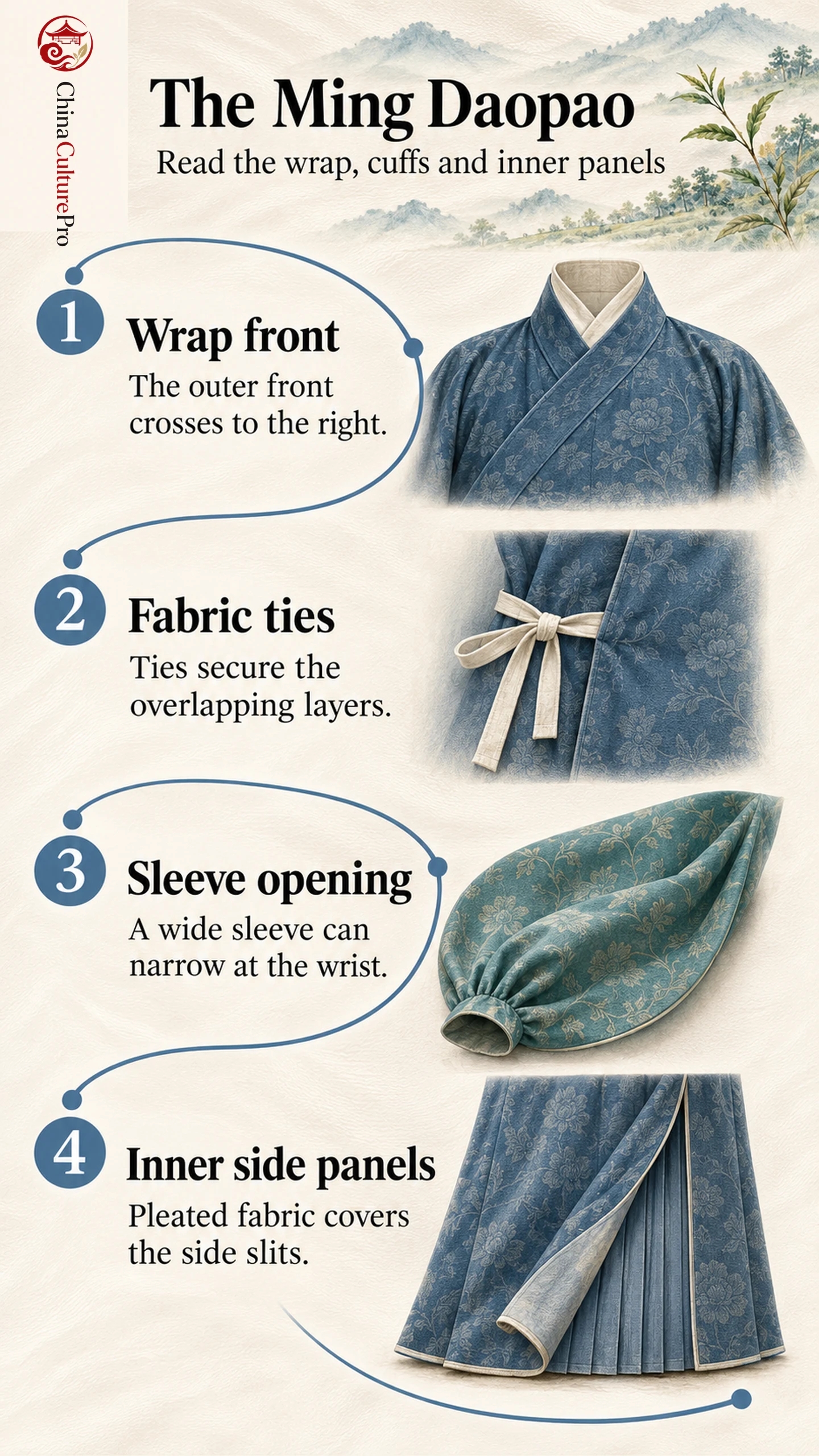
The Wrap, Ties and Side Openings
A documented Ming construction uses one pair of ties on the small inner front and two pairs on the large outer front. The arrangement holds the overlapping panels in place. The resulting neckline is one example of a Chinese cross-collar.[1]
In the recorded construction, one inner panel, or neibai (内摆, nèibǎi), extends from each side of the front and is pleated into the inside of the back. The cloth covers the underlayers at the slit, and the pleats give it room to spread during a step.[1]
A Ming Robe With Several Uses
Eight robes identified as daopao were found at Dingling, the tomb of the Wanli emperor. Daopao could be worn as informal dress or as an inner robe.[1] Literary examples also show a range of wearers and settings.[3]
A surviving blue gauze daopao from the Confucius family collection has white silk along the collar and embroidered crane badges. Its decoration is a reminder that the form could also appear in dressier contexts.[2]
Comparing a Modern Daopao
Ask for a photograph of the inside at one side slit and a second of the front open, with the ties visible. With the robe fastened over your intended layers, take a long stride to see how the pleats open and lift your arms to check the sleeve opening. Compare hat and belt choices with the setting you want to evoke in Ming scholar dress.
FAQs About the Daopao
Was the Daopao Only for Daoist Priests?
Daoist priests wore garments with this name in their own dress tradition. Ming sources and surviving objects also use the name for robes worn in secular settings.[2][3][4]
How Does a Daopao Differ From a Zhishen?
The zhishen (直身, zhíshēn) can have a similar wrapped front. In the documented comparison, its side panels sit outside, while the daopao has pleated inner panels.[1]
Does Every Daopao Have the Same Sleeve?
Sleeve proportions vary. Check the sleeve body and opening separately when comparing individual objects or modern sizes.[2][3]
出典
[1] Dong Jin. Informal Dress of Ming Emperors
[2] Guo Zheng. Dress in the Confucius Family Collection
[3] Xiangyang Bian, Menghe Tian and Liyan Zhou. From Sacred to Secular: Daoist Robes in Ming Literature
[4] RISD Museum. Taoist Robes and Their Symbols