
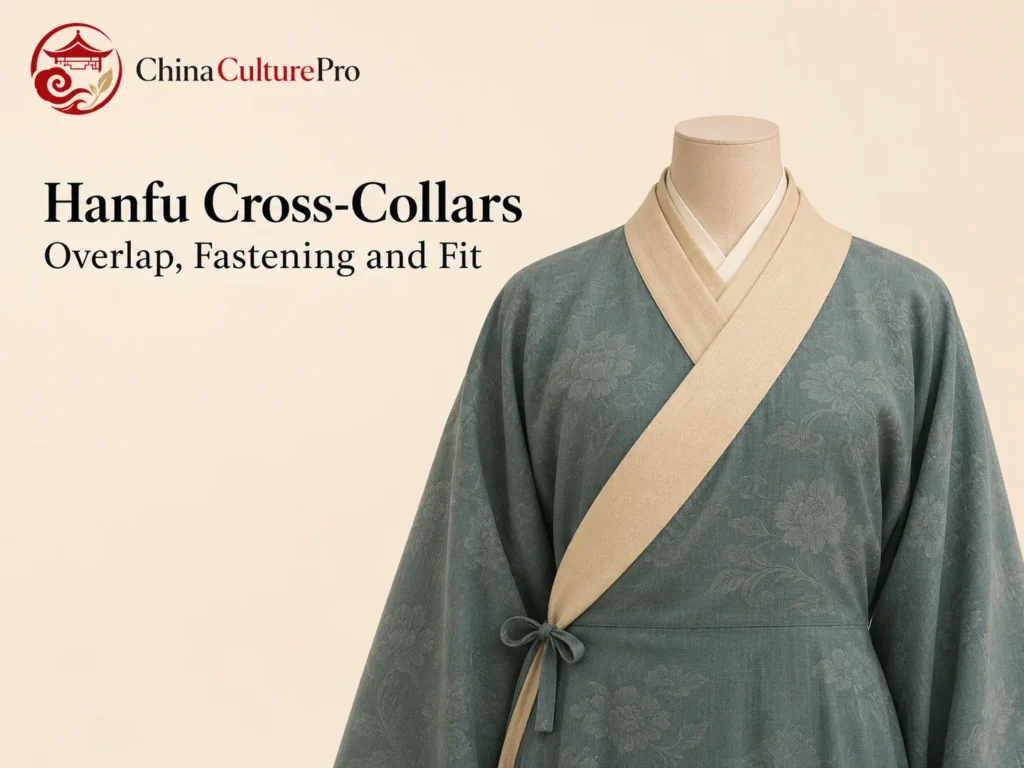

Quick Answer: How Does a Hanfu Cross-Collar Close?
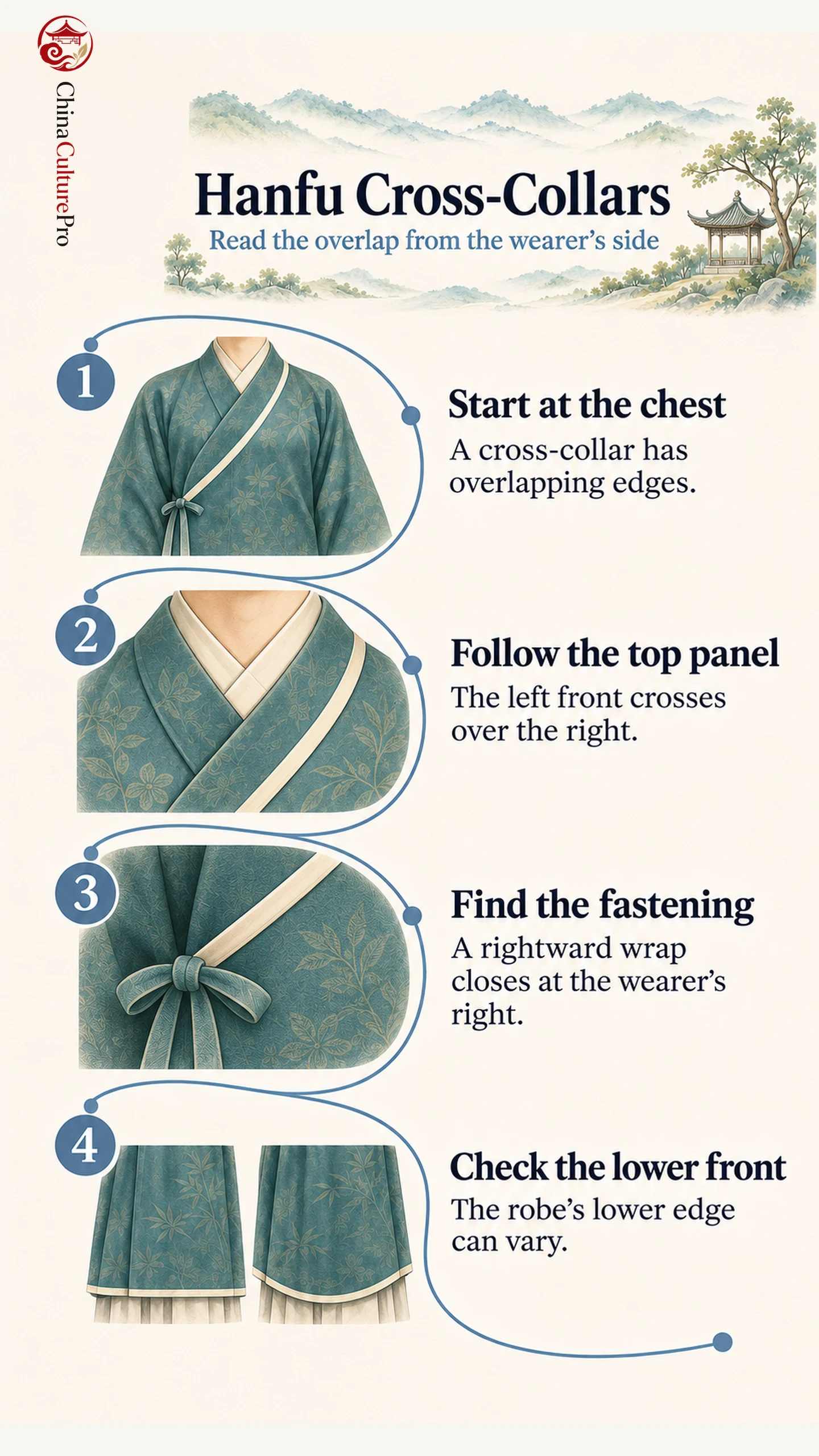
In a common Hanfu (汉服, hànfú) arrangement, jiaoling youren (交领右衽, jiāolǐng yòurèn), the wearer’s left front panel crosses over the right panel and fastens on the wearer’s right.[1][2]
- Collar: The front edges cross at the chest.[1]
- Overlap: Follow the outer edge toward the fastening to identify the closing side.[2]
- Fasteners: Historical examples use ties or buttons and loops.[2][3]
Read the direction from the wearer’s perspective.
Follow the Outer Edge
Stand facing someone wearing a right-closing cross-collar. The outer edge starts at the viewer’s right and travels down toward the viewer’s left. From the wearer’s perspective that is left over right. A contrasting border can make the outer edge easier to follow.[1]
Follow the edge below the chest separately. A longer, curved lower panel can continue around the body, as in one reconstruction based on a Mawangdui find. Compare the lower fronts of Han dynasty robes.[4]
Southern Song Loops and Ming Ties
A lined silk jacket from Zhao Boyun’s Southern Song tomb, dated 1216, has a crossed collar and rightward closure. Buttons and loops at the diagonal front and under the arm secure the layers.[2]
A documented Ming daopao construction uses one tie pair on the inner front and two on the outer front.[3]
Leftward Closures and Other Necklines
Zuoren (左衽, zuǒrèn) describes a leftward closure. The Analects uses leftward dress as a cultural reference in a passage about Guan Zhong.[5] A separate example from material culture is a museum reconstruction of a Liao robe from a find at Daiqintala in Inner Mongolia, with its front tied to the left.[4]
The neckline and closing direction can vary independently. The silk museum’s exhibition also describes a Qing jacket with a standing collar and a rightward overlap.[2] Compare the parallel fronts of a beizi for a different way to arrange the neckline.
Checking the Fit of a Modern Cross-Collar
Locate the inside and outside fasteners before putting the garment on. Trace the outer edge with your hand if a mirror or flipped photo makes the direction confusing. Check the neckline with your planned layers, then sit and reach forward to see whether the overlap stays flat.
FAQs About Hanfu Cross-Collars
What Does Left Over Right Mean?
The panel starting on the wearer’s left lies on top of the right panel and crosses to the wearer’s right.[1][2]
Does a Rightward Closure Require a Crossed Neckline?
Rightward describes the direction of the front overlap. A Qing jacket in the textile exhibition combines that direction with a standing collar.[2]
Do Cross-Collars Always Use Ties?
The Ming daopao example uses ties. The Southern Song silk jacket uses buttons and loops for its two layers.[2][3]
資料來源
[1] Technical University of Munich. Overlapping Collars in Chinese Dress
[2] China National Silk Museum. Auspicious Patterns in Traditional Chinese Dress
[3] Dong Jin. Informal Dress of Ming Emperors
[4] 中國絲綢博物館。 Chinese Garment Reconstructions
[5] The Analects. Xian Wen