


Quick Answer: What Does Face Mean in Chinese Culture?
In Chinese social life, “face” concerns how a person’s standing, dignity and conduct are evaluated in relationships. Two important terms are mianzi(面子,miànzi)and lian(脸,liǎn).
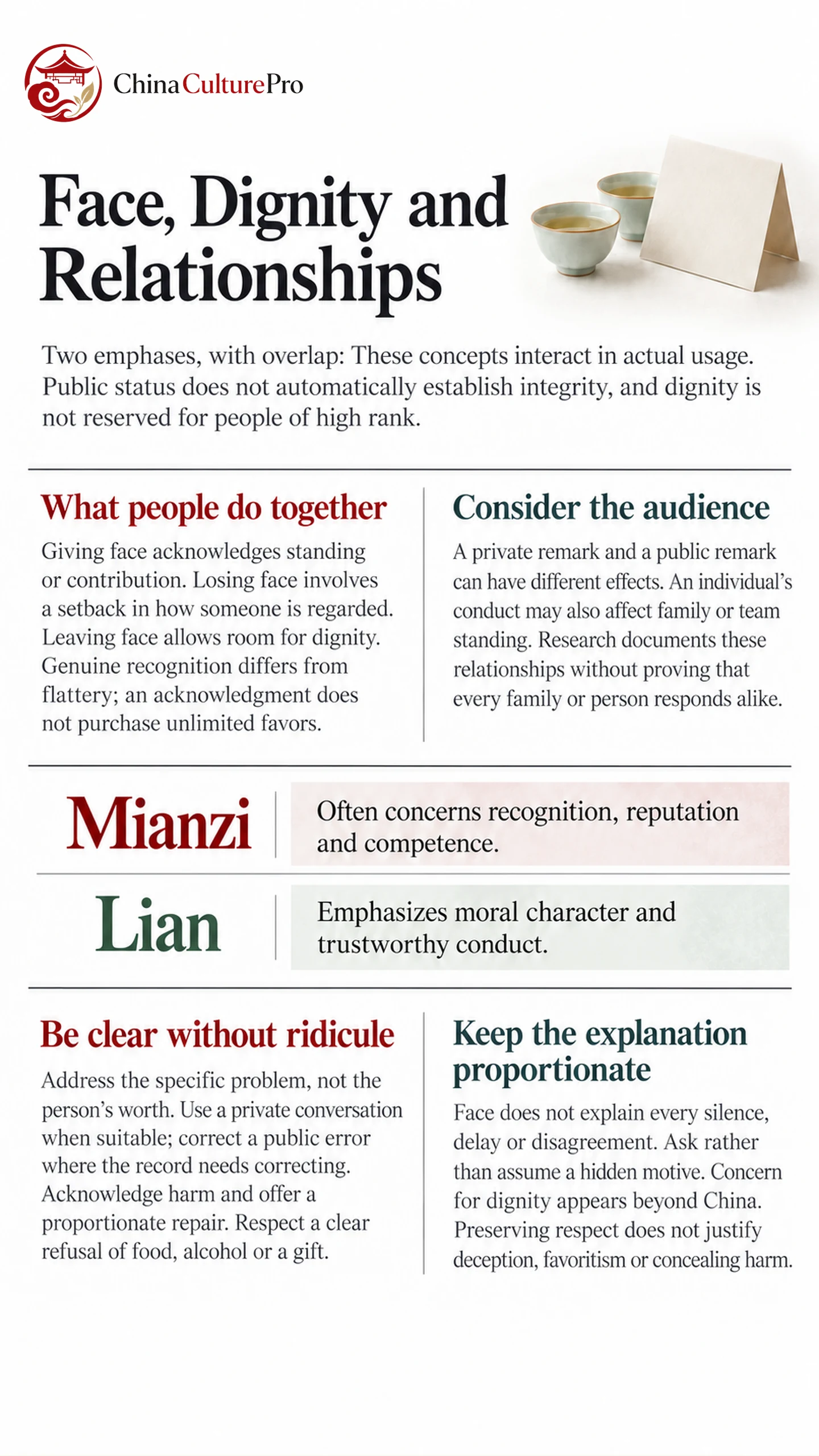
- Mianzi: Often emphasizes social recognition, reputation, capability or prestige.
- Lian: Often places greater weight on moral character and being regarded as a decent, trustworthy person.
- Interaction: People can acknowledge another person’s standing, cause embarrassment or leave room for a dignified response.
The two terms overlap in actual usage. Face is neither a physical feature nor a rule that every Chinese person behaves alike; its meaning depends on the situation, relationship and audience.
A colleague can appreciate a correction yet dislike being mocked while it is delivered. A family can take pride in one member’s achievement. Such situations help make face understandable, but the Chinese vocabulary adds distinctions worth learning. Within Chinese etiquette, face offers one way to examine how respect is expressed and negotiated.
Mianzi and Lian: Different Emphases, Overlapping Meanings
A useful starting distinction is between social standing and moral respectability. Mianzi can concern recognition of achievement, competence, position or dignity. Lian can concern whether conduct meets expectations of integrity. A spoken-corpus study identifies reputation and morality as distinguishing emphases while also finding substantial overlap between the two. [1]
| 用語 | 主要側重 | Illustrative question |
|---|---|---|
| Mianzi | Recognition of a person’s standing, competence or reputation in a social setting | “Am I being treated as a capable contributor here?” |
| Lian | Moral respectability and judgments of character or conduct | “Can others regard my behavior as decent and trustworthy?” |
These questions illustrate the distinction; they are not translations for every use of either word. Someone can receive public recognition while their honesty is questioned; impressive status does not automatically establish moral standing. Conversely, a person without a senior position can be respected for reliable and considerate conduct.
It is also too simple to call mianzi wholly external and lian wholly private. Moral judgments are social, while people can internalize expectations about their public standing. The corpus evidence treats the terms as interacting parts of face, not independent compartments. [1] English “pride,” “honor,” “reputation” and “dignity” each capture something, but none works as a perfect replacement in every context.
Giving, Losing and Leaving Face
Common expressions make face visible as something people do together. Gei mianzi(给面子,gěi miànzi), “give face,” means acknowledging someone in a way that shows respect or supports their standing. An invitation accepted warmly or a contribution recognized accurately can serve that purpose. Diu mianzi(丢面子,diū miànzi), “lose face,” concerns a setback to how someone is regarded. Liu mianzi(留面子,liú miànzi), “leave face,” describes allowing room for dignity rather than exhausting every opportunity to embarrass someone. These expressions appear in discussions of social and professional relationships. [2]
Consider an illustrative group project. “Mei identified the problem and helped us fix it” recognizes a real contribution. “Mei is the only competent person here” adds a flattering claim at everyone else’s expense. Both mention Mei positively, but they have different consequences for the group.
Giving face is therefore not identical to exaggerated praise. It can be as ordinary as using someone’s preferred title, listening without ridicule or thanking the person who organized a gathering. Chinese forms of address provide a more specific guide to titles and names.
Nor does the vocabulary make face a literal bank account. An acknowledgment does not purchase unlimited favors, and saying “give me face” does not make a request obligatory.
Why Relationships and Audiences Matter
A remark in private and the same remark in front of colleagues can affect a person differently. So can an achievement attributed to an individual, a household or a team. Face may extend through relationships rather than ending at the boundary of one person’s feelings.
An interview-based study published in 2017 drew on 154 interviews conducted in seven mainland Chinese cities from 2015 to 2017. It examined how another person’s conduct or status could affect an individual’s face, and how individual actions and collective standing could influence each other. [3] These are findings from a particular qualitative study, not a survey proving that all families respond alike.
For an illustrative family example, a parent may feel recognized when a child’s work is praised. The child may welcome that pride or feel burdened by it. Neither response follows automatically from being Chinese. Filial piety explores the related but distinct language of family care and obligations.
Likewise, professional standing does not mean only the senior person deserves consideration. Published guidance on face stresses respect for junior and peer relationships as well as senior ones. [2] A manager who avoids personal embarrassment while ridiculing staff has not applied a neutral principle of dignity to everyone.
Face can intersect with guanxi, the maintenance of relationships, but the two are not synonyms. Guanxi concerns relationships and their maintenance; face concerns how people and conduct are evaluated within a social setting.
Disagreeing, Saying No and Repairing Embarrassment
You can be clear about a problem while choosing how to raise it. Separate the claim that needs correcting from a verdict on the person’s intelligence or worth. Where the issue allows it, a private conversation can remove an unnecessary audience. Where other people need the correct information, correct the information without turning the speaker into a spectacle.
For example, “The date in this version is different from the confirmed schedule; let’s check it” identifies the issue. “You never know what you’re talking about” attacks the person and expands the dispute. These are suggested communication choices, not fixed Chinese phrases or reports of an observed incident.
Research on Chinese politeness distinguishes social norms and values from a simple tactic for satisfying someone’s immediate wishes. [4] That distinction helps explain why tact need not mean agreement. A respectful tone can accompany a firm correction, refusal or request for accountability.
If you cause avoidable embarrassment, acknowledge what happened, correct your own contribution and offer an appropriate next step. A brief private apology may suit a minor incident. If the error was public and affected someone’s reputation, a private apology alone may leave the public record uncorrected. Choose a repair proportionate to the harm rather than demanding that the other person act as if nothing happened.
A refusal also remains a refusal. You can appreciate hospitality while declining food, alcohol or an invitation. Formal etiquette guidance recognizes a person’s choice not to drink. [5] Our gift giving guide applies the same respect for clear boundaries to presents.
The Limits of a Face-Based Explanation
Face is a useful concept, but it does not explain every disagreement, silence, purchase or social gesture. A delayed answer may reflect uncertainty, workload or a simple lack of interest. Ask what the person means instead of deciding that every indirect response conceals a face problem.
It is equally misleading to portray Chinese people as uniquely concerned with reputation while everyone else supposedly ignores dignity. Comparative scholarship treats face as relevant beyond China while investigating culturally specific forms and relationships. [3] Learning the Chinese distinctions adds precision; it should not become a theory of a single national personality.
Finally, concern for standing does not justify deception, favoritism or concealing harm. Preserving dignity can shape the manner of a conversation while the facts and responsibilities remain open to scrutiny. A considerate response protects room for participation, not immunity from consequences.
FAQs About Face in Chinese Culture
Is face the same as pride or vanity?
No. It can involve reputation and prestige, but also dignity, moral judgments and relationships. Vanity describes only one possible concern, not the whole concept.
Can I disagree without causing someone to lose face?
You can reduce unnecessary embarrassment by addressing the issue specifically and avoiding ridicule. You cannot guarantee another person’s response, but tact and clarity can coexist.
Is face important only to senior people?
No. Peers, junior colleagues, friends and family members also have standing and dignity. Rank is one contextual factor, not a measure of who deserves respect.
Does saving face mean hiding a mistake?
It need not. A correction can be factual and accountable without being humiliating. Concealing a problem may harm the trust and integrity that face also involves.
資料來源
[1] Ling Zhou and Shao-jie Zhang. How face as a system of value-constructs operates through the interplay of mianzi and lian in Chinese: a corpus-based study
[2] David Smith, Global Corporate Governance Forum. Guanxi, Mianzi, and Business: The Impact of Culture on Corporate Governance in China
[3] Xiaoying Qi. Reconstructing the concept of face in cultural sociology: in Goffman’s footsteps, following the Chinese case
[4] Yueguo Gu. Politeness phenomena in modern Chinese
[5] Trade Commissioner Service of Canada. Business etiquette in China