

Quick Answer: What Are Common Chinese Superstitions?
Common Chinese superstitions connect numbers, objects, colors, dates or actions with good or bad fortune. Many work through similar sounds; others draw on ritual associations or wishes for a good beginning.
- Numbers: Six, eight and nine have familiar auspicious associations, while four can evoke death through sound resemblance.
- Objects and occasions: Gifts, dining gestures and New Year activities may carry meanings beyond their immediate function.
- Belief and participation: Someone may observe a custom sincerely, for family harmony or simply as a recognizable tradition.
These associations describe cultural beliefs, not proven causes of future events. Their significance varies across regions, language communities, families and individuals.
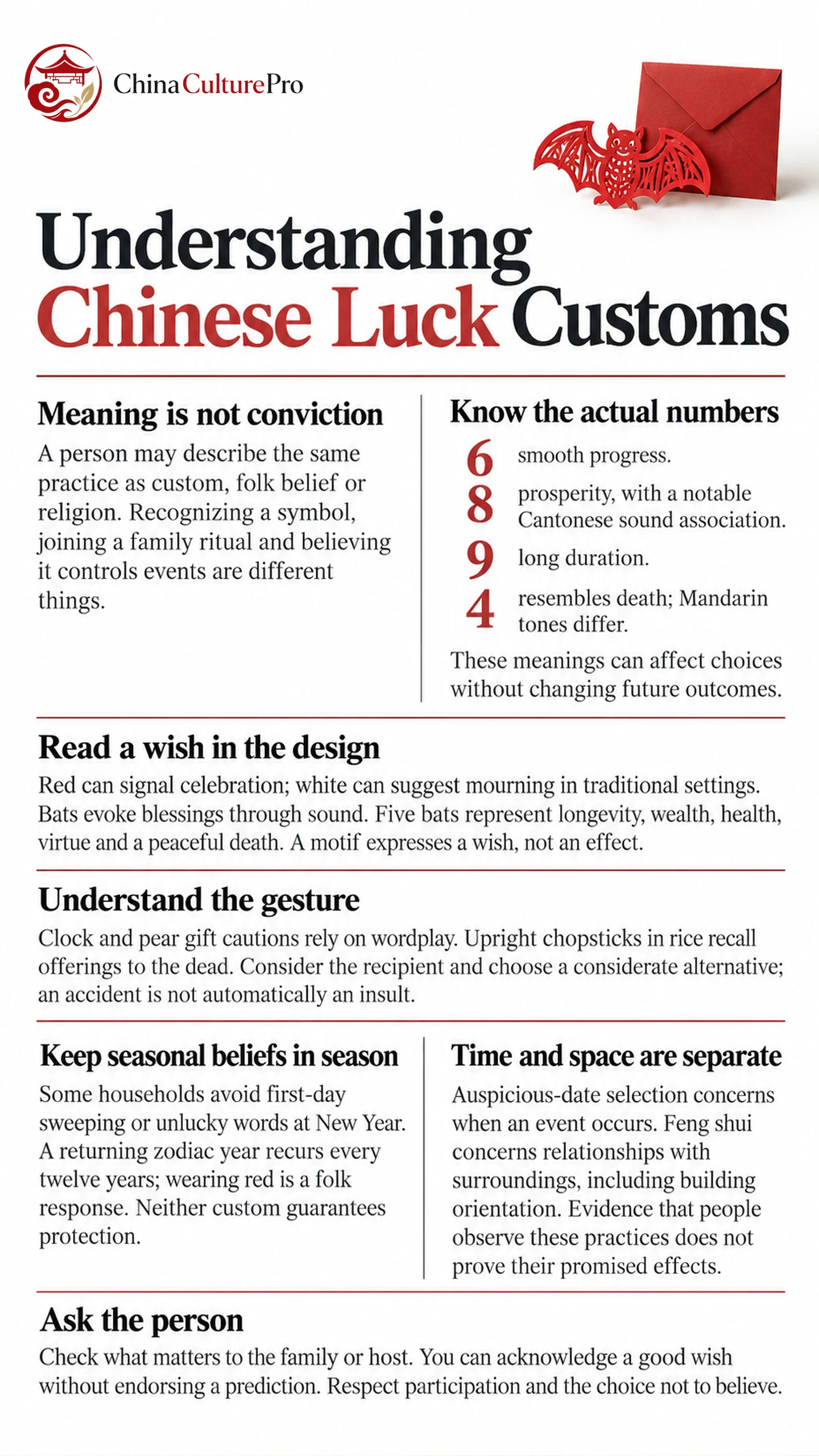
An elevator button without a four, a red New Year decoration and a carefully chosen wedding date may seem like unrelated details. Each can express a way of managing uncertainty or wishing someone well. Understanding their context offers a more useful introduction to Chinese etiquette than assuming every custom is a compulsory national belief.
What the Word Superstition Covers
The Chinese word mixin(迷信,míxìn)is commonly translated as “superstition,” but the label is not neutral for every speaker. A practice one person dismisses as superstition may be described by another as family custom, folk belief or religious observance. Participation and formal religious identification do not necessarily coincide. [1]
It helps to separate three questions: What does the custom mean? Who observes it? Does the participant think it changes an outcome? Wearing an auspicious color can express a festive wish without implying confidence that it controls events. Equally, a person may take a particular prohibition seriously without following every other traditional belief.
The boundaries between Chinese folk religion, household ritual and customary symbolism are porous. Calling the whole collection “Chinese superstition” is convenient for an overview, but it should not erase those distinctions or turn a person’s ethnicity into evidence of what they believe.
Lucky and Unlucky Numbers
Six, eight and nine are useful concrete examples of auspicious numbers; four is a familiar unfavorable one. An original study of Chengdu apartment transactions identifies six and eight as lucky-number conventions and four as unlucky. Tourism material also records nine’s connection with longevity. [2][3]
| 編號 | 常見聯想 | Language and context |
|---|---|---|
| 6 — 六 (liù) | Smooth progress or things going well | A conventional auspicious association; not a literal guarantee of success |
| 8 — 八 (bā) | 繁榮 | Particularly associated with sound resemblance to the prosperity word pronounced “faat” in Cantonese; Mandarin bā and fā are not identical |
| 9 — 九 (jiǔ) | Long duration or longevity | Resembles 久 (jiǔ), long-lasting; an example of a favorable odd number |
| 4 — 四 (sì) | Death | Resembles 死 (sǐ); the Mandarin tones differ |
These meanings help explain choices of telephone numbers, addresses and numbered floors. They do not mean every even number is favorable, every odd number is unfavorable, or every occurrence of four is offensive. A number in a mathematics problem is not the same social object as a deliberately chosen celebratory gift amount.
A study published in 2014 examined transactions from 2004–2006 in Chengdu and found that floors ending in eight affected prices or selling speed in parts of its sample. Its discussion also considers the role of expected resale demand. [2] That is evidence that shared expectations can influence behavior in a particular market; it does not establish that eight brings prosperity, nor does it describe today’s property market everywhere.
Colors, Bats and Wishes for Good Fortune
Red is familiar in celebratory gift presentation, while white can carry mourning associations in traditional settings. Neither meaning applies to every item of clothing, interior or package. Neither meaning is an instruction to interpret every item of clothing, interior or package the same way. Contemporary styling and the actual occasion still matter.
Decorative motifs provide a particularly clear example of how a wish becomes visible. Fu(福,fú)means good fortune or blessing. The final syllable of bianfu(蝙蝠,biānfú), bat, has the same sound. Bats in Chinese decorative art can therefore express a blessing rather than something sinister. Five bats can represent five blessings: longevity, wealth, health, love of virtue and a peaceful death. Peaches can also symbolize long life. [4]
Festive red gift wrapping and white mourning associations are also documented in gift guidance; the actual occasion still matters. [5] A painted bat is an artistic message, not a claim that contact with a real animal changes luck. Likewise, an image of a peach expresses a wish for longevity rather than a health effect. This distinction allows a reader to appreciate symbolism without turning an artwork into a prediction.
Gift and Dining Taboos
Gift associations often depend on wordplay. “Giving a clock,” 送钟 (sòng zhōng), sounds like 送终 (sòng zhōng), attending someone at death or their final rites. Pear, 梨 (lí), resembles 离 (lí), separation. Traditional guidance also cautions about mourning-style packaging or flowers at celebrations. [5] These are reasons to ask about a recipient’s preferences, not proof that the gift causes separation or death.
At the table, chopsticks standing vertically in rice recall incense and offerings to the dead. That visual association helps explain a caution that otherwise seems arbitrary. [6] Other behaviors, such as pointing with utensils or rummaging through a shared dish, also have straightforward effects on fellow diners and should not all be treated as supernatural prohibitions.
The practical response is to choose a considerate alternative. Our Chinese gift giving guide explains suitable choices and presentation; chopstick etiquette covers placement and shared utensils. An accidental gesture is not automatically a deliberate insult.
New Year Customs and the Returning Zodiac Year
The start of a year gives small acts special symbolic weight. Recorded New Year taboos include avoiding sweeping on the first day, on the reasoning that it would sweep away fortune, and avoiding unlucky words or broken dishes. These are seasonal folk interpretations tied to hopes for a favorable beginning. [7] They are not everyday bans on cleaning, speaking about a problem or replacing a damaged plate.
A returning zodiac year is called benmingnian(本命年,běnmìngnián)and recurs in the twelve-year animal cycle. One folk belief treats that return as a vulnerable period rather than an automatically lucky birthday year. Wearing red clothing, including socks or underwear sometimes given by elders, is a documented customary response. [8] It is not protection whose effectiveness has been established.
Families differ in which practices they keep and for how long. The dedicated Chinese New Year taboos guide gives seasonal context. A guest can ask what the household observes without interpreting every accident as an omen or treating an inherited custom as a medical or practical instruction.
Auspicious Dates and Feng Shui
Selecting an auspicious date and arranging space are related ways of seeking a favorable setting, but they involve different tasks. A family might consult a calendar for a wedding date; the tradition of feng shui(风水,fēngshuǐ)concerns the relationship between people and their surroundings, including the orientation and placement of buildings. A historic geomantic compass illustrates that spatial practice. [9]
Dated surveys demonstrate why these topics deserve attention without supporting a claim that everyone follows them. In 2018 survey data summarized in a 2023 report, 62% of adults said they cared somewhat or very much about choosing auspicious days for special occasions. A separate 2018 survey found 47% expressing belief in feng shui. [1] These are different questions and datasets, not interchangeable measures or an estimate for 2026.
For deeper explanations, see Chinese auspicious dates and the luopan geomantic compass. Such preferences can matter to a family without establishing that a date or direction determines the result.
Responding Respectfully Without Assuming Belief
When a custom affects a shared event, ask what matters to the people organizing it. “Is there a family preference I should know about?” is more useful than telling someone what Chinese people supposedly must do. Follow an easy household preference when comfortable, and discuss a genuine conflict directly.
You can acknowledge a wish for good fortune without endorsing a supernatural explanation. Thanking someone for a red gift, choosing a different present or listening to a family story need not become a debate. Conversely, no one should use a traditional association to pressure another person into an unwanted expense or personal decision.
Treat unfamiliar claims with the same care you would apply elsewhere: distinguish a documented custom, an individual’s explanation and evidence of an effect. That keeps room both for cultural understanding and for a person’s right not to believe.
FAQs About Chinese Superstitions
Why is four considered unlucky?
Its pronunciation resembles the word for death. In Mandarin, sì and sǐ differ in tone; the association matters in some symbolic choices, not every use of the number.
Is eight always lucky?
Eight is commonly associated with prosperity, but that is a conventional meaning. It does not guarantee a favorable outcome or matter equally to every person.
Do all Chinese people follow these beliefs?
No. Recognition, participation and conviction are different. People may keep a family custom while rejecting its supernatural explanation, or choose not to observe it at all.
Are these customs the same as Buddhism or Taoism?
No. Folk practices can overlap with religious traditions, but a number preference or family taboo is not automatically a Buddhist or Taoist teaching.
資料來源
[1] Pew Research Center. Confucianism, Taoism and Chinese folk religions, 2023
[2] Matthew Shum, Wei Sun and Guangliang Ye. Superstition and “lucky” apartments: Evidence from transaction-level data
[3] Beijing Tourism. Lucky Numbers in China
[4] USC Pacific Asia Museum. Rank and Style: Symbols
[5] ChinaCulture.org. The art of giving to Chinese
[6] Spurlock Museum, University of Illinois. Chopsticks and Chopstick Rests
[7] Confucius Institute for Scotland. Taboos During Chinese New Year
[8] USC-hosted working paper. Superstition and risk-taking: Evidence from “zodiac year” beliefs in China, February 2020 version
[9] Science Museum Group. Wooden geomantic compass and calendar, object A642257