


Quick Answer: How Does Chinese Modesty Work?
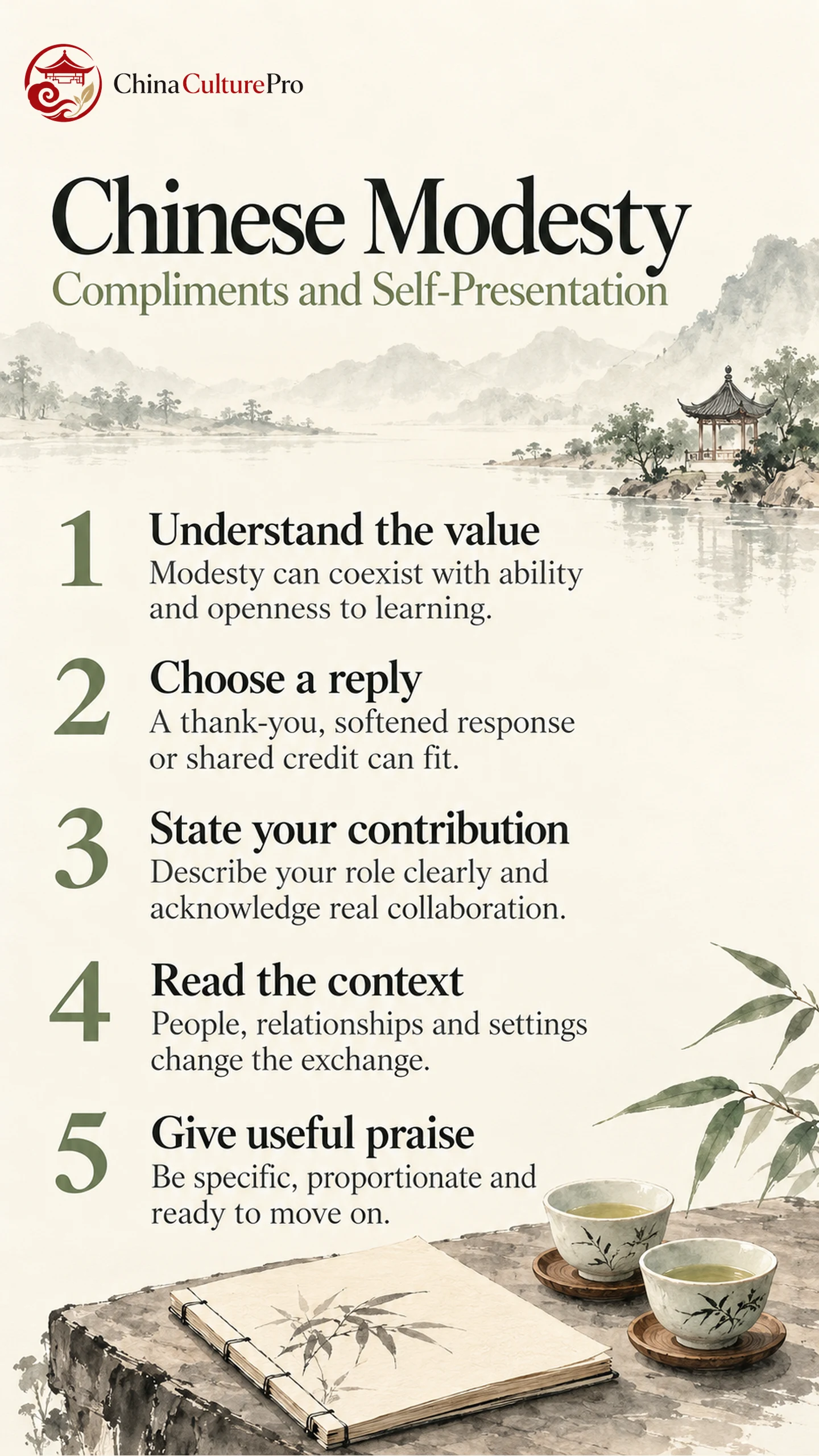
Chinese modesty can shape how people describe themselves and receive praise, but it does not require every compliment to be rejected. A brief thank-you, a softened response or shared credit can each fit a conversation.
- Recognize the value: Avoid boasting or presenting yourself as beyond improvement.
- Accept or soften praise: Choose wording you can say sincerely.
- Describe your contribution: State what you did and acknowledge other people accurately.
- Follow the person: Notice their response rather than applying a national script.
Expect differences between individuals, relationships and settings. No fixed number of denials makes an exchange polite.
A colleague praises your presentation. Should you thank them, insist it was poor or mention the team? Chinese modesty is often taught through the second response, yet actual conversations offer more possibilities. Understanding the value helps; assuming that every Chinese speaker wants the same ritual can make a friendly exchange awkward.
The useful question is what your reply does: acknowledge kindness, avoid exaggerated self-praise, credit a contribution or invite further discussion. These goals can work together. You do not have to deny a real achievement to sound considerate.
Modesty Is a Value, Not a Claim of Incompetence
Qianxu (谦虚, qiānxū) means modesty or humility, including an openness to learning rather than self-satisfaction. It can describe the way a capable person treats others, not just the words they use about themselves. Having achieved something and remaining willing to learn are compatible.[1]
For a visitor, this is a more useful starting point than memorizing negative replies. Avoid announcing that your work is obviously superior or that other people have nothing to teach you. Equally, do not claim that you know nothing when someone needs a clear account of your experience.
Self-presentation also affects the relationship in the room. A reply can make space for another person’s expertise without lowering your own worth. That connects with face in Chinese culture, although the other person’s actual reaction matters more than a theory about their feelings.
Keep modesty separate from apologies and politeness. Receiving praise is not a mistake requiring an apology. You can be pleased, grateful and still attentive to others.
Choose a Comfortable Response to a Compliment
Guojiang (过奖, guòjiǎng) means excessive praise, used as a self-effacing response to a compliment. With the sentence particle, “过奖了” (guòjiǎng le) is approximately “You’re too kind.” It softens praise without needing a detailed argument that the work was bad.[2]
The following replies are illustrative options, not a ranking from more to less Chinese. Choose one that fits what you mean and how comfortably you can say it.
| Response | What it does | When it can help |
|---|---|---|
| 谢谢。 Xièxie. “Thank you.” | Accepts the kindness directly | A brief, friendly exchange |
| 过奖了。 Guòjiǎng le. “You’re too kind.” | Softens the compliment | When straightforward acceptance feels too strong |
| “Thank you. The team helped a lot.” | Accepts praise and shares credit | When other people genuinely contributed |
| “Thank you. I’m still learning.” | Expresses appreciation and openness | When the statement is sincere |
The English examples can be used in an English-language conversation. They are not presented as quotations from research participants. For more Mandarin gratitude expressions, see how to say thank you in Chinese.
Avoid combining every option into a long performance. A quiet thank-you followed by continued conversation is often all the exchange needs. If someone has praised a specific part of your work, you can discuss that part instead of debating whether you deserve praise at all.
Describe Your Work Without Erasing It
A social compliment and a request for qualifications have different purposes. If an interviewer asks about your experience, they need enough information to assess it. Saying “I am not good at anything” hides the facts and makes the next question harder.
Use a specific contribution rather than a sweeping self-rating. “I prepared the analysis and presented the findings” is clearer than “I was the brilliant person behind everything.” Add relevant collaboration: “My colleague checked the calculations, and we revised the presentation together.” These examples demonstrate a practical writing choice, not a cultural formula everyone must adopt.
Share credit accurately. Do not assign your own work to a manager merely to appear deferential, or claim that a team achieved a result when you cannot explain your role. In Chinese business meetings, clear responsibilities help people know whom to contact afterward.
The same principle applies outside work. When a host likes a dish you brought, you can acknowledge the compliment and explain where you learned to make it. You need not criticize the dish in front of everyone eating it. Hospitality and guest etiquette concern the shared occasion as well as the words exchanged.
Context Changes the Meaning of a Response
A 1993 study, preserved in an archived teaching resource, emphasizes rejecting praise or lowering oneself but also includes thanking alone as an acceptance strategy. Its broad description is a dated research baseline, not a reliable prediction of every conversation today.[3]
A 2012 study examined 1,190 naturally occurring compliment exchanges in Shanghai and reported increasing acceptance alongside declining nonacceptance. Responses varied with factors including age, status, social distance and English use. This evidence concerns a particular speech community and study period; it does not establish a single national rule or prove that all younger speakers respond alike.[4]
A separate 2011 study explored modesty through social scripts, including imagined dialogues written by participants. An achiever’s denial could be followed by stronger praise from the admirer. That helps explain how apparent disagreement can sustain an exchange, but imagined dialogue is different from a recording of spontaneous conversation.[5]
These findings explain why advice can conflict. The setting, people and method being described differ. Listen to how this person responds here, including whether the exchange is warm, playful, formal or uncomfortable. Good introductions and greetings create room to learn that preference.
Give Praise That Leaves Room for a Reply
Make a compliment specific and proportionate. “Your explanation made the timeline easy to follow” gives the recipient something concrete to acknowledge. It also avoids turning a small success into a claim that they are better than everyone else.
If they soften or deny the compliment, you can briefly explain what you appreciated. Then let the conversation move on. Do not insist on extracting an enthusiastic agreement, and do not treat their response as evidence that the compliment was unwanted.
Take more care with public praise, comparisons and personal remarks when you do not know someone well. A comment about a useful contribution is usually easier to keep relevant than a judgment about their body, wealth or private life. Using their preferred name or form of address helps keep the exchange respectful.
Modesty becomes easier to navigate when the goal is a comfortable conversation. Speak honestly, leave space for the other person and avoid turning either acceptance or deflection into a test of cultural authenticity.
FAQs About Chinese Modesty
Must I reject a compliment in China?
No. Deflection is one possible response, alongside acceptance and mixed replies. Choose wording that suits the relationship and what was said. You do not need to deny a true achievement or repeat a fixed ritual.
Is saying thank you too confident?
A thank-you acknowledges the speaker’s kindness. It need not mean that you consider yourself superior. You can add shared credit or a brief comment about learning when it is sincere, rather than assuming that acceptance is rude.
How can I describe achievements in an interview?
Explain the task, your contribution and the result accurately. Acknowledge relevant teamwork without concealing your responsibilities. An interviewer’s request for evidence needs a fuller answer than a casual compliment does.
Should I repeat praise when someone denies it?
You can clarify briefly what you liked, then allow the conversation to continue. Repeated insistence may make the recipient work harder to respond. There is no universal number of rounds you must complete.
資料來源
[1] Taiwan Ministry of Education. Concised Mandarin Chinese Dictionary: 謙虛
[2] Taiwan Ministry of Education. Revised Mandarin Chinese Dictionary: 過獎
[3] University of Minnesota CARLA archive. Chinese Compliment Responses, citing Chen 1993
[4] Guo, Zhou and Chow. A variationist study of compliment responses in Chinese, 2012: abstract
[5] Han. The self-enhancing function of Chinese modesty: From a perspective of social script, 2011: abstract