


Quick Answer: What Defines Dong Village Architecture?
A Dong village (侗寨, Dòngzhài) in the mountain regions of Guizhou, Hunan or Guangxi often has a drum tower (鼓楼, gǔlóu), a wind-and-rain bridge (风雨桥, fēngyǔqiáo) and groups of timber houses. Together they provide places to meet, cross water and live on the slopes.[6]
- Drum tower: A tall timber landmark with stacked eaves provides a place to meet and hold village events.[6]
- Covered bridge: A roofed passage connects two banks and gives people a sheltered place to pause.[8]
- Hillside home: Raised timber houses adapt their supports to sloping ground.[1]
The layout varies with the terrain and the groups that share the settlement. Zhaoxing in Guizhou has five drum towers.[4]
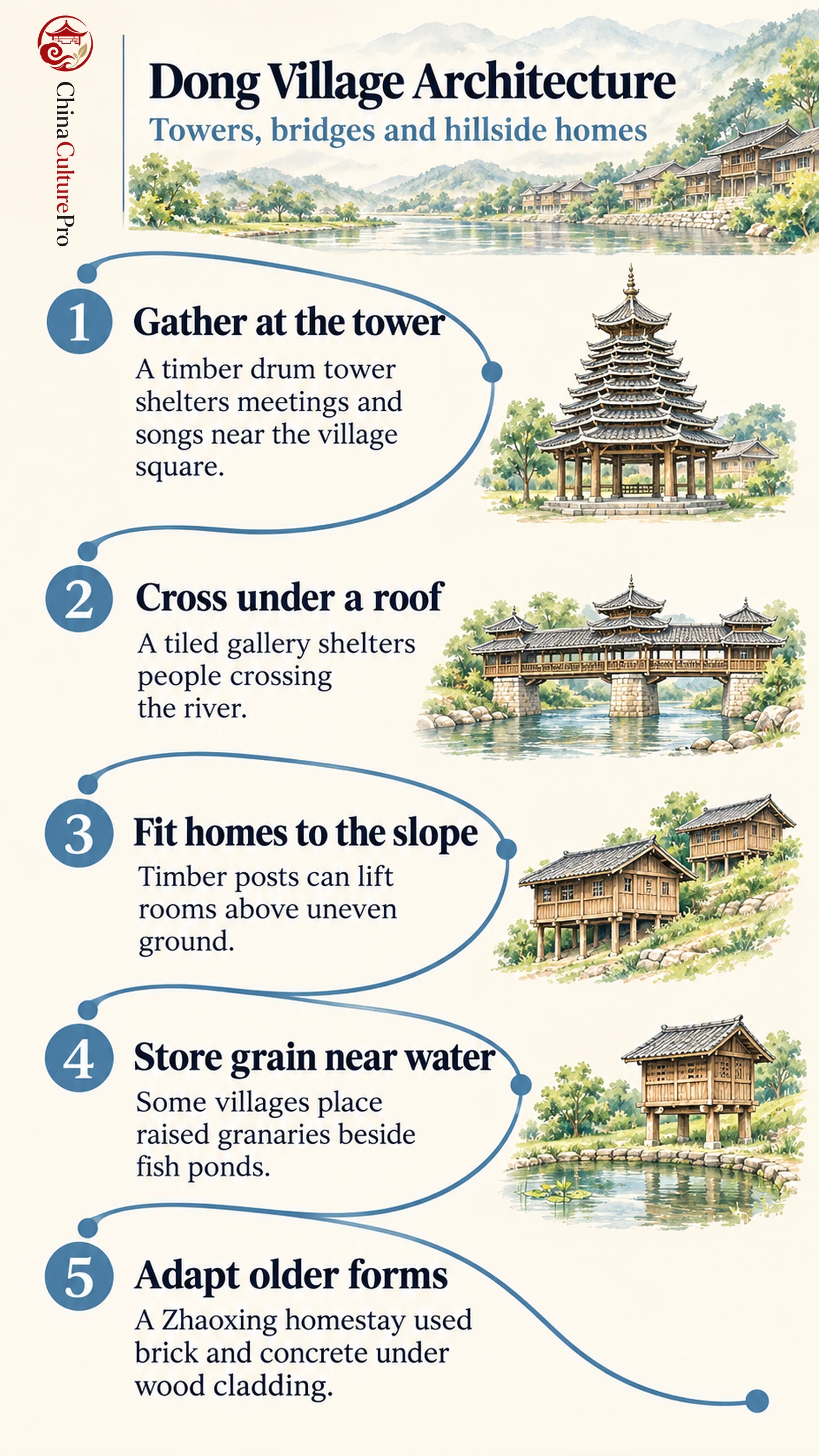
In a riverside Dong settlement, paths connect covered crossings, shared squares and homes on the slope. Reading their positions together shows how Chinese architecture can organize life at village scale.[3]
Drum Towers and the Space Around Them
Many drum towers rise through multiple tiers of tiled eaves over a single open interior. At ground level, benches around a hearth create a place to sit and talk.[6] Where the tower opens onto a square, the outdoor space gives meetings and celebrations room to expand.[1]
The tower is also a formal setting for Dong Grand Song (侗族大歌, Dòngzú dàgē), a choral tradition in which voices sing in multiple parts without instruments. Singers gather at the tower for formal performances. People also sing in homes and other public spaces.[7]
The five towers in Zhaoxing, in Liping County, sit within one village alongside five covered bridges and five theater stages. The cluster shows how a single village can have several public centers, one way that Guizhou’s built heritage varies from place to place.[4]
What a Wind-and-Rain Bridge Does
At Chengyang in Sanjiang, Guangxi, a tiled gallery links five timber pavilions along the crossing. It is one recognizable example among traditional Chinese bridges. The passage gives people shelter as they cross and places to pause along the way.[8]
Villagers raised funds for the bridge and local carpenters built it in the early twentieth century. Some pavilions once held tablets for deities, giving the bridge a ritual role alongside its everyday use as a crossing.[3]
Timber Houses, Granaries and Water
A common raised home is the diaojiaolou (吊脚楼, diàojiǎolóu). On slopes or near rivers, supports lift parts of the timber frame above the ground. Families could live upstairs and use space below for fodder, animals or storage. That division of space is a useful point of comparison with other Chinese stilt houses.[6]
The houses are part of a wider system for food and water. In some villages, timber grain-drying racks stand near the edge of the settlement and raised granaries stand beside ponds. The ponds can hold fish and provide water for firefighting.[1]
How Dong Villages Have Changed
Sanjiang’s craft tradition uses mortise-and-tenon joinery to connect timbers in drum towers and bridges. China included Dong timber building techniques on its first national intangible heritage list in 2006.[2]
A renovation in Zhaoxing shows how the look and structure of a building can change at different rates. One family converted its two-story timber house into a homestay. The rebuilt structure used brick and concrete, with timber cladding and rails that fit the surrounding houses.[5]
FAQs About Dong Village Architecture
Where Are Dong Villages Found?
The villages included in China’s World Heritage Tentative List submission lie in Guizhou, Hunan and Guangxi. Zhaoxing is in Liping County, Guizhou.[1][4]
Do All Dong Villages Have One Drum Tower?
The number varies. Zhaoxing, for example, has five drum towers in one village.[4]
Are Dong Villages a UNESCO World Heritage Site?
China submitted a group of Dong villages to UNESCO’s World Heritage Tentative List in 2013. The tentative entry records a proposal for possible nomination. The Grand Song of the Dong ethnic group has a separate 2009 inscription on UNESCO’s Representative List of the Intangible Cultural Heritage of Humanity.[1][7]
資料來源
[1] UNESCO World Heritage Centre. Dong Villages
[2] China Intangible Cultural Heritage Museum. Dong Timber Construction Techniques
[3] Li Xuemei and colleagues. Craft Rules, Rituals and Dong Wind-and-Rain Bridges
[4] Guizhou government portal. Zhaoxing Dong Village
[5] China Daily via the Guizhou government portal. Tourism Transforms Dong Village
[6] National Ethnic Affairs Commission. Dong Customs
[7] UNESCO Intangible Cultural Heritage. Grand Song of the Dong Ethnic Group
[8] Ministry of Culture and Tourism. Central Guangxi Ethnic Culture Route